






In December, the United Nations officially designated Jakarta the world’s largest city, hosting a staggering 42 million inhabitants. Michael Neilson speaks to several people who call the ‘big durian’ home – about the positives and the negatives – and how community and the city’s infamously dry humour get them through.
4am
Few things are more synonymous with Jakarta than the bright green jackets worn by the sprawling megacity’s more than a million ojek, or motorcycle taxi, drivers.
Like tens of millions in the world’s largest Muslim-majority nation, ojek driver Dicky Rio Suprapto, 48, wakes at 4am to pray. After dropping his two teenagers at school, he begins a 12-hour day navigating one of the world’s most congested cities.
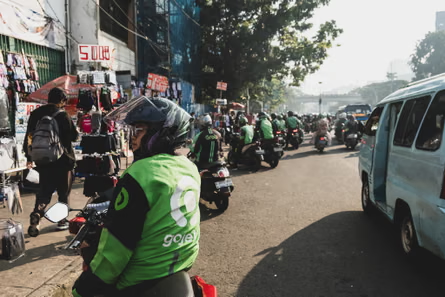
Suprapto trained as an engineer, but has been out of formal work since 2017. After Covid-19, he turned to ojek driving, using ride-sharing apps.
In a city infamous for its deadlock traffic, Suprapto says he has to be creative. Rather than relying on maps, he draws upon his decades of knowledge of the city’s labyrinthine streets.
“I have already memorised it,” he says, “So it’s a shorter time.”
Utilising his knowledge of narrow alleyways, he transports people, food and packages through the city’s capillaries.
“[The customers] use our services, they want to [work to] earn money. That’s why I have the obligation to help the city, to make sure they reach their destination fast.”
Despite the grind, pollution, and relentless macet (traffic), humour persists. After surviving brain surgery, he jokes about the tube in his head.
“I have a tube … so I am like ‘Robocop’, you know.”
He stops work at sunset due to light sensitivity, earning Rp400,000–500,000 a day (US$23-$29), which he says is “more than enough” to support his family, provided they live simply.
“Enjoy while you have it,” he says.
10am
Dhewa Radya, 22, represents a different Jakarta: young, highly educated, and plugged into the city’s burgeoning tech sector.
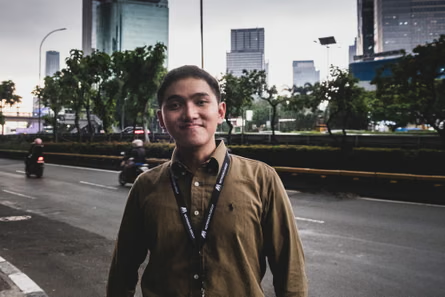
He works in artificial intelligence and structures his life around avoiding the worst of the city’s congestion. Unlike many, he walks to work from his kost, or shared living space, in West Jakarta, which costs Rp1.6million ($92) a month to rent.
The pollution, however, is unavoidable. After a year, a check-up showed lung spots typical of passive smokers.
Jakarta is not his “favourite city,” he admits, but the best place to find work.
“In Jakarta, you can find everything … so it’s really good for [an] early career.”
Originally from Central Java, Radya is one of millions who move to Jakarta each year seeking better opportunities. He counts himself lucky, with youth unemployment about 17%, including many university graduates.
Longer term, he wants to go abroad, then return.
“The hope is I can go back to Indonesia, have a good impact, and also have better jobs, better life, better living quality.”
He is concerned about growing inequality, and – like many young Indonesians – isn’t shy to speak about politics, and apply a humorous Jakarta lens to current affairs.
“Even though the government screws us every day, the thing that we can only do is just to enjoy it,” he says, “No matter how hard it is, just go with it.”
1pm
By lunchtime, the city shifts again.
Neneng Muslimah, 45, runs a riverside family warteg, or traditional eatery, in the central business district of Kuningan, feeding office workers through a system born of necessity – and ingenuity.
The river highlights Jakarta’s evolution, and increasingly stark divide: crowded kampungs (villages) on one side, and five-star hotels and glass office towers on the other.
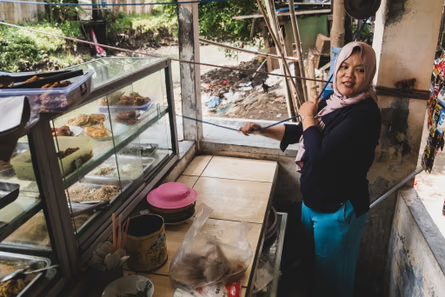
Her warteg’s most distinctive feature is a pulley system used to deliver food across a gap left when a bridge was removed.
Starting work at 5am, the rush hits at noon.
“At 12pm, we get through about 100 portions,” she says.
Traditional meals – fried chicken with pungent sambal, rice, vegetable, and egg dishes – cost as little as Rp10,000 ($0.60).
Orders are shouted across the river – or sent via WhatsApp – and often paid using smartphone scanners attached to the basket.
“We prefer WhatsApp. If you shout, sometimes the order is wrong – our voices get carried away by the wind,” she says, adding that mistakes are sometimes part of the fun.
“Sometimes when we mishear an order, we just laugh. They might ask for coffee, and we deliver an iced drink.”
Despite rising living costs and the constant risk of flooding – driven by the city’s subsidence and heavier rains – Neneng says Jakarta has its own special beauty.
“People from outside only know Jakarta for the traffic jams, the dirt, and the pollution … But once you’ve been here and felt it, then it becomes comfortable.
“The people are so friendly, so supportive. It is beautiful.”
6pm
As the day cools, the traffic returns.
At a busy intersection near the national monument – Monas – Faqih Ibnu Ali, 28, paints himself silver and steps into the road.
He is one of Jakarta’s street performing “manusia silver”, or “silvermen” – one of the city’s millions of informal workers.
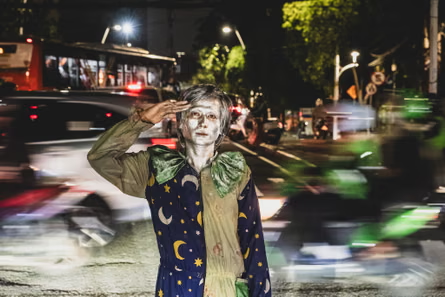
On a good day he earns about Rp200,000 ($11).
He works the morning rush hour and, after a short rest, from the afternoon until sometimes midnight.
Behind the metallic paint is a harder story.
A former fisher, he says he lost everything when his ship burned down. He now lives under a bridge with his wife and children. Years ago, he lost a son in a traffic accident.
“It feels sad,” he says, “But that’s life on the street, brother.”
He says he feels judged and like an outsider, left behind in the world’s largest city.
“If people look at me, it’s with one eye.”
His workplace reflects Jakarta’s growing inequality, as he weaves between air-conditioned SUVs and motorbike riders choking on exhaust fumes.
Phones are hidden when he approaches.
“People are afraid they’ll be taken. It’s like I am not considered.”
And yet, he keeps going – for his children.
“We shouldn’t lose hope, don’t give up, it’s for the sake of the family.”