








The first branch of Gap was a single small storefront selling men’s denim and vinyl discs at 1850 Ocean Avenue, in the classy Inglewood neighbourhood of San Francisco, the city which, at the time of the store’s opening, 1969, was at the centre of hippy and other youth cultures. The founding story is that a middle-aged real-estate developer, Donald Fisher, couldn’t find Levi jeans in his size – with a 31in inseam – in the city, and set up the store to supply Levi’s piled wall-high in all cuts and sizes. But much of what the world now thinks of as Gap actually came from his wife, Doris Fisher, who has died aged 94.
The Fishers invested their life savings in the $63,000 start-up cost of the store, which Donald wanted to call Pants and Discs. The night before they had to instruct the signwriter what to paint on its fascia, Doris came up with “The Generation Gap” (referring to the divide between their age group and the then-young baby boomers), then shortening it to “The Gap”; although her style choices for Gap clothes often diminished rather than accentuated age and gender differences.
Early on, she bought in the most youth-appeal garments that Levi’s manufactured – bell bottoms, dazzle colours and crazy fabrics. But that 60s fad for almost-fancy-dress outfits worn on a daily basis waned through the 70s, and was succeeded in the US by a counter-countercultural vibe.
In 1974 the Fishers had Gap-labelled clothes made to add to their stock; for these, Doris tapped her own background, the relaxed outfits of college campuses (she had gone to Stanford University, Donald to Berkeley) and a Californian preference for sports and leisure wear. The “preppy look” – originally the lifetime “uniform” of the wealthy who in their teens had boarded at preparatory high schools – became a phenomenon at the end of the decade; by then Gap had been selling its affordable versions of core preppy garments, such as chinos and T-shirts, for some time.
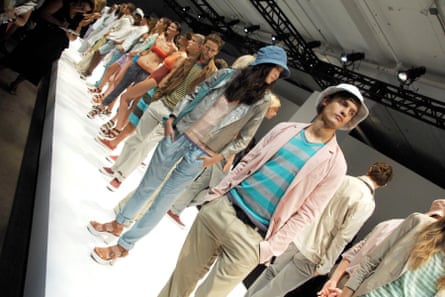
The style defined hip and cool more quietly. Lisa Birnbach, who wrote The Official Preppy Handbook, said it was about “a desire to look like you’re at ease … to look like your life is easy”, which was Doris’s personal wardrobe principle – simple-cut silhouette, garments developed over time rather than designed into existence, all put together by the individual who wore them. In the early store years, Doris did stints at the till dressed in stock items. Whatever she modelled shifted off fast. She saw herself as a customer as much as a retailer.
Her individuality in putting it together came from being a woman of character from a family that, like her husband’s, had long been settled in San Francisco before its 1906 earthquake. Her father, Joseph Feigenbaum, a noted lawyer, and her mother, Dorothy (nee Bamburger), believed in educational equality, and encouraged Doris to pursue her interest in economics, an unusual subject for a woman to study at Stanford then. She graduated in 1953 and married Donald that year; their sons, William, Robert and John, were test customers when their parents launched the first Gap store, and later worked in the company.
Gap advanced slowly in California, where everybody understood its modest proposition. Then, after the company went public in 1973, it had finance enough to expand nationally as American shoppers began to turn from department stores to single-label apparel chains in multiplying malls. Doris was Gap’s merchandising chief (Donald was CEO, then chairman of the board), and, after Millard Drexler was recruited to manage it in 1983, continued to supply the discreet decisiveness behind many of its moves: the plain, light styling of the stores, with neat stacks of stock on shelves (she was sympathetic to the shop assistants who had to keep them that way); the successful capture of customers from birth, through the children’s ranges Baby Gap and GapKids; the acquisition of Banana Republic, a small Californian retailer with a romantic approach to practical outfitting, and the launch in 1994 of Old Navy, an economy version of Gap.
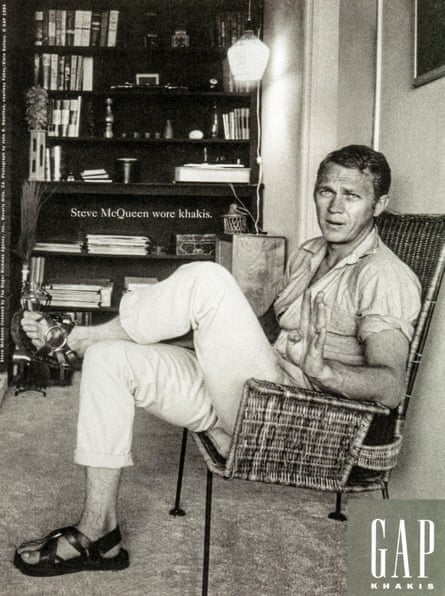
When Drexler dropped stocking Levi’s in favour of upgraded all-Gap merchandise as the company opened international stores from the late 80s, Doris’s classic casualness-plus-culture attitude was part of the template. Drexel said that every Monday she sent him “samples of cool stuff she saw the week before”, and you can see her tastes in Gap’s 1989 ad campaign Individuals of Style, for which photographers such as Annie Leibovitz shot well-known figures, including Spike Lee and Joan Didion, wearing Gap basics, or the 1993 Who Wore Khakis campaign, monochrome archive images of people famous when the Fishers had been young. US Vogue celebrated the publication’s centenary in 1992 with a cover of 10 supermodels in white Gap shirts and jeans – democracy as a mode, very Doris. “If you like something,” she advised, “buy it in multiples.”
The couple strolled into acquiring a huge private collection of modern art by buying prints for their offices’ bare walls in the 1970s, then educated themselves by visiting galleries and museums. As The Gap Inc’s turnover rose towards multi-billions towards the end of the 20th century, they bought American artists in depth, including Roy Lichtenstein, Andy Warhol and Ellsworth Kelly – Doris got to know Kelly personally. She left off merchandising for Gap in 2003, and stood down from its board in 2009; she had intended to build a gallery for the Fishers’ collection, but instead presented more than 1,000 works to the San Francisco Museum of Modern Art.
Donald died in 2008. Doris’s sons survive her.