






You know Hieronymus Bosch’s The Garden of Earthly Delights? That psychedelic triptych chock-a-block with creatures real and imagined and the monstrosities of hell? Well, my toddler and I are in it. To be precise, we’re slap-bang in the middle of the cosmic central panel, which is projected on to the wide walls around us, as well as the ceiling and the floor. There are naked men and women riding bareback on ducks and deer and horses. Camels and cattle. Butterflies and birds. Pale legs lolling from a shell.
This is our first trip to Frameless, an immersive art experience near Marble Arch in London that bills itself as a place “where art breaks free”. Call me a traditionalist, but digital art isn’t usually my thing. I enjoyed David Hockney at the Lightroom, where I also took my son to see the dinosaurs – the day we went, the audience was almost exclusively made up of tots and their adults. But I prefer paintings to be still rather than animated. I like to concentrate on a canvas rather than watch it deconstruct and dissolve. I want art to be meaningful and long-lasting. Tangible. Real.
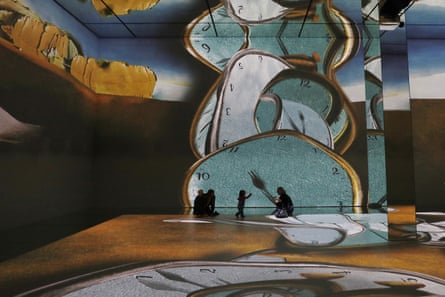
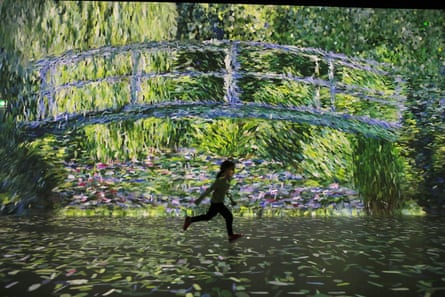
This isn’t just about me, though, which is why we’re here, in what could be described as a baby sensory class on steroids. I’m being unfair. Across the four main underground galleries are moments of beauty and ingenuity. While the paintings in the surrealism space are spliced according to their parts (think melting clocks), the impressionist canvases are appropriately broken down by brushstrokes. The accompanying soundtrack is a ride: my son bops along to jazz; I’m soothed by one of Bach’s cello suites. Witnessing thousands of tiny dots gradually come together to form Seurat’s La Grande Jatte is quite remarkable.
“I hope it’s a bridge for people to learn to love art,” creative director Ryan Atwood tells me. “I can’t imagine being a kid and seeing something like this, what it would have done for me.” In the galleries, children starfish on the ground and lean against the walls. One girl practises her ballet. Another sings. A forward-facing baby in a carrier cranes its head. I overhear a boy tell his father that he knows this one, he did it in an art lesson.
My son’s feedback is mixed. Sure, it’s easier to retain his attention here than in regular galleries and museums. Little squiggles make him think of pasta, and silver flashes remind him of fish. But he doesn’t love the projections whizzing across the floor (cue raised arms and wriggly fingers) and I don’t blame him – the moving parts beneath my feet also leave me feeling unsteady. There are peaceful pockets, but mostly it’s loud and frenetic, and he clings on. Images are here one second, gone the next. There’s lots of cascading and crashing.
He’s happiest in the temporary gallery space currently devoted to The Colour Monster, a picture book by Anna Llenas, which is calmer and slower, and where he can sit and scribble with crayons and paper. I later learn that Frameless hosts special sessions for toddlers, which in hindsight might have made him feel more comfortable; I’d say the standard gallery experience is best suited to children aged three and up (I have no doubt my niece and nephew, five and three, would love it).
I’m also mindful, after the first 15 minutes have passed in the main galleries, about the fact that we’re surrounded by screens. The argument around children and screen time isn’t new, and the government recently published its first guidance for under-fives, off the back of research that shows about 98 per cent of children under two are watching screens daily, and that too much time on screens can contribute to children not being ready for school. The report advises that under-twos should avoid screen time “other than for shared activities that encourage bonding, interaction and conversation”.
I’m not a purist – my son watches television with his toast after nursery, and there are times when we’re supremely grateful for the iPad (flights, haircuts, toenail-trimming – my God, the toenail trimming). But there are limits. I was never totally comfortable with the idea of taking him to baby cinema, and I prefer my husband not to have the football on when we’re all in the living room (sorry, husband). Then again, this is art, which makes it OK, doesn’t it? Does it?
“I often think it’s not really about screens, it’s about content,” says Dylan Yamada-Rice, professor of experience design and immersive storytelling, when I ask her whether parents should be cautious about exposing small children to digital art. “We should definitely consider the content, but I don’t think we should consider not taking them just because it’s screen-based. We want our kids to be exposed to art as a cultural practice – especially as it’s being knocked out of the school curriculum – and digital art is another form of that.”
When I ask Atwood how digital art compares with typical screen time, he tells me the difference is that Frameless is meant to be experienced together. “It’s about talking to the person you’re with and discussing what you’re seeing, feeling, hearing.” In other words, it isn’t passive – though, he stresses, “It can be experienced any way you want.”
For us, that will be once in a while. There’s something magical about getting up close and personal with great art, and watching it come to life. I appreciate that a multisensory experience offers a fresh perspective. My back appreciates not having to constantly scoop up my son to show him pictures or stop him touching things.
But I don’t love the idea of him becoming accustomed to art that, let’s face it, can look more like a video game than the canvas it’s based on. I don’t want him to be disappointed, after all the bells and whistles, by static art without the bumf. I don’t want him to think that art is best seen through a phone (most of the people we pass are experiencing the experience through theirs). Crucially, I’d rather not pay for the two of us to see digital projections of artworks when (for now at least) we can see the real thing for nothing elsewhere.
Three immersive art exhibitions to discover
Prehistoric Planet: Discovering Dinosaurs at Lightroom, London (18 July-1 September)
Titanic Exhibition at NEC, Birmingham (until 26 May)
Beyond Van Gogh and Beyond Monet at Motorpoint Arena Nottingham, Nottingham (18 July-7 August)