



Last year, Jim Ghedi was having a chicken dinner at his mother’s house in Sheffield when he checked his phone. “This director started following me on Instagram,” he recalls. “And there’s pictures of him with Nicolas Cage. As a joke, I said to my mam: ‘I might message him and say, let me do your next film score.’ As I said it, he messaged me, saying: ‘I want you to do my next film score.’”
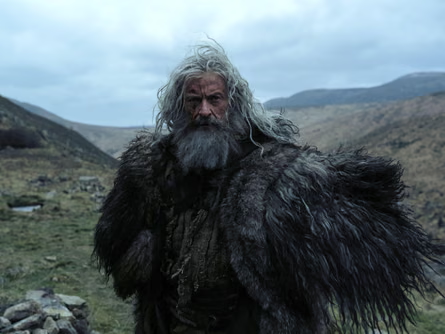
The director was Michael Sarnoski and the film is the forthcoming A24 production The Death of Robin Hood, starring Hugh Jackman and Jodie Comer. Sarnoski had heard Ghedi’s excellent 2025 album, Wasteland, a stirring and brooding album of apocalyptic folk that was a reflection of societal rot and collapse in England. Released on the small Calder Valley label Basin Rock, the album was critically acclaimed – and his most successful and ambitious to date – but it had not turned Ghedi into a household name. He thought that the film opportunity “would all blow away and they’d find out who I am”, he says. “Some top producer would put up the red flag.”
Despite having never scored a film before, he was given the gig. He bonded instantly with Sarnoski through video calls and a shared love of Steeleye Span, and ended up writing the songs and score. He describes the finished material as “quite doomy, earthy and dark” – but also “quite light and orchestrated”.
Ghedi was invited out to LA to to work on the project there, but instead chose to stay rooted in Sheffield. Even so, he had some wobbles. “There were moments when impostor syndrome was a real thing,” he tells me in an Irish pub in the city, over Guinness Zero and Scampi Fries. “It’s very rare for someone like me, and where I’m from, to get those kinds of opportunities. You don’t usually get to see that world. But I also had to think: ‘I’m being asked for a reason.’ I held tight to that.”
Ghedi, 35, was given a guitar when he was eight and quickly became a skilled player, but his teenage years were lit up by hip-hop and punk. The lyrical output of the first proved formative. “Hearing people talk about being raised by a single mum was like, whoa,” he recalls. “Here’s someone artistically talking about something that I’m also experiencing in my life.”
Then came the revelatory discovery of Bert Jansch. “It was the first time I’d heard someone who played an acoustic guitar and it was not pretty,” he says. “It was really heavy and aggressive. So then I ripped him off for 10 years.” However, that through-line from hip-hop to folk made total sense to Ghedi. “Folk music, traditionally, was music for the working people, from the working people. Hip-hop and grime are the same.”
Ghedi’s early albums were instrumental, showcasing his deft, dextrous guitar playing, but he was also immersed in Sheffield’s DIY scene, soaking up noisy, avant garde gigs, as well as regularly attending folk sessions in pubs. It was in these that he found his voice and began singing. Soon, this collision of worlds began to manifest in his music: traditional folk songs used as allegories for modern issues, alongside his own originals, while leaning into more experimental terrain.
His latest single, The Hungry Child, is an extension of this. “I’ve gone even further sonically,” he says. “This one is bigger, doomier, darker, heavier.” Based on a German poem from the early 1800s, later translated into English by Judith Piepe, it’s a raw, visceral song that depicts the story of a child pleading for food and told to wait – until it’s too late.
Ghedi only works with traditional material if he can find a real-time connection to it, and he sat on this one for years. “Sometimes, the time has to find you for it to make sense and do it with conviction,” he says. “I was looking at where I’m from and thinking about working-class people who have repeatedly been let down, and how government failures have allowed starving people to continue to starve.”
While Ghedi favours metaphor and nuance rather than state-of-the-nation-style delivery, class is central to his music and ethos. “When I was younger, I was really naive and I tried to assimilate,” he recalls. “But I realised: I need to own where I’m from. I’m not trying to be a spokesperson, but the folk scene is very middle class. The divide and the drop-off is huge, and in some ways, the disparity is worse now than when I started.”
He says that, had he begun his practice today, or even in the past five years, “in the current [economic] climate, I don’t think I would have been able to sustain doing it. It’s important to raise awareness but also for that kind of working-class voice to have a place within the material. It’s become more important to me as I’ve got older – it’s so entwined and ingrained in what I’m doing.”
Ghedi’s trajectory to landing a huge project such as The Death of Robin Hood is a rare but heartening one. Despite having an memorable time working on the film, with a team on whom he heaps praise, he appears resolutely unmoved by the idea that he now needs to play any kind of game. “As long as I stick to focusing on creativity, nothing else matters,” he says. “Whether I’m playing to 10 people in a room or 1,000, it’s the same for me.”