





Bea Esteves Mendez knew as much about Woody Guthrie as most people her age – which is to say, she knew This Land is Your Land – when one of her professors put on a recording of All You Fascists last semester. It’s an upbeat folk anthem written at the height of the second world war that connects the forces of oppression abroad with those, like Jim Crow, that festered at home. “Well I’m a gonna tell you fascists, you may be surprised, people in this world are getting organized,” Guthrie sings, shouts, whoops and whistles in his distinctive Oklahoma twang. “You’re bound to lose. You fascists bound to lose.”
“It was our first time really sitting down to listen to a Woody Guthrie song, and we were like, ‘Wow,’” said Mendez, 19, a sophomore at New York University. “‘This could have been written today.’”
The salience of Guthrie’s classic American protest music to today’s political environment is the central theme of Woody Guthrie: What This Guitar Might Do, a new exhibition at NYU’s Clive Davis Institute of Recorded Music in downtown Brooklyn. Curated by Mendez and three of her fellow students, the show features a cozy recreation of Guthrie’s apartment on Mermaid Avenue in Coney Island – complete with three guitars, two accordions, a keyboard, a turntable, and enough chairs, books and notepads to round out an afternoon jam session – as well as more than 130 reproductions of archival materials from the Woody Guthrie Center in Tulsa, Oklahoma.
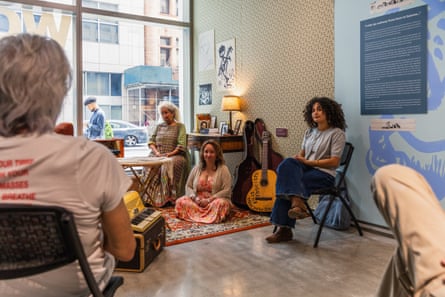
These facsimiles of Guthrie’s cartoons, drawings, scribbled notes and typewritten lyrics fill the gallery space like a physical manifestation of Guthrie’s explosive creativity. They cover the walls, hang from the ceiling, and are even scattered across the floor. “It’s as if you’re walking into his office and he’s writing so much that things are falling off his desk,” said Mendez. “We wanted to encapsulate this very abundantly creative energy that he had, and also the playfulness.”
A placard encourages visitors to “play the instruments, doodle, write, and generally be creative”. On a recent afternoon, one of the provided notepads featured the results: “Long live Woody and what he stands for,” read one scrawl. “You are the machine that kills hate,” read another.
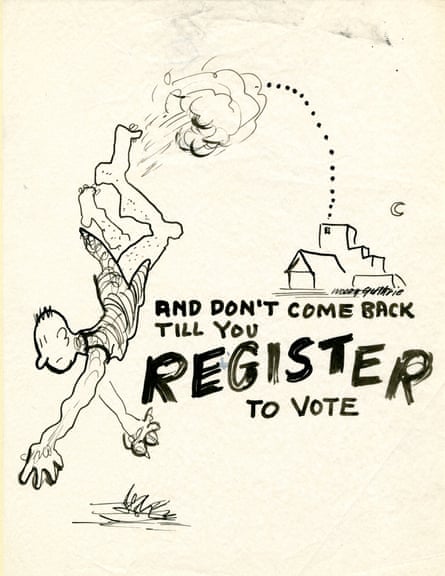
The materials highlight the breadth and depth of Guthrie’s political engagement, with drawings exhorting people to organize and vote, cartoons lampooning bosses and capitalists, and memorabilia from benefit shows protesting against police brutality and fundraising for union drives and dust bowl refugees.
This tradition of protest music remains alive and well in 21st century America – witness Bruce Springsteen’s Streets of Minneapolis and the Dropkick Murphys’ Citizen ICE, both released in early 2026 amid the violent occupation of Minnesota’s Twin cities by federal immigration forces. The students have also selected songs from Bad Bunny, A Tribe Called Quest, Jesse Welles and Solange to give a sense of this genealogy of “creative resistance”.
That continuity across historical eras delighted Nora Guthrie, one of Woody’s daughters, who drew particular attention to Bad Bunny’s Super Bowl half-time show during an interview in the exhibit’s living room.
“The thing that was great about it was that it was a history lesson, but it was joyous. You could dance to it,” she said. “Woody was very playful. A lot of people confuse other protest singers’ seriousness with Woody’s playfulness. Woody was the Rosa Luxemburg – ‘I don’t want to be part of a revolution I can’t dance to.’” (The line is actually attributed to Emma Goldberg.)
Nora Guthrie had little truck with her father’s music when she was growing up in Brooklyn: the folk singer had Huntington’s disease and was by then largely confined to the hospital, and she had little interest in “the usual folk songs and dust bowl ballads”. “I didn’t think he was very interesting growing up,” she said. It was later in life, when she rescued boxes of his notebooks and papers from a basement in Queens after a flood, that she got to know her father outside the sepia-toned version in history books.
“These are all teachings,” she said of the exhibits surrounding us. “I didn’t have that growing up with him because of Huntington’s, so discovering Daddy at 42 was just so exciting. I could say, ‘Dad what do you think about such and such?’ and I can find a lyric that tells me whatever I need to know.” Since establishing the archive, her work has included bringing the unseen sides of her father to the public through collaborations with Billy Bragg and Wilco, the Dropkick Murphys and the Klezmatics.
A certain pall is cast over the exhibit, through no fault of the student curators or the Guthrie family, by the behavior of NYU itself. The university’s heavy-handed response to student and faculty protests against the war on Gaza suggest that it prefers anti-fascist activism to be confined to museum exhibits and history books. Next month, NYU graduates will listen to pre-recorded (and pre-approved) commencement speeches; in 2025, one student speaker deplored the “atrocities” in Palestine in his speech, only to have the university withhold his diploma as punishment.
This chilling climate clearly influenced the contents of the exhibit, which was originally going to focus on Guthrie’s relationship with New York and feature 19 locations around the city where he wrote. “We scrapped it,” said Anna Canoni, Nora’s daughter and president of Woody Guthrie Publications, who worked with the students on the exhibit. “I said, ‘How can Woody be a safe haven for what you need to say in this moment in 2026, for what you stand for and what you want to say?’ And this was their answer.”
“We were very, very forward on the whole fascism side of things,” said Mendez. “Even on NYU campus, it’s been very real – the repression of any kind of connection to a political agenda. We were still able to make something that had a political connotation, and I’m glad to see that being celebrated.”
“This is what we do – we infiltrate,” said Nora Guthrie. “This is what creative resistance is. Even when we protest, it’s joyful and loving. I believe in better angels. I’m sorry that NYU doesn’t get it, but that’s their problem.”
-
Woody Guthrie: What This Guitar Might Do is on display at the Clive Davis Gallery from 31 March through 15 May