







On a crisp bright early spring afternoon on a small uninhabited island in the Ångerman river in northern Sweden, the stars of The Great Moose Migration are proving suitably elusive. Just as they do, for the most part, to viewers of the world’s biggest slow TV phenomenon – a three-week-long, 450-hour, free-to-view continuous livestream from the Västernorrland wilderness that has a global audience of millions mysteriously captivated every year, despite precious little happening at all.
Hardcore watchers will be lucky to spot an älg, as they are called in Swedish, making their annual crossing of the Ångerman en route to richer summer pastures north any more frequently on average than about once every 400 minutes. But among this landscape, which moose have traversed for 6,000 years, traces of the illustrious beasts are everywhere if you know where to look for them. After a bit of raking among some lingonberry bushes, The Great Moose Migration producer and co-creator Stefan Edlund eventually finds a firm round lump of dried moose dung to hand me. “It’s a bit gross,” he acknowledges, “but they only eat plants.”

Nearby, he points out distinctive heart-shaped hoof prints pressed into the wet mossy undergrowth, where they have lain concealed for months beneath the snow. Faintly visible trails worn into the undergrowth over millennia wind between trees and rocks, down to the shore. Yesterday, Edlund spotted a few moose from a distance moving close to the “entrance”, as he calls the fordable causeway linking the southern shore to the mainland. An unusually early spring, which has already brought the thaw, should invite more along soon. The Great Moose Migration cameras, 30 of them hung discreetly from the trees, will be quietly waiting.
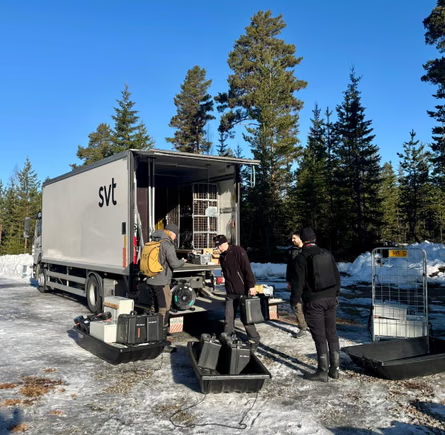
The forest and riverbank are freshly rigged for this year’s broadcast with a setup comprising 42 microphones and more than 15 miles of cabling. A chat function in the show’s online viewing platform allows fans to communicate with one another and the team as they watch. “There might be only 200 people in the group,” series co-creator Johan Erhag says, “then a moose starts swimming and suddenly it goes up 10,000, 20,000.” In seven seasons to date, the highest volume of “swimmers” registered was 87 in 2023. In 2026 they hope to break 100. Extra cameras at new spots ensure the setup covers the widest sweep yet of a U bend-shaped stretch of the Ångerman, measuring roughly five miles.
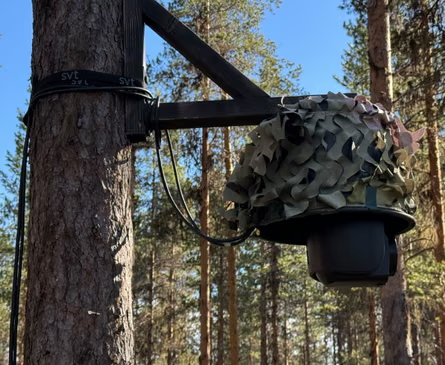
Produced by Swedish national broadcaster SVT, The Great Moose Migration is done on a shoestring, carried by a rugged, maverick spirit. None of the cameras are designed for outdoor use, necessitating a few DIY weatherproofing improvisations – upturned black plastic buckets, for instance, bought from a hardware store then wrapped in camouflage netting. Electricity is supplied by friendly locals from a nearby house. One lifeline for the broadcast is a long, thin fibreoptic broadband cable, laid along the riverbed and the forest floor. Hungry mice once chewed through it, leaving Edlund to frantically phone around in search of a handyman able to microscopically stitch the thing back together at short notice.
Edlund and Erhag had previous in slow TV – real-time events, depicted with little or no editing – through work with Norwegian state broadcaster NRK, which invented the concept circa the early 2010s through broadcasts of things like leaping salmon, crackling fires and long-distance train and ferry journeys. The two Swedes later worked together on an SVT nature series, during the making of one episode of which they happened to travel here, to the Junsele region of Västernorrland, to meet local residents Irene Hägglund and Kjell Mähler, who had noticed that moose regularly swam across the Ångerman river each spring right across from their house. “We were visiting this couple,” Erhag recalls, “and they were standing in the window with binoculars, counting the moose as they crossed. That’s when we had the idea.”
In the unrelenting enormity of Sweden’s mostly forested wild, here Edlund and Erhag had stumbled on something wonderful: a spot on the moose’s annual migration route with inbuilt challenge and drama ripe for visual storytelling. “Art by accident,” as Edlund likes to put it. “Nature has formed this place,” he says, “it was perfect from the beginning. We just found it.”
Selling the concept to execs for Den stora älgvandringen, as the show is called in Swedish, proved a slog. In 2019, they were given a chance to make a first season, but things did not immediately go to plan. “We didn’t see a single moose for a week,” Erhag recalls, “my phone was going nuts with the bosses calling me.” At last, one strolled into shot, then another, then more. “What a feeling. Me and Stefan were high-fiving and hugging.”
Season two happened to fall during the first lockdowns of the Covid-19 pandemic, boosting the show to a huge new audience trapped and bored at home, desperate to be transported to another world. An unofficial Facebook group – now with around 96,000 members – started up organically. “We had to ask to join it,” remembers Erhag.
How to explain The Great Moose Migration’s extraordinary appeal? The answer may lie, in part, in the moose itself. Known in Sweden as Skogens konung, the King of the Forest, the Alces alces (often referred to as the European elk) has long been a celebrity of the Nordic animal kingdom. “It’s the iconic species of Sweden and the north,” says professor Göran Ericsson from the Swedish University of Agricultural Sciences. “It represents something very Swedish: the accessibility of nature. Everyone has a relationship with moose, even though they may never see one.”
Swedes have expressed fascination with these animals in different ways for thousands of years – from prehistoric moose cave paintings to a clever modern-day marketing gimmick by northern Sweden’s biggest beer brand that sees its cans adorned with a moose-shaped thermochromic symbol that turns blue when your beverage is chilled. Along the southern side of the island where The Great Moose Migration is filmed lie a row of fallgropar – capture pits, first dug by stone age man and used for thousands of years to trap unsuspecting moose.
Such a prized source of protein were the animals that until as recently as the mid-19th century moose were driven to near extinction. But numbers have rebounded since. “There are roughly 300-400,000 moose in Sweden today,” says professor Ericsson. And yet, as a species these shy, lumbering, roughly 300-500kg creatures remain, he notes, “a little bit secret”. The closest any Swede today is liable to get to one is hitting a moose with their car, which happens in the country about 5,000 times a year on average. Thus, the distinctive red-and-yellow triangular moose-crossing warning signs visible at the sides of roads – long a popular target for theft by tourists, who take them as souvenirs of the Swedish wilderness.
Which is what gave rise to the inspired idea at SVT that there could be an audience beyond Swedish borders for The Great Moose Migration. The broadcaster was already experimenting with un-geo-blocking certain native content not tangled up in any complicated rights restrictions on its streaming platform SVT Play. The elegant simplicity of The Great Moose Migration – “Fortunately the moose don’t have a manager,” Erhag jokes – made it an ideal candidate.
SVT isn’t able to track viewer numbers through its streaming platform, much less break them down country by country. But they know that, in 2025, The Great Moose Migration produced 12m watched hours of broadcasting. Erhag and Edlund proudly show me clips of American TikTok influencers and Twitch streamers getting excited about swimming moose. The show has even spawned a meme: a moose falling ungracefully through ice – universal internet shorthand for a plan gone comically awry.
What could have just been one of those Covid-era passing fads, like livestreamed concerts or PE with Joe Wicks, has somehow stuck around and grown, in a way no other slow TV experience has before. Annette Hill, a professor in Media and Communication at Jönköping University, who is leading an academic study of The Great Moose Migration’s transnational appeal, reckons that its longevity lies in not only presenting a quietly genuine alternative to the endless scroll of fast-paced, fragmented modern media, but also an escape from the AI slop and fakery that leaves us constantly questioning our eyes and ears. “In a mixed-up media world,” she says, “where it’s like: is that real? Can I trust that? I think this is a beautiful antidote.”
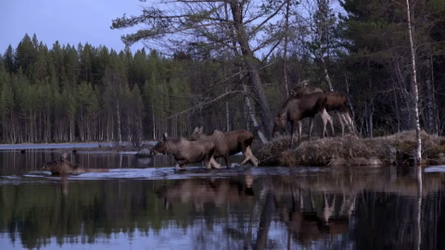
It’s a show not designed for traditional sit-down watching, but mostly passive consumption, on an extra screen or browser window, at home or at work. The canvas is left deliberately peaceful and blank – no voiceover narration, only the ambient sounds of wind and water and birdsong. Other animals make occasional cameos – foxes, beavers, lynx, a whole host of birdlife (though never yet a wolf – the truly elusive beast of the Swedish wild). A camera monitoring a bear at a separate location might be thrown in as a bonus. But even more than the moose, the silent landscape might be the true star. The glittering river, the long shadows of trees crawling across the forest floor. An empty space for viewers to insert themselves into far from everyday urban reality. All that’s missing is the smell of the fresh, clean northern spring air.
The day after my trip to the island, I’m invited into The Great Moose Migration nerve centre at SVT’s studio in the city of Umeå, 140 miles east. Here, in a darkened room on dozens of screens, Edlund and Erhag and team will sit in shifts for three weeks during broadcast, manually hunting pixellated moose. Because as yet, they have been unable to find any technological solution to warn them one is in shot. Sometimes, they rely on fan support. “We can have someone sitting at home with a 98-inch screen,” says Edlund, “who can clearly see a moose that we’ve missed, screaming at us in the chat: ‘Move the camera to the right!’”
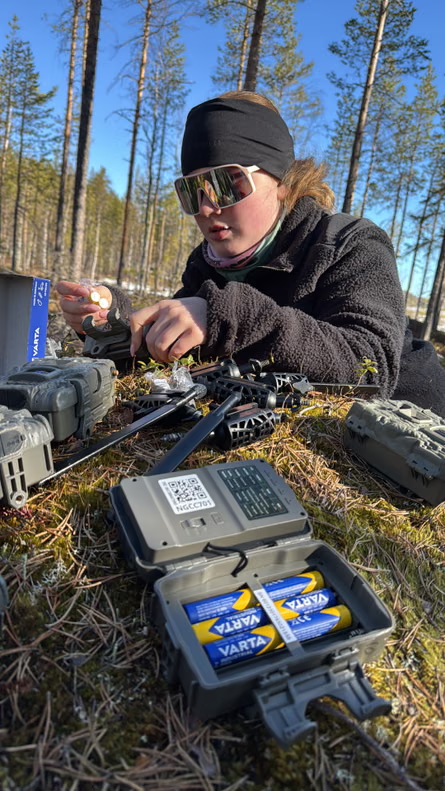
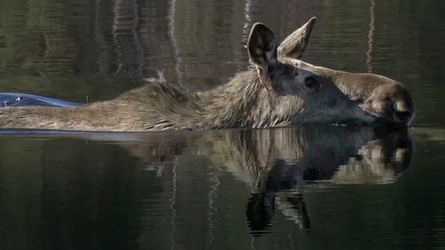
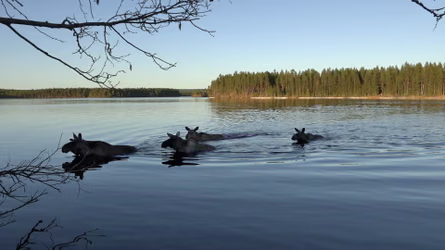
A few of the animals, especially the bolder females, plough straight into the freezing flow and swim across in seconds. Others can take hours to pluck up the courage. Some turn back and find another way. There is occasional peril (see the moose falling through ice gif for proof), and even if it hasn’t happened yet, a moose death could one day be witnessed. “Because this is nature,” says Edlund. “This isn’t a Disney movie. It’s the real thing.”
Previously, the team have rigged the island in deep snow, travelling by ATV over the ice. Due to the oddly early spring, 2026 was the first time they did it post-thaw. The climate crisis may be to blame and if it gets worse, six millennia of moose behaviour at this spot may cease. Because, as moose expert Ericsson points out: “If the difference between the seasons is less pronounced, the need for migration is not as necessary.” He soberly anticipates that there will be relatively few swimming moose visible in 2026, because less snow meant many animals never moved south for winter.
Erhag prefers to remain more optimistic. “One hundred moose,” he predicts, grinning. However many make the trek, The Great Moose Migration team will be ready and waiting to show them to the world.