




As black-clad police combatants charged into the hillside favela and opened fire, a black-clad punk scurried out of the community in the opposite direction, his hands trembling from fright.
“Holy shit! All those guns! Things are getting ugly!” spluttered Rodrigo Cilirio, the founder and bassist of one of Rio’s most enduring punk bands, as he took cover behind a tree.
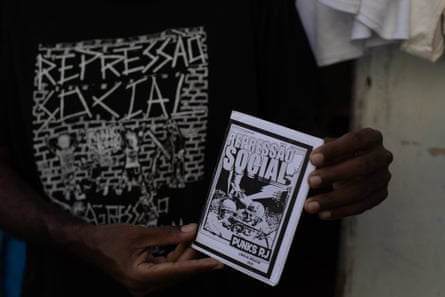
It was here in the Morro da Lagartixa on Rio’s volatile northside that Cilirio’s group, Repressão Social (Social Repression), was born just over 30 years ago: a howl of rage against the relentless cycle of urban violence, police brutality, deprivation and discrimination that continues to plague the outskirts of Brazil’s largest cities.
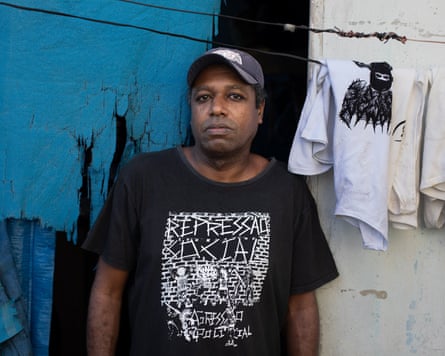
“[Punk] is my way of letting it all out so I don’t choke to death. It’s my voice,” Cilirio, 47, explained while waiting for the gunfire to subside near the favela where he grew up.
“This is what we are exposed to,” the black musician sighed of that morning’s gun battle, during which one local was shot in the leg. “Punks go through what everyone goes through: bullets flying and a life of stress … every single day.”
Fifty years after punk culture took off on the streets and stages of the UK, the movement is alive and kicking in Brazil and across the world, from Indonesia and Myanmar to Colombia and Mexico.
“The global south has really embraced punk culture as a way to respond to their own individual and local contexts … I suspect it’s outlived and gone global more than most people would probably have expected from the outset,” said Kevin Dunn, author of Global Punk: Resistance and Rebellion in Everyday Life.
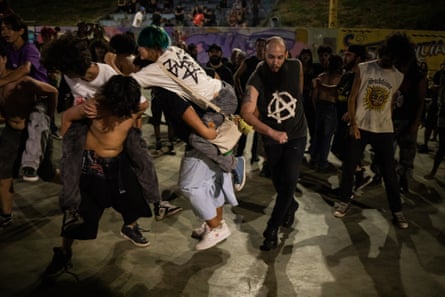
Dunn partly attributed that expansion to the flexibility of punk’s do-it-yourself culture. Colombian bands have embraced traditional Indigenous instruments while Mexican and Guatemalan sounds have influenced southern California’s punk scene. “It can mould to whatever kind of local musical tradition is around,” Dunn said.
Punk music exploded in London and New York in the mid-1970s with bands such as the Sex Pistols and Ramones – although some trace its roots to a Peruvian group called Los Saicos (the Psychos) a decade earlier.
Dunn called the movement “a response to the stultifying, oppressive aspects of life” and frustration at social conservatism, unemployment and the unfulfilled promises of modernisation. “There was a lot of discontent and what punk did was [capture] the forms of alienation that people felt … where the forces of life – economic, political, social – they’re all up there beating down on you … [Punks thought]: The world is shit and … we’re gonna push back.”
Half a century later Latin American punks continue to push back, as police militarisation, gender-based violence, corruption, racism, inequality and a resurgence of authoritarian governance and far-right politics provide a backdrop and motivation.
“Punk started over in Europe but it became much stronger here because the violence is so much worse,” said Cilirio, who has lost numerous friends and acquaintances to deadly police violence which disproportionately affects young black men.
Brazil’s punk scene is focused on the hardscrabble working-class fringes of cities such as São Paulo, Belo Horizonte and Rio; places like the Morro da Lagartixa (Lizard Hill) favela, where Repressão Social formed in 1995.
“It’s about police violence. It’s about poverty. It’s about all the people living on the streets. We deal with all of this [in our songs],” Cilirio, who friends call Abutre (Vulture) because of his religiously black attire, said during a Friday night band practice fuelled by dirt-cheap ginger cognac and cigarettes.
The musician compared his socially divided city to colonial-era Brazil, when wealthy enslavers lived in opulent residences called the “casa grande” and their workers in quarters called the “senzala”. “This is the modern-day senzala,” Cilirio said of the depressed redbrick favelas that blanket the hills around his home. “They banished everyone here to the suburbs … and all they care about is our cheap workforce.”
The band’s scarlet dreadlocked vocalist Vic Morphine, who lives in Rio’s oldest favela, Providência, said she had been drawn to punk by her indignation at social injustice and violence against women. “We feel angry – and we have reason to be angry,” said Morphine, 31, calling punk a way of “expressing all my outrage in my way of being, in my style, in my voice and in the music I make”.
The singer included Brazilian punk in long history of resistance and uprisings, including 1835’s Malês slave revolt of African Muslims and the War of Canudos in 1896.
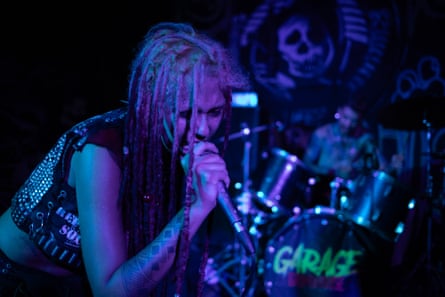
At a recent gig a barefoot Morphine launched into a fevered rendition of a song excoriating the barbarity of 21st-century life. “Massacres! Murders! … They snatch you! They kill you! There is no more hope!” she shrieked into the mic as a mixed-breed poodle with a pink mohican circled the mosh pit.
Punk culture has spread far beyond Brazil’s big cities since it first landed in the land of samba and bossa nova at the tail-end of the 1964-85 dictatorship.
One recent Sunday, scores of music fans flocked to a skate park in a rural city called Varginha to watch punk and hardcore bands, including Repressão Social play, although in true punk style, the Rio band failed to turn up.
Moshing at the heart of the circle pit was Willkesley Franciscato, a 35-year-old punk with a circle-A tattoo on his biceps. “Punk has this really virulent ideology, like a virus. It has the capacity to contaminate people who are just fed up with everything…. Punk contaminates everyone who identifies with these questions of freedom, equality, believing in a better future,” Franciscato said.
Varginha’s oldest punk, 45-year-old Kleberson Eugênio da Silva, believed the resurgence in punk culture under way in Brazil had come just in the nick of time.
During the far-right 2018-2023 presidency of Jair Bolsonaro neo-Nazi skinheads came out of the woodwork, emboldened by his radical and racist rhetoric, Silva claimed. “It was a massive trigger for these guys to hit the streets … Before, they hid away … now you see them parading all over the place. We can’t allow this to grow,” said the punk who has a scar on his belly from being stabbed during an altercation with a Brazilian bonehead.
Twenty-four hours after the police operation on Lizard Hill, calm had returned as Cilirio led the way through deserted streets covered in graffiti glorifying the local drug gang.
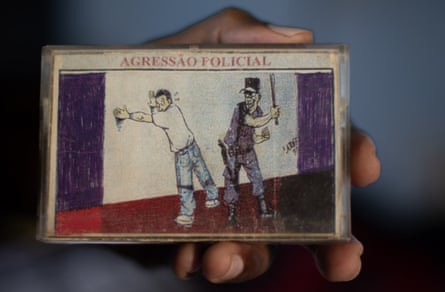
In a cluttered backroom, he showed off a treasure trove of counterculture memorabilia: dog-eared demo tapes, screenprinted T-shirts and anarchist pamphlets.
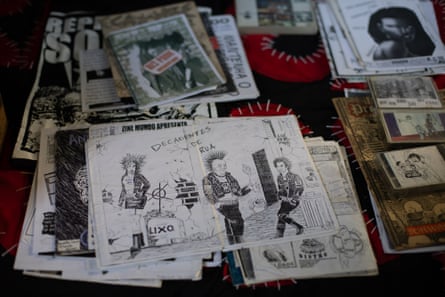
Punk rallying cries cried out from the collaged pages of handwritten punk zines in a mix of English and Portuguese. “Fight back … Hell Vomit … Fuck Nazi … Guns don’t kill hunger! … Resist!” Hanging from a washing line was a T-shirt stamped with a cartoon of a ski-masked punk decapitating Donald Trump with a hunting knife.
“It’s a museum,” Cilirio said, showing off his group’s first record, a 14-track blaze of high-octane anti-establishment fury called Police Brutality.
One zine in his collection contained the lyrics to a 1981 track by Discharge, a hardcore punk group from Stoke-on-Trent whose words perfectly captured the futility of Rio’s “war on drugs”. “It’s all a fuckin’ farce,” they said. “A stray bullet kills an innocent child. Nothing’s gained and nothing’s solved.”
Another sheet of lyrics had been penned by Cilirio to celebrate his movement’s unstoppable global march. “We are suburban punks. Favela punks. Third world punks,” he wrote, before proclaiming: “Punk culture will never die”.