








The situation around the Strait of Hormuz is once again becoming one of the central pressure points of global politics. It is now the number one issue, at least until military action by the United States against Iran potentially resumes.
This narrow maritime corridor, through which a significant share of global oil supplies passes, has long ceased to be merely a geographic location on the map and has instead become a tool of pressure and a focal point of major geopolitical rivalry.
At first glance, the situation appears to be another cycle of escalation, marked by mutual statements, demonstrations of military readiness, threats to block shipping, and the increased presence of external actors. However, behind this familiar pattern lies a far more complex configuration of interests.
Experts note that the Strait of Hormuz is not only an energy artery but also a kind of barometer of global mistrust. Any escalation here is immediately reflected in markets, triggering increases in the prices of oil, gas, fertilisers, and other commodities.
Tehran is developing its own system for regulating maritime transit. Fees have been introduced which, according to Iranian officials, can reach millions of dollars for certain categories of vessels. Formally, the principle of openness for international navigation remains in place, but with exceptions for a number of countries, including Russia, India, China, Iraq, and Pakistan. This approach is creating a new model of selective access, where economic and political allies are placed in a more advantageous position.

Source: aljazeera
At the same time, there are increasing reports of mining activity, tanker attacks, and operations involving fast attack boats of the Islamic Revolutionary Guard Corps. All of this contributes to rising tension rather than de-escalation. Even without a full closure of the strait or direct naval clashes, the level of threat itself has become a deterrent to shipping. Many tankers are choosing to avoid the route, fearing damage or detention, and such concerns are not without basis.
Both the United States and Iran claim full control over the strait. US President Donald Trump has stated that no vessel can enter or leave without permission from the US Navy, making the claim on the platform Truth Social. He also warned that the strait would remain closed until Iran agrees to a deal, though no evidence of such control has been provided.
Reports indicate that Iran has intensified mining operations in recent days. If Trump’s statements are to be believed, the US Navy has been ordered to destroy any vessels engaged in such activity.
Meanwhile, Iranian military authorities have declared that the strait has returned under their “strict control”, reversing an earlier decision to keep it open to navigation. The country’s joint armed forces command warned that it would block passage until the United States lifts its blockade of Iranian ports and restores freedom of movement for vessels entering Iran.
According to reports citing informed sources, the US military is developing new strike plans targeting Iranian forces in the Strait of Hormuz in case the current ceasefire collapses. Potential options include precision strikes on fast attack boats, mine-laying vessels, and other asymmetric assets operating in the Strait of Hormuz, the Persian Gulf, and the Gulf of Oman. It is noted that US efforts are complicated by Iran’s large fleet of small, highly manoeuvrable vessels capable of launching attacks.
Sources also indicate that while previous strikes were focused on Iranian targets away from the strait, attention has now shifted directly to this maritime corridor. Some analysts argue that strikes limited to the strait alone will not resolve the situation, as there is no clear evidence that Iran’s military capabilities have been fully neutralised, contrary to some claims.
According to the US Central Command, more than 10,000 American personnel are currently involved in enforcing the blockade of Iranian ports.
At the same time, there are indications that Washington may be reluctant to resume full-scale hostilities and could be open to negotiating a new ceasefire. This suggests that even as tensions rise, diplomatic options remain under consideration.
The United States speaks of a strict blockade, Iran of firm control, yet despite these measures, some vessels continue to pass through the strait. On Thursday, a tanker reportedly transited the corridor despite the declared blockade. The vessel, named Koba and flying the flag of Curaçao, has been included on US sanctions lists over the alleged transportation of Iranian oil to China.
On Wednesday, Iran reportedly fired upon three vessels in the strait and seized two of them. Iranian naval forces escorted the detained ships to Iranian territory. These included the cargo vessel MSC Francesca, flying the flag of Panama, and Epaminondas, under the Liberian flag. The company managing Epaminondas stated that a military boat approached the vessel off the coast of Oman and opened fire, damaging the captain’s bridge. Another vessel, the container ship Euphoria, operated by a Greek company, was also attacked and subsequently ran aground near the Iranian coast.
Interestingly, White House press secretary Karoline Leavitt stated that the seizure of these ships is not considered a violation of the ceasefire by the Trump administration, as the vessels do not belong to the United States or Israel. This position has drawn attention, particularly in light of earlier reports that the United States itself had seized Iranian vessels in the strait.
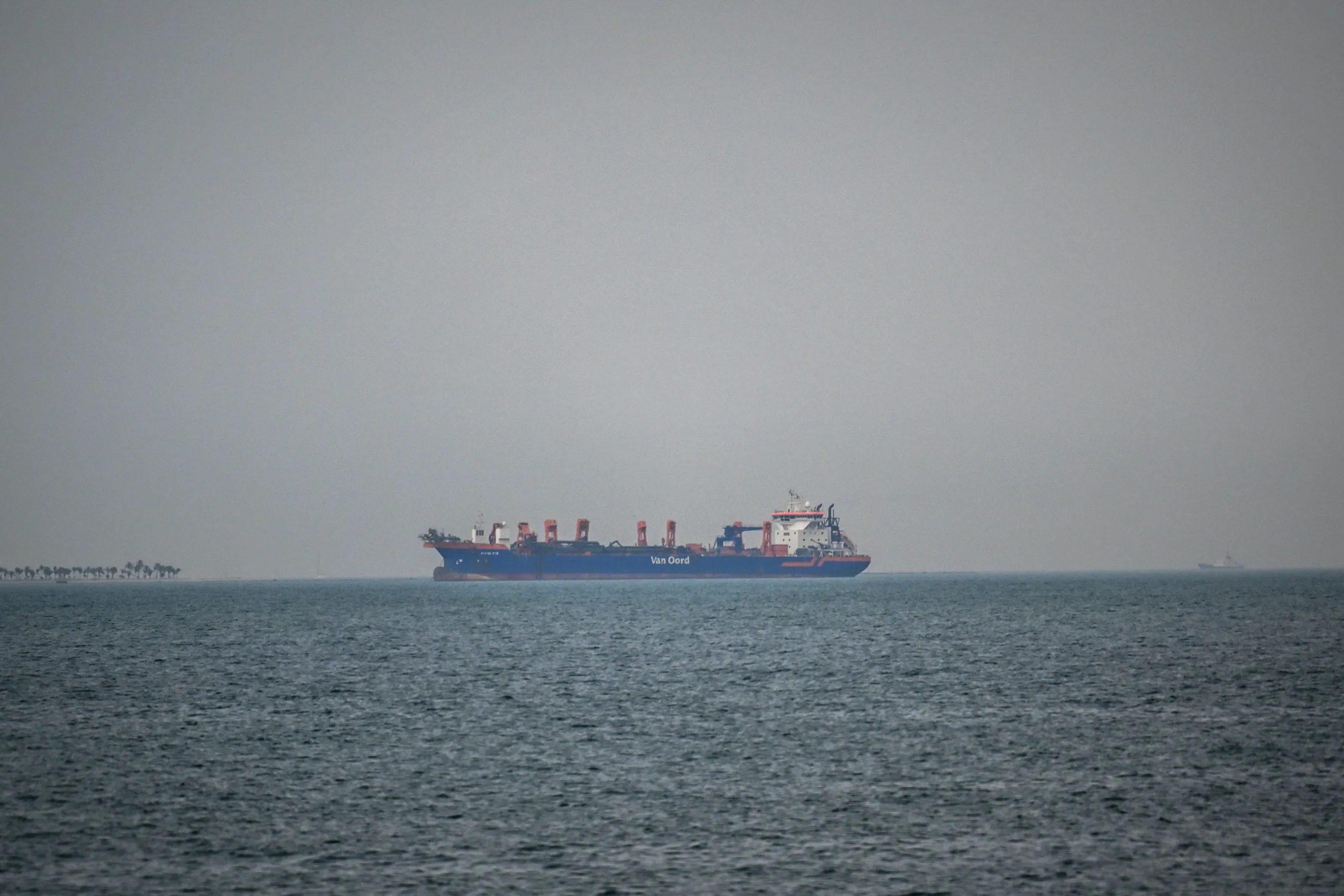
Source: PRESS TV
The defining feature of the current situation is that the strait is not fully closed, yet its operation has become politically controlled and unstable. It has effectively turned into a “grey zone”, where formal openness coexists with practical restrictions, threats, and selective access rules.
In this sense, the Strait of Hormuz is no longer just a shipping route but a bargaining instrument in geopolitical negotiations. Energy interests, military calculations, and diplomatic manoeuvring intersect here. The longer this uncertainty persists, the more the world becomes accustomed to the idea that one of the most critical arteries of the global economy can be used as leverage, with consequences far beyond the region.
As if the situation were not already complex enough, India has now declared the corridor part of its core strategic interests.
According to reports, India’s new naval strategy provides for active operations across the Indian and Pacific Oceans, including the Strait of Hormuz, as well as other key maritime regions that significantly influence global trade and the country’s energy security. These include the Cape of Good Hope, the Suez Canal, the Persian Gulf, the Red Sea, and major straits such as Sunda, Malacca, and Singapore.
The strategy emphasises that as India’s strategic and economic activity in the world’s oceans increases, external pressures affecting national interests will also intensify. Maritime capabilities, infrastructure, and naval operations are seen as key drivers of economic growth and prosperity.
By Tural Heybatov
此内容由惯性聚合(RSS阅读器)自动聚合整理,仅供阅读参考。 原文来自 — 版权归原作者所有。