










Indian Defence Minister Rajnath Singh’s statement that India could become the world’s largest arms exporter within the next 25–30 years is more than a bold political slogan. It signals a deeper transformation in India’s foreign and industrial policy.
New Delhi no longer wants to remain one of the world’s largest arms buyers. It aims to move into a different category — that of a producer, supplier, and technological power capable not only of purchasing weapons from Russia, France, the United States, or Israel, but also of exporting its own defence systems to countries across Asia, Africa, the Middle East, and the Indo-Pacific.
The statement came after the inauguration of a major private-sector ammunition manufacturing facility in Shirdi, Maharashtra. According to Indian media, the plant is expected to strengthen the role of private companies in India’s defence industry. Singh also said the government intends to raise the private sector’s share in defence production to 50 percent. This is a key point: India is trying to build not merely a state-controlled defence machine, but a more flexible military-industrial ecosystem in which private companies, start-ups, state corporations, and the armed forces operate within a single strategic framework.
At first glance, the goal of becoming the world’s largest arms exporter may seem overly ambitious. Today, the global arms market is dominated by the United States, France, Russia, China, and several major European producers. India is not yet part of this group as a full-scale export giant. Moreover, for decades, the country itself has been one of the world’s largest importers of weapons. This demonstrates that, despite its push for self-reliance, New Delhi still depends on foreign suppliers in several critical defence sectors.
Yet the trend is beginning to change. India’s defence exports reached a record level in the 2024–2025 financial year, exceeding 23,600 crore rupees, or roughly $2.7–2.8 billion. This is still far below the level of the United States or China, but the direction is significant: over the past decade, India has sharply increased its defence exports and set a target of reaching 50,000 crore rupees by 2029.
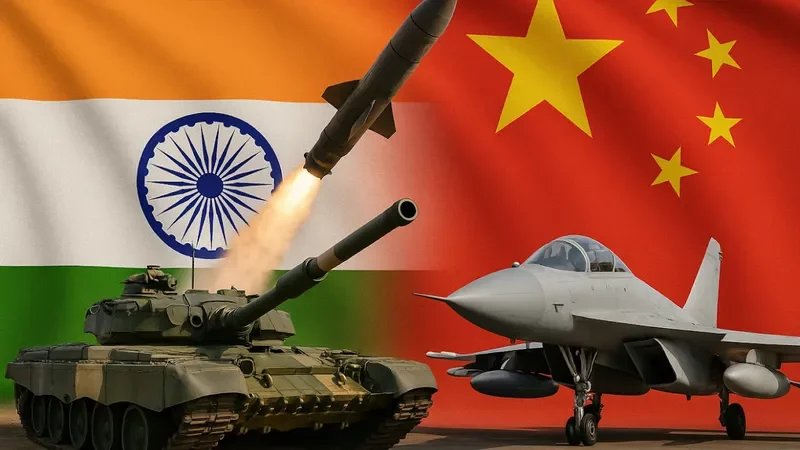
This is where the comparison with China becomes especially important. China went through a similar process earlier. Several decades ago, Beijing was actively importing Soviet and Russian technologies, copying certain systems, building up its engineering base, and gradually creating its own military-industrial complex. Today, China is no longer merely a buyer. It manufactures fighter jets, drones, missiles, warships, air defence systems, armoured vehicles, and other military platforms, exporting them to countries that, for political or financial reasons, find it difficult to purchase Western weapons.
Credit: indianewsnetwork.com
China’s model was built on three main pillars: large-scale state financing, strict centralisation, and the use of arms exports as an instrument of geopolitical influence. India is trying to move in a similar, though not identical, direction. The main difference is that New Delhi does not seek to fully replicate China’s state-command model. India’s strategy relies on a combination of government orders, private business, foreign partnerships, and the Make in India programme.
While China built its defence giant through the vertical mobilisation of state resources, India is trying to create a more mixed system based on competition, joint ventures, foreign technology transfers, and a large domestic market that can later serve as a foundation for exports.
China has one major advantage: industrial scale. Its manufacturing base is far broader than India’s. Beijing can produce large quantities of weapons quickly, reduce costs, and offer buyer countries comprehensive packages that include equipment, training, infrastructure, loans, and maintenance. This has made Chinese weapons attractive to a number of countries in Asia, Africa, and the Middle East. For states that cannot or do not want to depend on the West, China often acts as a convenient alternative supplier.
India, by contrast, is still at an earlier stage. Its strength lies not in mass production, but in political flexibility. New Delhi maintains defence ties with Russia, expands strategic cooperation with the United States and France, works closely with Israel, strengthens relations with Arab monarchies, and at the same time positions itself as a voice of the Global South. This gives India a unique advantage: it can sell weapons to countries that do not want to choose between the West, Russia, and China.
Trust is also an important factor. Chinese arms exports are often viewed through the prism of Beijing’s broader geopolitical ambitions. Buying Chinese weapons may imply not only a military transaction, but also deeper dependence on China. India, on the other hand, is trying to present itself as a less aggressive, more neutral, and more acceptable partner. For countries in Southeast Asia, Africa, the Middle East, and the Indian Ocean region, this could become a serious argument.
However, India also has clear weaknesses. First, its defence industry has not yet proven that it can produce a wide range of complex systems in large quantities and at consistently high quality. Second, many Indian defence projects have progressed slowly because of bureaucracy, coordination problems, and dependence on foreign components. Third, India still has to convince potential buyers that it can not only sell equipment, but also provide long-term maintenance, modernisation, spare parts, and personnel training. In the arms market, after-sales support is often as important as the initial contract itself.
China already has an advantage in this area. It has learned how to work with customers that need affordable weapons and rapid delivery. India is only beginning to build such a system. However, New Delhi has a real opportunity to occupy a niche where Chinese weapons raise political concerns, Russian arms have become less accessible because of the war and sanctions, and Western systems are either too expensive or subject to political restrictions.
The Russia factor is also important. Historically, Moscow has been India’s main arms supplier. However, Russia’s defence industry is now under pressure from the war in Ukraine, sanctions, and limited production capacity. This creates both a risk and an opportunity for New Delhi. The risk is that India remains dependent on Russian systems in several key areas. The opportunity is that India can gradually replace part of these imports with domestic production and later offer similar systems to third countries.
The comparison with China shows that India will not quickly become a second China in the defence industry. It does not have the same level of production centralisation, industrial mobilisation, or speed of decision-making. However, India can offer a different model — not a Chinese one, but an Indian one. It is the model of a country seeking to transform its geopolitical multi-vector policy into a commercial advantage.
If China sells weapons as part of its broader strategy of influence, India can sell them as part of a partnership strategy without rigid political dependence. If Beijing is often perceived as a power expanding its influence through infrastructure, loans, and military ties, New Delhi can position itself as a more balanced supplier for countries seeking to diversify their defence relations.
Still, the road to becoming the world’s largest arms exporter will be extremely difficult. To come close to this goal, India must solve several major tasks: accelerate the development of domestic technologies, improve product quality, strengthen the private sector, reduce dependence on imported components, build an effective after-sales service system, and use its diplomatic network more actively to promote defence contracts.
Rajnath Singh’s statement matters because it reflects a change in strategic thinking. India no longer wants to be a country that buys security from others. It wants to become a country that sells security to others. That is a serious shift in the global defence architecture.
Credit: intoindia.blog
In the coming years, India is unlikely to catch up with China in terms of export volume. However, it is already beginning to compete with Beijing for political space in the Global South. If China’s military-industrial complex became a symbol of Beijing’s industrial rise, India’s defence strategy may become a symbol of New Delhi’s next stage of growth — from a regional power to an independent player in the global arms market.
The real intrigue is not whether India can become the world’s largest arms exporter tomorrow. That is impossible in the short term. The real question is whether India can, over the next 25–30 years, follow the path China began earlier, but do so in its own way, through a democratic system, private-sector participation, strategic partnerships, and growing demand from countries seeking alternatives to the West, Russia, and China.
If New Delhi succeeds, the global arms market could indeed change. In that case, Rajnath Singh’s words will be remembered not merely as a political slogan, but as the beginning of a new Indian defence era.
By Murad Samedov
此内容由惯性聚合(RSS阅读器)自动聚合整理,仅供阅读参考。 原文来自 — 版权归原作者所有。