Most enterprises experimenting with artificial intelligence (AI) agents face the same problem. Building an agent is one task. Connecting it to live data is another. Securing it, governing it and knowing when it fails has historically required a separate tool, a separate vendor and a separate procurement decision for each.
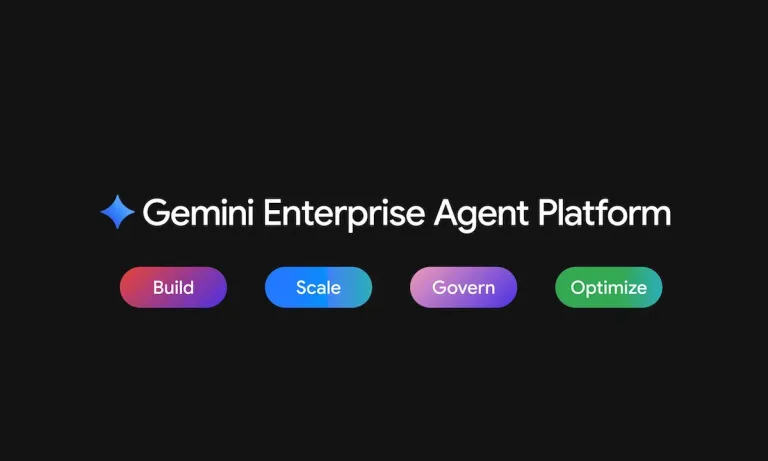
At Google Cloud Next 2026, Google announced the Gemini Enterprise Agent Platform, a unified system designed to handle all of it. The platform replaces Vertex AI as Google’s primary enterprise AI development environment and bundles agent building, deployment, data integration, security and optimization into a single offering. All future Vertex AI services and roadmap updates will be delivered through it.
The launch is Google’s direct answer to Amazon’s Bedrock AgentCore and Microsoft’s Foundry. The timing reflects a broader shift in enterprise AI competition. The race is no longer about which model performs best. It’s about which platform makes agents easiest to build, deploy and trust at scale.
Building and Scaling Agents
Google’s platform separates builder tools by audience. Technical teams work through the Agent Development Kit (ADK), a code-first environment that supports graph-based multi-agent networks where specialized agents delegate tasks among themselves. Business users access Agent Studio, a low-code visual interface for designing agent logic without writing code, according to SiliconAngle. Both tools received significant upgrades, with the ADK processing more than six trillion tokens monthly on Gemini models, Google said.
The scaling layer addresses a failure point common to enterprise AI pilots. Proof-of-concept agents break down when moved into production because they can’t maintain context across multi-step workflows or extended time periods. The revamped Agent Runtime supports long-running agents that maintain state for days at a time, backed by a Memory Bank for persistent, long-term context, according to Google Cloud. An agent managing a sales prospecting sequence, for example, can now run autonomously across multiple days without losing track of prior interactions.
Payhawk, the expense management platform, told Google its Financial Controller Agent now uses Memory Bank to recall user-specific constraints and history, cutting expense submission time by more than 50%. PayPal said it uses the Agent Development Kit and visual tools to manage multi-agent workflows and inspect agent interactions, with Google’s Agent Payment Protocol providing the foundation for trusted agent-based commerce.
Advertisement: Scroll to Continue
Data Integration and the Enterprise Context Problem
Agents are only as useful as the data they can reach. Most enterprise AI deployments stall not because the model is wrong but because the agent can’t connect to the systems that hold the relevant information.
The ADK supports native ecosystem integrations that connect agents to internal data without building custom pipelines, and lets users activate data in platforms such as BigQuery and Pub/Sub with batch and event-driven agents that run asynchronous tasks like content evaluation and data analysis in the background, as reported by SiliconAngle. The platform also connects to more than 200 models through Model Garden, including Google’s own Gemini 3.1 Pro and third-party models including Anthropic’s Claude Opus, Sonnet and Haiku.
L’Oréal said it is building a proprietary agentic platform on Google Cloud using the ADK, connecting agents to its data platform and core operational applications through Model Context Protocol. The company described the approach as a shift from workflow automation to autonomous, outcome-oriented agent orchestration.
Governance and Security
The governance layer is where the platform makes its clearest break from point solutions. Enterprises deploying agents at scale face a specific risk: agents acting without a traceable identity, operating outside approved boundaries or exposing sensitive data.
The platform assigns every agent a unique cryptographic ID through Agent Identity, creating an auditable trail for every action mapped back to predefined authorization policies, according to Google. An Agent Registry indexes every internal agent, tool and approved skill. An Agent Gateway enforces consistent security policies across the entire agent fleet. Agent Anomaly Detection flags unusual reasoning in real time using statistical models alongside an LLM-as-a-judge framework.
TechCrunch noted that given how new agent technology is to the enterprise and how real security concerns remain, Google has oriented the platform primarily toward IT and technical teams, with business users directed toward the separate Gemini Enterprise app for task-level use cases.
For all PYMNTS AI and digital transformation coverage, subscribe to the daily AI and Digital Transformation Newsletters.