


After nearly a decade in development, NASA’s much-anticipated big telescope officially launched into space on Sunday. The launch put the Nancy Grace Roman Space Telescope — a wide-angle camera that promises to revolutionize astrophysics — approximately eight months ahead of its original schedule. With its advanced capabilities and massive lens, it’s going to survey more of the cosmos than any prior space telescope from NASA.
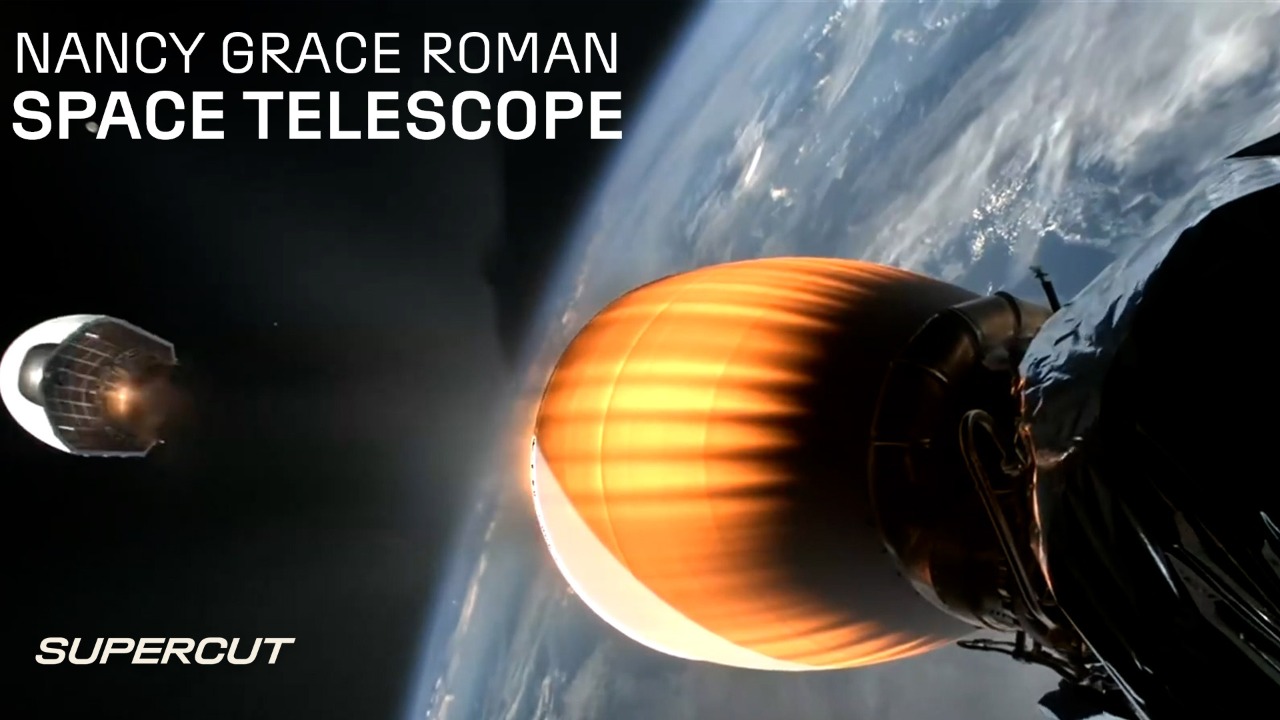
NASA launched the telescope at 7:26 a.m. ET on Sunday with the help of SpaceX’s Falcon Heavy rocket. The ground team started receiving telemetry from the rocket 7 minutes into the flight, and the telescope successfully separated from the Falcon rocket 31 minutes after launch. SpaceX’s rocket made a successful landing at NASA’s Landing Zone 2 following the separation. It was NASA’s fourth mission to use the Falcon Heavy rocket.
The Nancy Grace Roman telescope is now on a three-month journey to the Sun-Earth L2 Lagrange point, located about 1 million miles from Earth on the far side of the sun. The region is a gravitational sweet spot that allows spacecraft to maintain a relatively stable position while orbiting the sun alongside Earth.
During its mission, Roman is expected to observe more than 100 billion stars and billions of galaxies, detect tens of thousands of supernovae and transmit nearly 1.4 terabytes of scientific data to Earth every day. That’s more than any other individual spacecraft ever launched by NASA.
“We’ve never been able to view the universe with eyes like Roman’s before,” said Julie McEnery, Roman’s senior project scientist at NASA Goddard. “There’s no telling what more we’ll know and have seen by this time next year.”

The Roman Telescope can see as much of space in just two images as the Hubble does in over 400.
NASAThe telescope is named after astronomer Nancy Grace Roman, NASA’s first woman executive and an instrumental voice in the planning and construction of the Hubble Space Telescope.
The two telescopes share more than just a connection to Roman. Both use 2.4-meter mirrors and can produce images with similar sharpness. But Roman is designed to see much more of the sky at once, capturing images at least 100 times larger than Hubble’s. The observatories also specialize in different wavelengths of light: Hubble observes ultraviolet, visible and near-infrared light, while Roman focuses on visible and infrared wavelengths.
NASA envisions Roman and Hubble working hand in hand. Roman will scan enormous swaths of the sky, uncovering objects and phenomena that can later be examined in greater detail by Hubble. By combining Roman’s panoramic surveys with Hubble’s more focused observations, astronomers hope to build a richer picture of the cosmos.
“Roman will be a discovery machine that will bring us closer than ever before to answering humanity’s most profound questions about our cosmic history,” Nicky Fox, associate administrator for the Science Mission Directorate at NASA Headquarters in Washington, said in a statement. “With its large field of view and fast survey speeds, Roman will usher us into a new era of discovery and make the invisible visible, setting the foundation for humanity’s search for life beyond our solar system.”

With its wider field of view, the Roman telescope promises to see quite a lot of the universe.
NASANASA livestreamed the launch, which took off from Launch Complex 39A at the Kennedy Space Center in Florida. The event featured pre- and postlaunch coverage, with a media Q&A session at the end of the stream.
It was streamed on all of NASA’s social media accounts, including Facebook, Instagram, Twitch, YouTube and X. The agency also streamed it on NASA Plus, Amazon Prime and Discovery Plus. The launch and additional coverage are available in their entirety on NASA’s YouTube channel; you can watch it here at CNET as well.
此内容由惯性聚合(RSS阅读器)自动聚合整理,仅供阅读参考。 原文来自 — 版权归原作者所有。