



惯性聚合 高效追踪和阅读你感兴趣的博客、新闻、科技资讯
阅读原文 在惯性聚合中打开

推荐订阅源

Engineering at Meta
Engineering at Meta
D
Docker
IT之家
IT之家
博客园_首页
罗磊的独立博客
V
V2EX
OSCHINA 社区最新新闻
OSCHINA 社区最新新闻
美团技术团队
Y
Y Combinator Blog
博客园 - 聂微东
量子位
阮一峰的网络日志
阮一峰的网络日志
GbyAI
GbyAI
Microsoft Security Blog
博客园 - Franky
Martin Fowler
Martin Fowler
Jina AI
Jina AI
大猫的无限游戏
大猫的无限游戏
C
Check Point Blog
月光博客
月光博客
G
Google Developers Blog
B
Blog
T
The Blog of Author Tim Ferriss
爱范儿
爱范儿

Futurism

Man Creates Tiny Submarine for His Parakeet to Experience Life Underwater The Effects of AI-Generated Code Tearing Through Corporations Is Actually Kind of Funny Trump Hires Orbital Towing Company to Build Space Interceptors Psychologists Found Something Horrible About the Kind of Men Seeking Trad Wives To Get Swole, Teens Are Pumping Themselves Full of Drugs Meant for Fattening Cows for the Slaughterhouse Foolish Pollsters Are Now Just Asking AI What Voters Would Say in Response to Questions and Publishing It at Face Value OpenAI Says It’s Already Made $100 Million by Stuffing ChatGPT With Ads Man Punished for Breaking Into Moo Deng’s Zoo Enclosure AI Is Causing Healthcare Costs to Surge There’s a Mass Rebellion Against AI in the Workplace People Who Lose Their Job to AI Are in for a World of Pain, Goldman Sachs Report Finds OpenAI Says Not to Worry About UBI, Because It Has Another Idea Police Officer Helplessly Waves Arms at Waymo That Careened Wrong Way Through Whataburger Drive-Thru Someone Just Threw a Molotov Cocktail At Sam Altman’s House New York Times Makes Substantial Changes to Article That Glazed a Sleazy AI Startup: “Our Piece Should Have Included That Information” Space Scientists Wince as Astronauts’ Lives Depend on Artemis 2’s Controversial Heat Shield During Plunge Back to Earth The Moon Astronauts Have Been Working Out With a NASA Rowing Machine in Space First AI Model From Zuckerberg’s Wildly Expensive Superintelligence Lab Flops Compared to Virtually All Rivals Economists Starting to Admit They May Have Been Wrong About AI Never Replacing Human Jobs AI-Powered Drug Marketer Medvi Responds After Allegations About Fake Doctors and Patients As Astronauts Visit the Moon, NASA Insider Says Agency Is in Shambles Behind the Scenes Man Lights 1.2 Million Square Foot Warehouse on Fire for Not Paying Him Enough NASA Scientists Screamed With Delight When They Saw Something Smashing Into the Moon Google Says Showing Polymarket Bets on Google News Was a Mistake Las Vegas Sphere Turns Into Huge Moon to Celebrate NASA Mission The New York Times Says It’s Identified the Creator of Bitcoin We Talked to a Writer Accused of Publishing An AI-Generated Essay in The New York Times Naked Man Bursts Into Tesla Service Center With a Shotgun Student Dies When Hospital Has No ICU Doctors, Calls One on Videochat Who Pronounces Him Dead Remotely, Lawsuit Claims Analysis Finds That Google’s AI Overviews Are Providing Misinformation at a Scale Possibly Unprecedented in the History of Human Civilization
Astronomers Say Star Self-Destructed So Catastrophically ...
Frank Landymore · 2026-06-07 · via Futurism

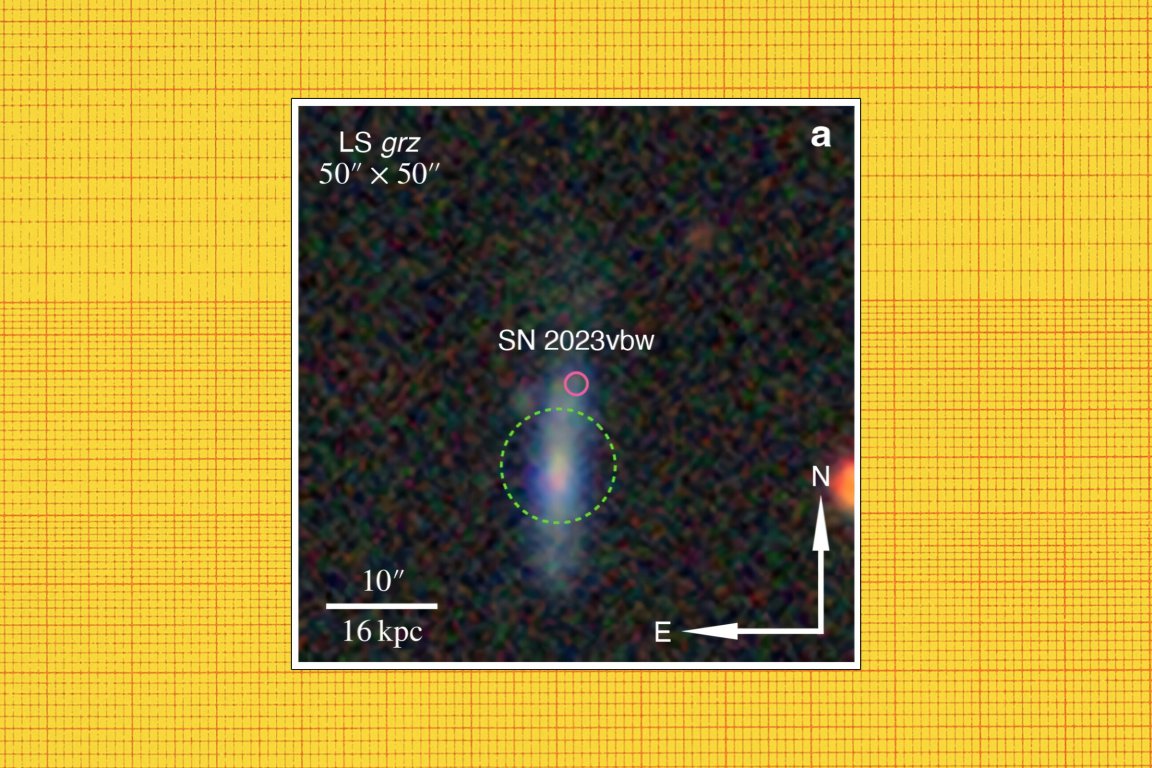
A photograph featuring the location of SN 2023vbw in the outskirts of its dwarf host galaxy. 

Illustration by Tag Hartman-Simkins / Futurism. Source: Hiramatsu et al. via arXiv

Sign up to see the future, today

Can’t-miss innovations from the bleeding edge of science and tech

When a star explodes, it typically leaves behind some sort of remnant: an exposed, ultra-dense core, for example, or even a black hole.

But one massive star, hundreds of times heavier than our Sun, self-destructed so catastrophically that it left behind no remnant whatsoever, astronomers report in a new study awaiting peer review and highlighted by Phys.org

First detected in 2023 in a dwarf galaxy some 1.3 billion light years away, the blast is now believed to be an elusive class of explosion called a pair-instability supernova. Over the course of 190 days, the object, dubbed SN 2023vbw, steadily peaked in brightness, after which it rapidly tapered off. This stands apart from the light curve astronomers see with a more typical Type II supernova, which appears as light quickly spiking and plateauing.

To produce such a blast, the now-vanished star would’ve had to be enormous. The astronomers believe it was a class known as a blue supergiant, which are some of the brightest and hottest stars in the cosmos. Based on the amount of material it ejected upon exploding, the astronomers estimated that the deceased titan was at least 170 — and perhaps as much as 350 times — more massive than the Sun.

These stars’ deaths are suitably epic. In a typical Type II supernova, a star that’s at least eight but up to fifty solar masses runs out of fuel at its core, becomes unable to sustain the nuclear reactions that exert outward pressure, and near-instantly collapse under their own gravity. A huge burst of energy follows, and what’s behind will be a dense object like a white dwarf or a black hole.

But in stars that are as incredibly massive as blue supergiants, their cores burn so hot that they start blasting out gamma rays. While these gamma rays provide outward pressure, if they’re too energetic, they’ll start turning into electrons and positrons upon colliding with the star’s outer layer, and stop providing pressure.

If the star is also low in certain heavy metals, this leads to a partial collapse that snowballs in a sustained series of thermonuclear explosions that rip the star apart so viciously that no remnant survives. As such, some astronomers believe that pair-instability supernovas could cause a theoretical “upper mass gap” in black holes masses, since the stars massive enough to form them are completely obliterated when dying, though this view is being challenged

All told, if their findings are borne out, the astronomers have serendipitously stumbled on a clear look at one of the rarest stellar deaths in the universe.

More on astrophysics: Scientists Spot What Appears to Be a Ring-Shaped “Planet Factory” Deep Out in Space