



惯性聚合 高效追踪和阅读你感兴趣的博客、新闻、科技资讯
阅读原文 在惯性聚合中打开

推荐订阅源

博客园 - 叶小钗
Last Week in AI
Last Week in AI
OSCHINA 社区最新新闻
OSCHINA 社区最新新闻
V
V2EX
J
Java Code Geeks
The GitHub Blog
The GitHub Blog
博客园_首页
U
Unit 42
人人都是产品经理
人人都是产品经理
Engineering at Meta
Engineering at Meta
IT之家
IT之家
G
Google Developers Blog
L
LangChain Blog
钛媒体:引领未来商业与生活新知
钛媒体:引领未来商业与生活新知
爱范儿
爱范儿
罗磊的独立博客
博客园 - 三生石上(FineUI控件)
Martin Fowler
Martin Fowler
Jina AI
Jina AI
有赞技术团队
有赞技术团队
Apple Machine Learning Research
Vercel News
Vercel News
小众软件
小众软件
H
Help Net Security

Futurism

Man Creates Tiny Submarine for His Parakeet to Experience Life Underwater The Effects of AI-Generated Code Tearing Through Corporations Is Actually Kind of Funny Trump Hires Orbital Towing Company to Build Space Interceptors Psychologists Found Something Horrible About the Kind of Men Seeking Trad Wives To Get Swole, Teens Are Pumping Themselves Full of Drugs Meant for Fattening Cows for the Slaughterhouse Foolish Pollsters Are Now Just Asking AI What Voters Would Say in Response to Questions and Publishing It at Face Value OpenAI Says It’s Already Made $100 Million by Stuffing ChatGPT With Ads Man Punished for Breaking Into Moo Deng’s Zoo Enclosure AI Is Causing Healthcare Costs to Surge There’s a Mass Rebellion Against AI in the Workplace People Who Lose Their Job to AI Are in for a World of Pain, Goldman Sachs Report Finds OpenAI Says Not to Worry About UBI, Because It Has Another Idea Police Officer Helplessly Waves Arms at Waymo That Careened Wrong Way Through Whataburger Drive-Thru Someone Just Threw a Molotov Cocktail At Sam Altman’s House New York Times Makes Substantial Changes to Article That Glazed a Sleazy AI Startup: “Our Piece Should Have Included That Information” Space Scientists Wince as Astronauts’ Lives Depend on Artemis 2’s Controversial Heat Shield During Plunge Back to Earth The Moon Astronauts Have Been Working Out With a NASA Rowing Machine in Space First AI Model From Zuckerberg’s Wildly Expensive Superintelligence Lab Flops Compared to Virtually All Rivals Economists Starting to Admit They May Have Been Wrong About AI Never Replacing Human Jobs AI-Powered Drug Marketer Medvi Responds After Allegations About Fake Doctors and Patients As Astronauts Visit the Moon, NASA Insider Says Agency Is in Shambles Behind the Scenes Man Lights 1.2 Million Square Foot Warehouse on Fire for Not Paying Him Enough NASA Scientists Screamed With Delight When They Saw Something Smashing Into the Moon Google Says Showing Polymarket Bets on Google News Was a Mistake Las Vegas Sphere Turns Into Huge Moon to Celebrate NASA Mission The New York Times Says It’s Identified the Creator of Bitcoin We Talked to a Writer Accused of Publishing An AI-Generated Essay in The New York Times Naked Man Bursts Into Tesla Service Center With a Shotgun Student Dies When Hospital Has No ICU Doctors, Calls One on Videochat Who Pronounces Him Dead Remotely, Lawsuit Claims Analysis Finds That Google’s AI Overviews Are Providing Misinformation at a Scale Possibly Unprecedented in the History of Human Civilization
Scientists Say They’ve Figured Out What That Golden Orb F...
Frank Landym · 2026-04-24 · via Futurism

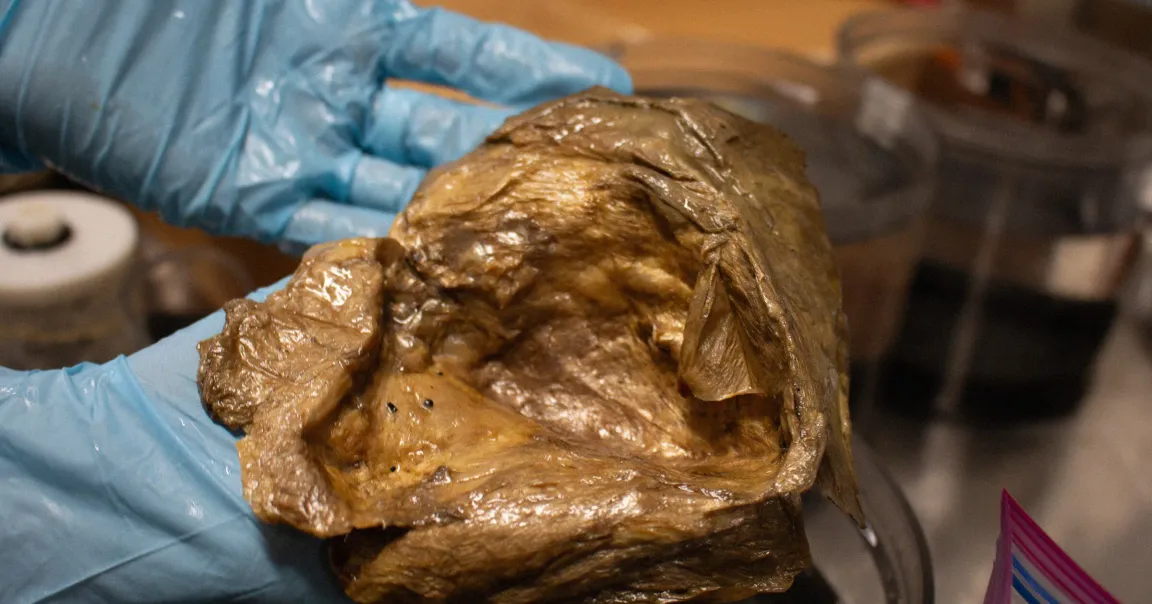
A gloved hand holding a mysterious object recovered from underwater that they described as a "golden orb." The background is blurred, showing some laboratory equipment.

NOAA Fisheries

Sign up to see the future, today

Can’t-miss innovations from the bleeding edge of science and tech

After spending two and half years pondering a “golden orb” found at the bottom of the ocean, scientists have finally figured out what in the thundering typhoons it actually is.

The aureate object looked like some sort of alien relic when it was first discovered clinging to a rock over two miles underwater in the Gulf of Alaska, before collapsing into a blob resembling molten leafs of gold when it was recovered.

Now, scientists at the National Oceanic and Atmospheric Administration and the Smithsonian Institution reveal that the baffling object is a remnant of what was once a giant anemone — though it took considerable detective work to reach that conclusion.

“This turned into a special case that required focused efforts and expertise of several different individuals,” said Allen Collins, a zoologist and director of NOAA Fisheries’ National Systematics Laboratory, in a statement. “This was a complex mystery that required morphological, genetic, deep-sea and bioinformatics expertise to solve.”

While the orb attracted a great deal of public interest, scientists regularly encounter strange organisms they can’t immediately explain when exploring the deep ocean.

“We see weird stuff every dive,” NOAA physical scientist Sam Candio said in an interview with Futurism after the discovery. The orb “wasn’t even the most interesting thing that jumped out at us at that time.”  

But the golden object proved to be more of an enigma than expected. It was discovered during an expedition on the NOAA Ship Okeanos Explorer, and at the time, the expedition team could only conclude it was biological in nature. Its smooth surface was marked with a noticeable hole, which was interpreted as a clue that something either crawled into or out of it. Early theories suggested it was some sort of dead sponge or egg case.

To get to the bottom of the mystery, NOAA and Smithsonian scientists physically examined the orb-turned-lump and analyzed its genetic makeup. Starting with the physical examination, they found that though its anatomy was unusual for an animal, it contained fibrous cells called spirocysts which are a hallmark of aquatic invertebrates called cnidarians. This finding was repeated in a similar specimen discovered in an earlier expedition.

Whole genome sequencing then sealed the deal. It confirmed that the specimen shared genetic material with a giant deep sea anemone, and sequencing its mitochondrial genomes narrowed the species down. It was almost an exact match for Relicanthus daphneae, a cnidarian that was only described as an anemone in 2006 despite being discovered thirty years earlier. The species may be identified, but it still remains a source of fascination.

“So often in deep ocean exploration, we find these captivating mysteries, like the ‘golden orb,'” said William Mowitt, acting director of NOAA Ocean Exploration, in the statement. “With advanced techniques like DNA sequencing, we are able to solve more and more of them.”

More on the ocean: Man Creates Tiny Submarine for His Parakeet to Experience Life Underwater