

惯性聚合 高效追踪和阅读你感兴趣的博客、新闻、科技资讯
阅读原文 在惯性聚合中打开

推荐订阅源

大猫的无限游戏
大猫的无限游戏
D
DataBreaches.Net
M
MIT News - Artificial intelligence
量子位
N
Netflix TechBlog - Medium
The Cloudflare Blog
The GitHub Blog
The GitHub Blog
P
Proofpoint News Feed
人人都是产品经理
人人都是产品经理
B
Blog RSS Feed
B
Blog
博客园_首页
博客园 - Franky
MyScale Blog
MyScale Blog
有赞技术团队
有赞技术团队
Apple Machine Learning Research
MongoDB | Blog
MongoDB | Blog
云风的 BLOG
云风的 BLOG
爱范儿
爱范儿
H
Help Net Security
Y
Y Combinator Blog
Stack Overflow Blog
Stack Overflow Blog
钛媒体:引领未来商业与生活新知
钛媒体:引领未来商业与生活新知
酷 壳 – CoolShell
酷 壳 – CoolShell

MDN Blog

Introducing the MDN MCP server | MDN Blog Under the hood of MDN's new frontend | MDN Blog Image formats: Codecs and compression tools | MDN Blog A beginner-friendly guide to view transitions in CSS | MDN Blog Image formats: Pixel data from encoders to decoders | MDN Blog Celebrating 20 years of MDN | MDN Blog Image formats: Color models for humans and devices | MDN Blog Default styles for h1 elements are changing | MDN Blog Implications of Global Privacy Control | MDN Blog JavaScript Temporal is coming | MDN Blog Fix your website's Largest Contentful Paint by optimizing image loading | MDN Blog MDN 2024 content projects | MDN Blog A new learning experience on MDN | MDN Blog Countdown to the holidays with daily coding challenges | MDN Blog Monitoring and optimizing website performance | MDN Blog How to land your first developer job | MDN Blog Introducing the new MDN Community page | MDN Blog Fixing your website's JavaScript performance | MDN Blog Get back to school! Supercharge your learning with MDN and Scrimba | MDN Blog Efficient data handling with the Streams API | MDN Blog Locale-sensitive text segmentation in JavaScript with Intl.Segmenter | MDN Blog Optimize your workflow with Git stash | MDN Blog How to debug mobile apps across devices | MDN Blog Exclusive accordions using the HTML details element | MDN Blog Exploring the Broadcast Channel API for cross-tab communication | MDN Blog MDN partners with Scrimba to enhance web development learning | MDN Blog Introducing the MDN HTTP Observatory | MDN Blog Static Site Generation (SSG) with Next.js | MDN Blog New JavaScript Set methods | MDN Blog Securing APIs: Express rate limit and slow down | MDN Blog
Launching MDN's new front end | MDN Blog
The MDN Team August 19, 2025 2 minutes read · 2025-08-19 · via MDN Blog

In a big step forward for our platform architecture, we're rolling out a completely rebuilt front end for MDN — redesigned and reengineered from the ground up. After months of work, the Mozilla MDN team is proud to release this major update today. Whether you're checking out the latest Web APIs or brushing up on HTML basics, you'll notice the cleaner interface and improved experience right away.

We've intentionally targeted Baseline "Widely available" features when deciding on which ones to use, and polyfilling or progressively enhancing when using anything Baseline "Newly available". This means we're able to adopt modern CSS and web components for our UI. We'll dive into all of the implementation details in an upcoming article.

UI improvements

Along with this architectural overhaul, we've made a few updates to the site to improve usability and readability, focusing on refinement and consistency rather than big, drastic changes.

We have:

  • Improved typography for readability.
  • Added a code font for consistent and high-quality code rendering across different platforms.
  • Refreshed icons using the Lucide library.
  • Added a new search modal that lets you quickly find content from anywhere on MDN.
  • Redesigned the top navigation to help you discover all the content MDN has to offer more readily.
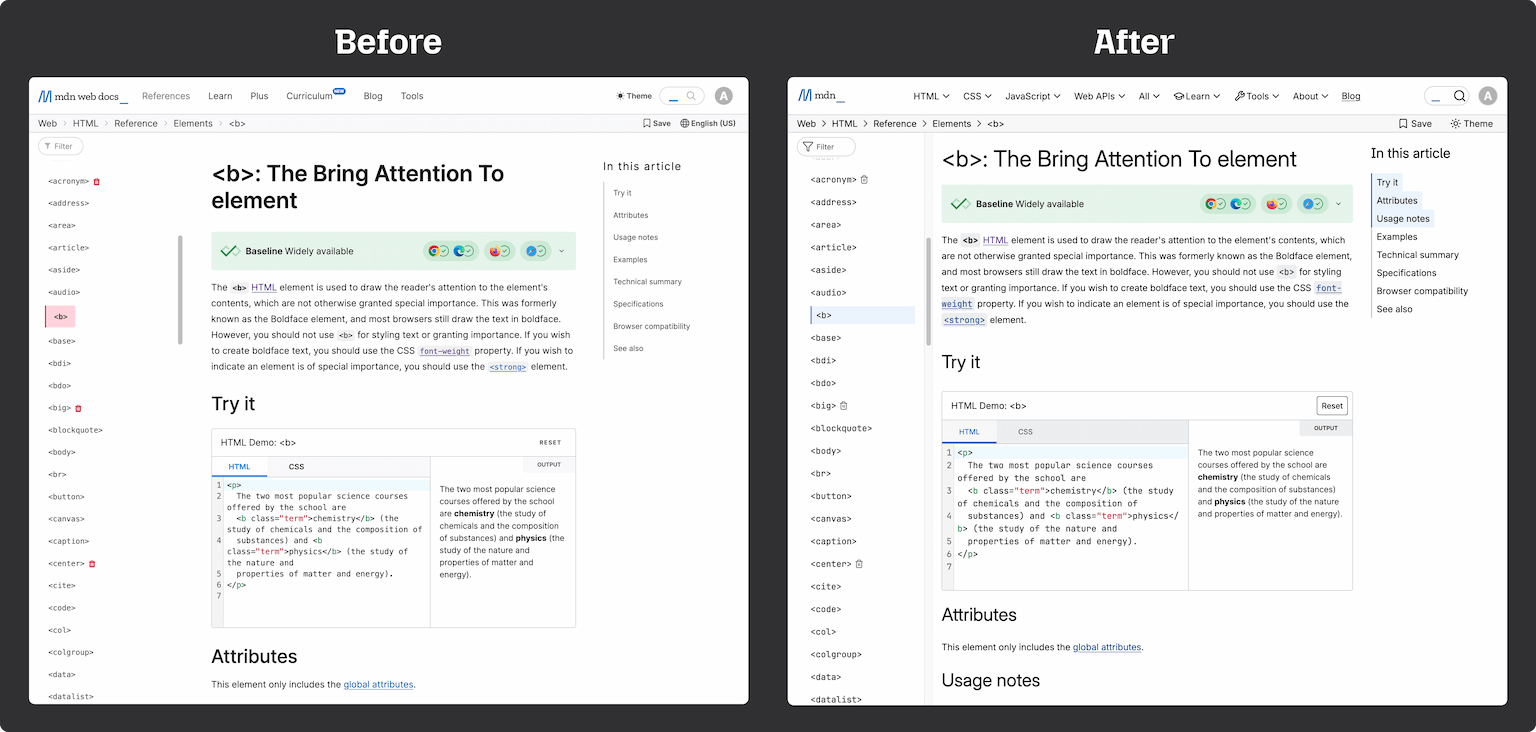
Comparison showing an MDN's reference page before and after.

What's next

We're committed to keeping MDN evolving and improving. The MDN team welcomes your feedback as we continue to iterate. Feel free to come chat with us in the #platform channel on our Discord. If you spot any issues, please raise them in fred GitHub repository. Let us know what's working for you and where we can do better — after all, MDN is built by developers, for developers.