







Hybrid cloud observability generates signals but not understanding. This article explores how semantic, context-aware AI transforms telemetry into intelligent, risk-aware infrastructure operations.

Transforming telemetry-driven AIOps into context-aware intelligence for hybrid cloud. Enterprises operating in hybrid cloud environments generate massive volumes of infrastructure signals across distributed systems. Learn how modern hybrid architectures are evolving with hybrid cloud solutions from HPE.
Executive summary
Enterprises operating in hybrid cloud environments generate massive volumes of infrastructure signal metrics, logs, traces, and alerts. Yet, despite advanced monitoring and AIOps investments, operational teams continue to struggle with noisy alerts and delayed root cause analysis. Learn how AI-driven infrastructure solutions from HPE support intelligent operations. The core challenge is not the lack of data.
It is the lack of semantic understanding.
Traditional AI models interpret infrastructure signals syntactically (numbers, anomalies, and patterns) but fail to understand the real-world meaning behind those signal dependencies, workload intent, hardware constraints, and business criticality. This blog explores how organizations can evolve from signal-driven automation to semantic, context-aware intelligence that aligns with enterprise hybrid cloud operations.
Modern IT operations management platforms are evolving to combine observability, automation, and AI-driven insights across hybrid environments. Learn more about IT Operations Management from HPE.
The modern hybrid cloud reality: Data-rich, context-poor
Hybrid cloud infrastructures span:
Monitoring systems such as Prometheus, Grafana Labs, and enterprise observability stacks continuously collect telemetry signals. However, these signals lack semantic meaning unless correlated with infrastructure context.
Example of raw signals
Without semantics, AI interprets this as high resource utilization.
With semantics, it may reveal:
Critical payment service impacted due to storage bottleneck on on-prem node.
Signals vs. semantics: What’s the difference?
|
Dimension |
Signals (traditional AIOps) |
Semantics (context-aware AI) |
|
Data type |
Metrics, logs, alerts |
Enriched operational context |
|
Understanding |
Pattern detection |
Infrastructure meaning |
|
Automation |
Reactive |
Intelligent and risk aware |
|
Decision quality |
Often noisy |
Operationally aligned |
|
Hybrid cloud readiness |
Limited |
High |
Why signal-only AI fails in infrastructure operations
1. Lack of topology awareness
Signal-based AI does not understand:
Real enterprise scenario
A retail enterprise running hybrid cloud workloads observed frequent latency spikes.
Their AI system recommended auto-scaling public cloud nodes based on CPU metrics.
Actual root cause:
Impact:
SLA degradation during peak sale window
2. Alert noise without operational meaning
Telemetry platforms generate thousands of alerts daily.
Without semantic correlation, AI treats each alert independently rather than understanding cascading failures.
This leads to:
The core concept: From telemetry intelligence to semantic intelligence
Traditional flow (signal centric)
Metrics + logs + alerts
↓
AI pattern models
↓
Generic recommendations
Semantic-aware hybrid cloud intelligence
Telemetry signals
+ Infrastructure topology
+ Workload criticality
+ Hardware telemetry
+ Policy and governance context
↓
Semantic intelligence layer
↓
Context-aware AI decisions and automation
Architecture diagram: Semantic intelligence in hybrid cloud
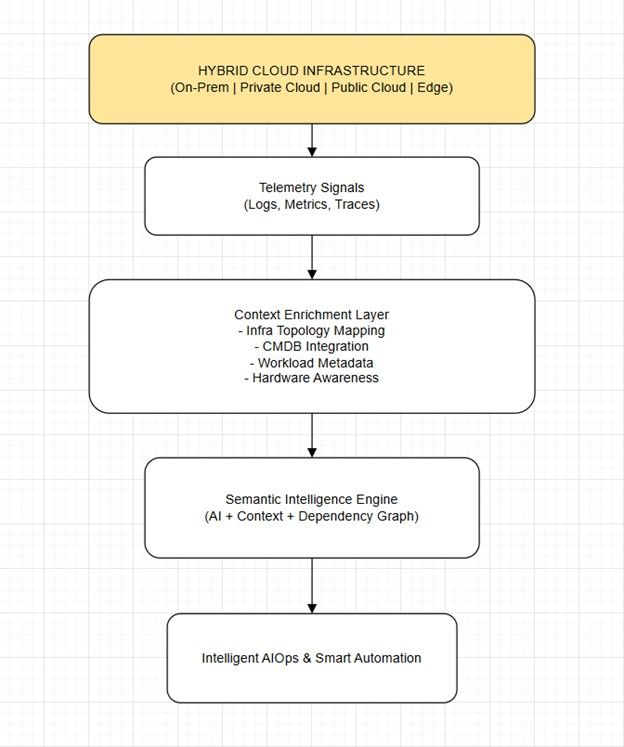
Figure 1. Architecture of semantic intelligence enabling context-aware AIOps in hybrid cloud environments.
Key building blocks to achieve semantic understanding
Raw telemetry must be enriched with:
This enables AI to understand what the signal represents rather than just detecting anomalies.
Infrastructure components in hybrid cloud are deeply interconnected.
Using dependency graphs, AI can map:
Frameworks like Ray and knowledge graph pipelines help operationalize semantic relationships at scale.
Hybrid environments include heterogeneous hardware stacks.
Semantic AI must ingest:
Tools such as OpenVINO and inference engines such as NVIDIA Triton Inference Server can enable efficient, hardware-aware inference for infrastructure analytics.
Faster root cause analysis
Semantic correlation reduces investigation time by mapping signals to real infrastructure events.
Smarter automation
Automation decisions become:
Improved hybrid cloud governance
Semantic AI can incorporate:
Tooling ecosystem to enable signal-to-semantic transformation
Enterprises can operationalize semantic intelligence using:
This stack aligns well with hybrid cloud operational models where data remains distributed but intelligence is centralized.
Strategic alignment with hybrid cloud application engineering
For application engineering practices, semantic infrastructure intelligence enables:
Instead of reacting to signals, teams can design systems that understand infrastructure behavior holistically.
Future outlook: Toward infrastructure-native AI
The next evolution of enterprise AIOps is not more data collection but deeper semantic interpretation. AI systems will increasingly:
Conclusion
In hybrid cloud environments, signals alone are insufficient to drive reliable automation. Enterprises must transition from telemetry-driven AI to semantic, context-aware intelligence that understands infrastructure reality.
By embedding topology awareness, hardware context, and workload semantics into AI models, organizations can significantly enhance operational resilience, reduce alert noise, and enable intelligent automation aligned with real-enterprise infrastructure needs.
The shift from signals to semantics is not merely a technical upgrade, it is a strategic imperative for scalable, intelligent, and future-ready hybrid cloud operations.
CTA: Learn how hybrid cloud platforms enable intelligent, context-aware infrastructure operations across distributed environments.
By Authors:
Sourabh Patil - Linkedin account: www.linkedin.com/in/sourabh-patil-5058a3157
Rutik Kalokhe
Aarohi Bhartiya
Rajvardhan Shinde
此内容由惯性聚合(RSS阅读器)自动聚合整理,仅供阅读参考。 原文来自 — 版权归原作者所有。