






- DESCRIPTION
- TABLE OF CONTENTS
- METHODOLOGY
- DOWNLOAD PDF
Feed Vitamins Market by Type (Fat-soluble, Water-soluble), Livestock (Poultry, Ruminants, Swine, Aquaculture), Source, Form, Function, and by Region - Global Forecast to 2030

USD 2.45 BN
MARKET SIZE, 2030

CAGR 5.7%
(2025-2030)

120
REPORT PAGES

200
MARKET TABLES
OVERVIEW
Source: Secondary Research, Interviews with Experts, MarketsandMarkets Analysis
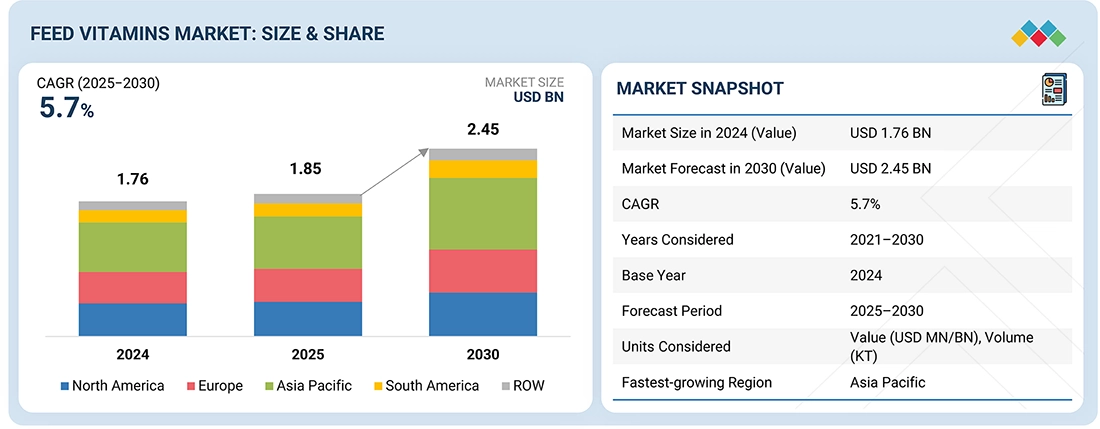
The global feed vitamins market is expected to grow from USD 1.85 billion in 2025 to USD 2.45 billion by 2030, at a CAGR of 5.7%, driven by a rising emphasis on balanced, science-based animal nutrition. Market expansion is supported by growing demand for vitamins that enhance animal health, immunity, growth performance, and reproductive efficiency across poultry, swine, ruminants, and aquaculture.
KEY TAKEAWAYS
-
BY REGION
The Asia Pacific feed vitamins market is estimated to account for a 36.% share in 2025.
-
BY VITAMIN TYPE
The water-soluble vitamins segment is projected to grow at the highest rate from 2025 to 2030.
-
BY LIVESTOCK
The poultry segment is expected to dominate the market with a share of 45.0% in 2025.
-
BY FORM
The dry segment is expected to hold a significant market share of 76.5% in 2025.
-
COMPETITIVE LANDSCAPE - KEY PLAYERS
Cargill, ADM, International Flavors & Fragrances, Evonik Industries AG, and BASF SE were identified as some of the star players in the feed vitamins market, given their strong market share and product footprint.
-
COMPETITIVE LANDSCAPE - STARTUPS
VITALAC, Tex Biosciences, and Centafarm SRL, among others, have distinguished themselves among startups and SMEs by securing strong footholds in specialized niche areas, underscoring their potential as emerging market leaders.
The global feed vitamins market is witnessing steady growth due to the increasing focus on improving animal health, immunity, productivity, and feed conversion efficiency. Rising awareness of vitamin deficiencies, along with the expansion of intensive livestock farming and aquaculture, is driving the adoption of vitamin supplements across animal diets.
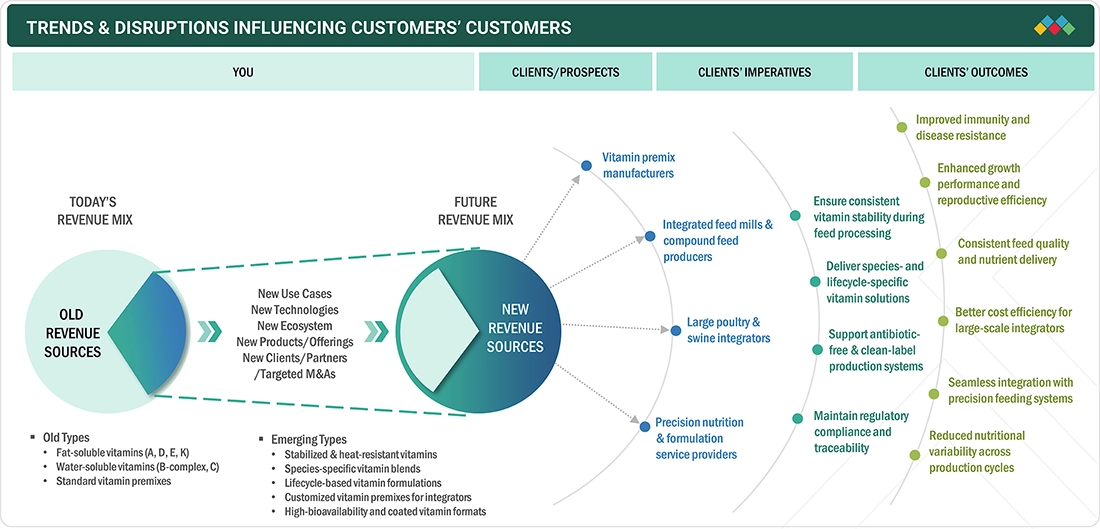
TRENDS & DISRUPTIONS IMPACTING CUSTOMERS' CUSTOMERS
Shifts in customer trends and industry disruptions directly influence the business performance of end users in the feed vitamins market. New feed additive types, evolving livestock sectors, and changing end-use patterns are reshaping demand dynamics. As these trends accelerate or shift, they affect end users' revenue streams, which in turn influence overall market performance and growth opportunities for feed additive manufacturers worldwide.
Source: Secondary Research, Interviews with Experts, MarketsandMarkets Analysis
MARKET DYNAMICS

Drivers
Impact
Level
-
High commercialization & large industrial livestock operations

-
Shift to antibiotic-free / clean label solutions


RESTRAINTS
Impact
Level
-
Volatility in commodity (corn/soy) prices

-
Conservative adoption by smaller family farms


OPPORTUNITIES
Impact
Level
-
Growth in value-added vitamin formulations

-
On-farm precision dosing and premix services


CHALLENGES
Impact
Level
-
Price competition from basic vitamin premixes

-
Regulatory compliance and formulation stability

Source: Secondary Research, Interviews with Experts, MarketsandMarkets Analysis
As commercial and intensive livestock production expands rapidly worldwide, demand for vitamin feed additives is rising. Large-scale producers rely on scientifically balanced vitamin formulations to support animal growth, immunity, reproductive performance, and feed efficiency in high-density farming systems.
Fluctuations in the prices of essential raw materials for feed substantially elevate overall feed costs, thereby restricting producers' capacity to invest in high-quality vitamin feed additives. This financial pressure may hinder adoption, especially in markets characterized by price sensitivity.
There is growing demand for value-added vitamin feed additives, including stabilized, coated, and bioavailable vitamin blends that enhance nutrient retention, improve animal performance, and reduce deficiencies across livestock species.
Low-cost, standardized vitamin premixes continue to exert pricing pressure on advanced and specialty vitamin formulations, making differentiation and value justification challenging, especially in cost-sensitive markets.
FEED VITAMINS MARKET: COMMERCIAL USE CASES ACROSS INDUSTRIES
| COMPANY | USE CASE DESCRIPTION | BENEFITS |
|---|---|---|
|
|
Cargill expanded its vitamin feed portfolio by strengthening its offerings in fat- and water-soluble vitamins, including vitamins A, D, E, B-complex, and customized vitamin premixes. These solutions are integrated into compound feeds and premix formulations to support animal growth, immunity, reproductive performance, and feed efficiency across poultry, swine, ruminant, and aquaculture systems. | Reinforces Cargill’s leadership in science-based vitamin nutrition by enabling producers to maintain consistent animal performance, reduce deficiency risks, and improve overall productivity through reliable, high-quality vitamin formulations |
|
|
ADM introduced advanced vitamin premixes and customized nutritional solutions designed to enhance nutrient absorption, metabolic efficiency, and stress resilience in livestock. These vitamin feed additives support precision feeding programs and address the growing demand for consistent nutritional intake in intensive livestock production. | Strengthens ADM’s competitive position by offering high-performance vitamin solutions that improve animal health, production efficiency, and sustainability outcomes in large-scale and commercial livestock operations |
|
|
IFF expanded its biosciences and nutrition portfolio with stabilized and bioavailable vitamin formulations and functional vitamin blends aimed at improving immune response, gut health support, and feed utilization efficiency in livestock and aquaculture. | Enhances IFF’s footprint in the global feed vitamins market by delivering innovative, targeted vitamin solutions that support animal wellness and operational efficiency for feed manufacturers and producers |

Logos and trademarks shown above are the property of their respective owners. Their use here is for informational and illustrative purposes only.
MARKET ECOSYSTEM
The global vitamin feed ecosystem comprises vitamin manufacturers, premix producers, regulatory authorities, research institutions, and end-use livestock and feed companies. It is a steadily expanding, nutrition-driven landscape shaped by rising demand for balanced diets, optimized animal health, and consistent production performance. The market brings together established multinational players and agile regional suppliers, all contributing to the development of advanced vitamin formulations that enhance immunity, growth, reproductive efficiency, and feed utilization across global livestock and aquaculture systems.
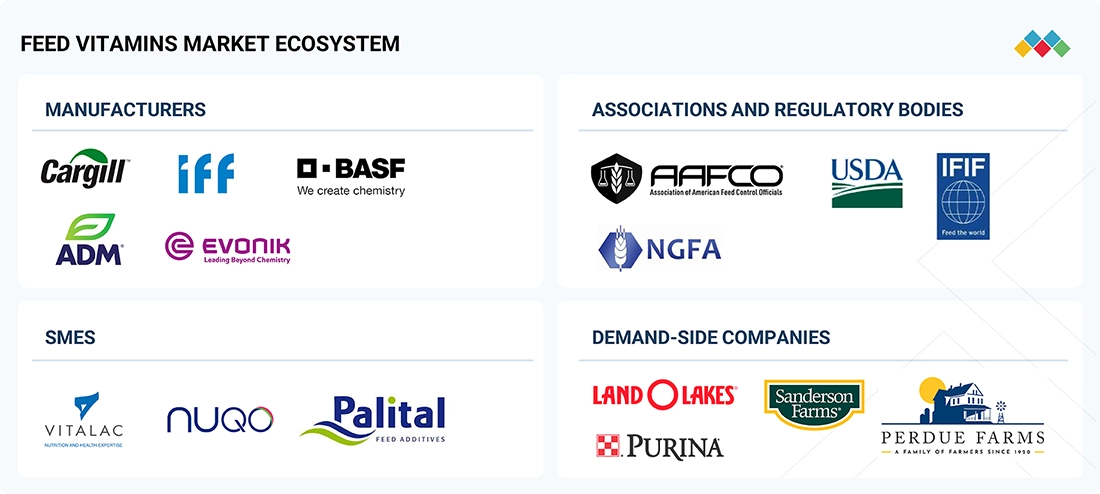
Logos and trademarks shown above are the property of their respective owners. Their use here is for informational and illustrative purposes only.
MARKET SEGMENTS
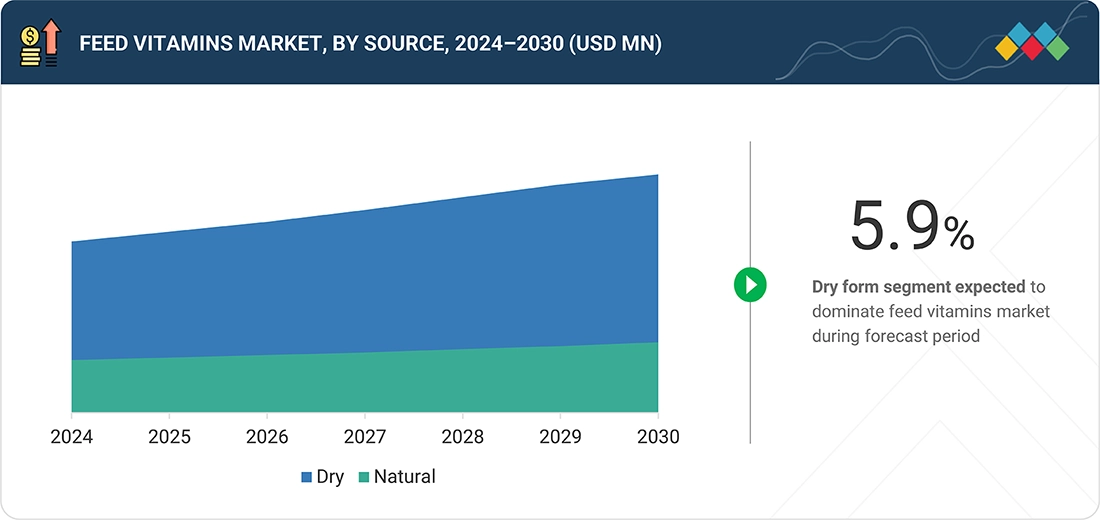
Source: Secondary Research, Interviews with Experts, MarketsandMarkets Analysis
The water-soluble vitamins segment is projected to be the fastest-growing, driven by the rising demand for improved metabolic efficiency, immunity support, and consistent nutrient intake in intensive livestock production.
The poultry segment is expected to dominate the market, as producers increasingly rely on vitamin supplementation to enhance feed efficiency, disease resistance, and overall flock performance.
The dry segment is expected to hold a significant market share, owing to its ease of handling, longer shelf life, and widespread use in commercial feed and premix manufacturing.
REGION
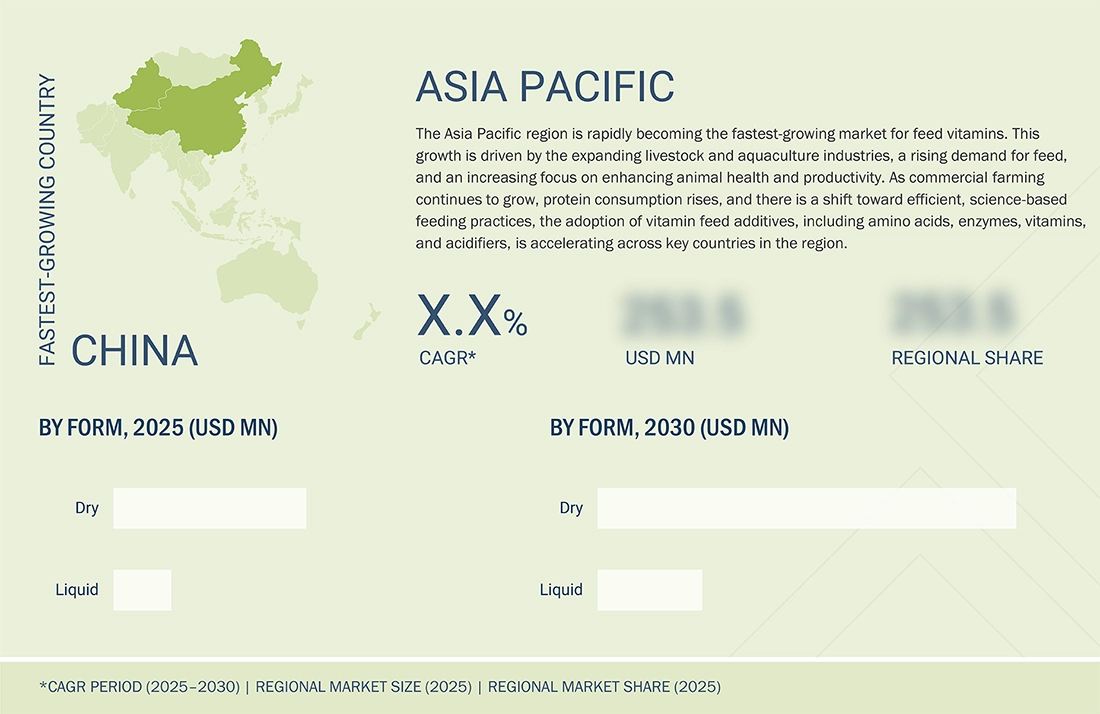
Asia Pacific is expected to dominate the feed vitamins market
Asia Pacific is set to dominate the feed vitamins market, driven by the rapid expansion of commercial livestock and aquaculture production and rising demand for nutritionally balanced animal diets. The region’s growing adoption of vitamin-enriched feed formulations to improve animal health, productivity, and feed efficiency further reinforces its market leadership.
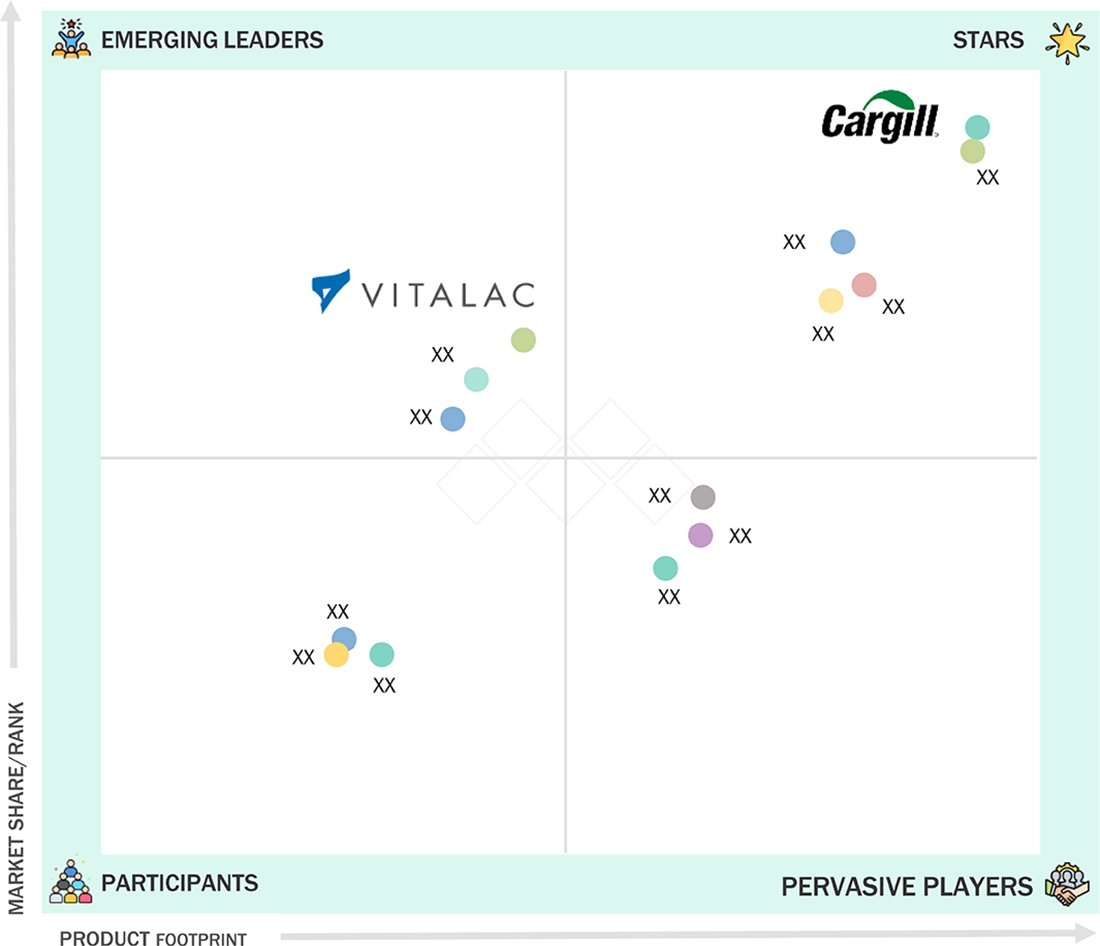
FEED VITAMINS MARKET: COMPANY EVALUATION MATRIX
In the feed vitamins market, leading players such as Cargill and ADM (Star) maintain a strong position, supported by large-scale production capabilities, comprehensive vitamin premix portfolios, and well-established global distribution networks. Their integration with commercial feed and premix operations and their emphasis on consistent, science-backed micronutrition reinforce their dominance. Meanwhile, VITALAC (Emerging Leader) is strengthening its presence through specialized vitamin and mineral premixes and customized nutritional solutions that address species-specific requirements and evolving animal health and performance needs.
Source: Secondary Research, Interviews with Experts, MarketsandMarkets Analysis
MARKET SCOPE
| REPORT METRIC | DETAILS |
|---|---|
| Market Size in 2024 (Value) | USD 1.76 Billion |
| Market Forecast in 2030 (Value) | USD 2.45 Billion |
| Growth Rate | CAGR of 5.7% from 2025 to 2030 |
| Years Considered | 2021–2030 |
| Base Year | 2024 |
| Forecast Period | 2025–2030 |
| Units Considered | Value (USD Billion), Volume (KT) |
| Report Coverage | Revenue Forecast, Company Ranking, Competitive Landscape, Growth Factors, and Trends |
| Segments Covered |
|
| Regions Covered | North America, Europe, Asia Pacific, South America, and RoW |
WHAT IS IN IT FOR YOU: FEED VITAMINS MARKET REPORT CONTENT GUIDE
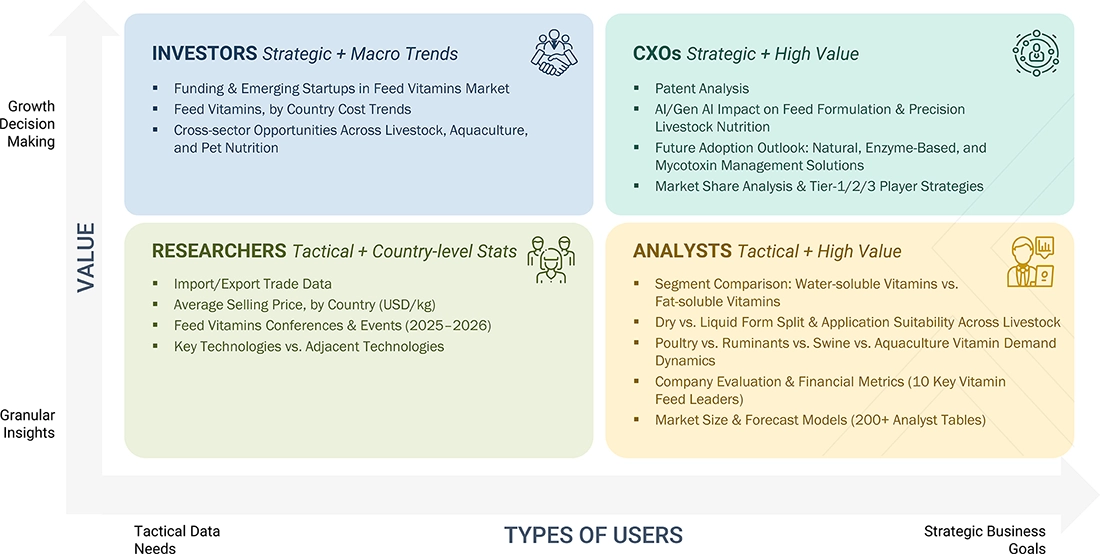
DELIVERED CUSTOMIZATIONS
We have successfully delivered the following deep-dive customizations:
| CLIENT REQUEST | CUSTOMIZATION DELIVERED | VALUE ADDS |
|---|---|---|
| US-based Feed Vitamin Manufacturers |
|
|
| Feed Vitamins – Type & Application Segment Assessment |
|
|
RECENT DEVELOPMENTS
- June 2024: dsm-firmenich (Netherlands) expanded its animal nutrition vitamin portfolio by enhancing stabilized and bioavailable formulations of vitamins A, D, and E for poultry and ruminants. The development focuses on improving vitamin retention during feed processing and storage, supporting immunity, bone development, and productivity in intensive livestock systems. This aligns with the company's strategy to deliver science-backed, sustainable micronutrition solutions.
- June 2024: BASF SE (Germany) strengthened its vitamin feed additives offering by improving formulation stability and supply reliability for fat-soluble vitamins used in commercial feed and premix applications. The initiative supports consistent vitamin delivery, reduces nutrient losses, and improves feed efficiency across poultry, swine, and ruminant nutrition programs.
- April 2024: ADM (US) enhanced its vitamin premix and micronutrition solutions for livestock by expanding its customized vitamin blends tailored to species-specific and lifecycle nutrition requirements. These solutions are designed to support precision feeding programs, improve metabolic efficiency, and meet growing demand for antibiotic-free, performance-driven animal nutrition.
Table of Contents
 Exclusive indicates content/data unique to MarketsandMarkets and not available with any competitors.
TITLE
PAGE NO
1
INTRODUCTION
15
2
EXECUTIVE SUMMARY
3
PREMIUM INSIGHTS
4
MARKET OVERVIEW
4.1
INTRODUCTION
4.2
MARKET DYNAMICS
4.2.1
DRIVERS
4.2.1.1
HIGH COMMERCIALIZATION & LARGE INDUSTRIAL LIVESTOCK OPERATIONS
4.2.1.2
SHIFT TO ANTIBIOTIC-FREE/CLEAN LABEL SOLUTIONS
4.2.2
RESTRAINTS
4.2.2.1
VOLATILITY IN COMMODITY (CORN/SOY) PRICES
4.2.2.2
CONSERVATIVE ADOPTION BY SMALLER FAMILY FARMS
4.2.3
OPPORTUNITIES
4.2.3.1
GROWTH IN VALUE-ADDED VITAMIN FORMULATIONS
4.2.3.2
PRECISION NUTRITION AND CUSTOMIZED PREMIX SOLUTIONS
4.2.4
CHALLENGES
4.2.4.1
PRICE COMPETITION FROM BASIC VITAMIN PREMIXES
4.2.4.2
REGULATORY COMPLIANCE AND FORMULATION STABILITY
4.3
UNMET NEEDS AND WHITE SPACES
4.4
INTERCONNECTED MARKETS AND CROSS-SECTOR OPPORTUNITIES
4.5
STRATEGIC MOVES BY TIER-1/2/3 PLAYERS
5
INDUSTRY TRENDS
5.1
PORTER’S FIVE FORCES ANALYSIS
5.1.1
INTENSITY OF COMPETITIVE RIVALRY
5.1.2
THREAT OF NEW ENTRANTS
5.1.3
THREAT OF SUBSTITUTES
5.1.4
BARGAINING POWER OF SUPPLIERS
5.1.5
BARGAINING POWER OF BUYERS
5.2
MACROECONOMIC INDICATORS
5.2.1
RISING DEMAND FOR COMPOUND FEED
5.2.2
REGULATORY ENVIRONMENT (FEED ADDITIVES APPROVAL & BANS)
5.2.3
FEED RAW MATERIAL PRICES (CORN & SOYBEAN MEAL)
5.3
VALUE CHAIN ANALYSIS
5.3.1
RESEARCH & PRODUCT DEVELOPMENT
5.3.2
RAW MATERIAL SOURCING
5.3.3
PROCESSING AND MANUFACTURING OPERATIONS
5.3.4
DISTRIBUTION & LOGISTICS
5.3.5
END-USER SEGMENTS AND CONSUMPTION PATTERNS
4.3.6
VALUE ADDED ACROSS VALUE CHAIN
5.4
ECOSYSTEM ANALYSIS
5.4.1
DEMAND SIDE
5.4.2
SUPPLY SIDE
5.5
PRICING ANALYSIS
5.5.1
AVERAGE SELLING PRICE TREND OF TYPE, BY KEY PLAYERS (2024)
5.5.2
AVERAGE SELLING PRICE TREND, BY COUNTRY (2021–2024)
5.6
TRADE ANALYSIS
5.6.1
EXPORT SCENARIO (HS CODE 230990) – MAJOR EXPORTING COUNTRIES & REGIONS
5.6.2
IMPORT SCENARIO (HS CODE 230990) – MAJOR IMPORTING COUNTRIES & REGIONS
5.7
KEY CONFERENCES AND EVENTS IN 2025–2026
5.8
TRENDS/DISRUPTIONS IMPACTING CUSTOMER BUSINESS
5.9
INVESTMENT AND FUNDING SCENARIO
5.10
CASE STUDY ANALYSIS
5.11
IMPACT OF 2025 US TARIFF – FEED VITAMINS MARKET
5.11.1
INTRODUCTION
5.11.2
KEY TARIFF RATES
5.11.3
PRICE IMPACT ANALYSIS
5.11.4
IMPACT ON COUNTRIES/REGIONS
5.11.4.1
US
5.11.4.2
EUROPE
5.11.4.3
ASIA PACIFIC
5.11.5
IMPACT ON END-USE INDUSTRIES
6
STRATEGIC DISRUPTION THROUGH TECHNOLOGY, PATENTS, DIGITAL, AND AI ADOPTION
6.1
KEY TECHNOLOGIES
6.1.1
COMPLIANT MICROBIAL FERMENTATION FOR ENZYMES
6.1.2
METHANE-REDUCTION FEED ADDITIVE TECHNOLOGIES
6.2
COMPLEMENTARY TECHNOLOGIES
6.2.1
TRACEABILITY & COMPLIANCE DIGITAL PLATFORMS
6.2.2
CLEAN-LABEL FORMULATION & NATURAL PRESERVATION TECHNOLOGIES
6.3
ADJACENT TECHNOLOGIES
6.3.1
ANIMAL WELFARE MONITORING SYSTEMS
6.3.2
CARBON-REDUCTION & EMISSION MEASUREMENT PLATFORMS
6.4
TECHNOLOGY/PRODUCT ROADMAP
6.5
PATENT ANALYSIS
6.5.1
LIST OF MAJOR PATENTS PERTAINING TO MARKET
6.6
IMPACT OF GEN AI ON FEED VITAMINS MARKET
6.6.1
TOP USE CASES AND MARKET POTENTIAL
6.6.2
BEST PRACTICE FOLLOWED BY MANUFACTURERS
6.6.3
CASE STUDY RELATED TO AI IMPLEMENTATION IN FEED VITAMINS MARKET
6.6.4
INTERCONNECTED ECOSYSTEM AND IMPACT ON MARKET PLAYERS
6.6.5
CLIENT READINESS TO ADOPT AI-INTEGRATED FEED ADDITIVES
6.7
SUCCESS STORIES AND REAL-WORLD APPLICATIONS
7
REGULATORY AND SUSTAINABILITY LANDSCAPE
7.1
REGIONAL REGULATIONS AND COMPLIANCE
7.1.1
REGULATORY BODIES, GOVERNMENT AGENCIES, AND OTHER ORGANIZATIONS
7.1.2
INDUSTRY STANDARDS
7.2
SUSTAINABILITY INITIATIVES
7.3
IMPACT OF REGULATORY POLICIES ON SUSTAINABILITY INITIATIVES
8
CUSTOMER LANDSCAPE AND BUYER BEHAVIOR
8.1
DECISION-MAKING PROCESS
8.2
BUYER STAKEHOLDERS AND BUYING EVALUATION CRITERIA
8.3
ADOPTION BARRIERS AND INTERNAL CHALLENGES
8.4
UNMET NEEDS FROM VARIOUS END-USE INDUSTRIES
8.5
MARKET PROFITABILITY
9
FEED VITAMINS MARKET, BY VITAMIN TYPE
(COMPARATIVE ASSESSMENT OF KEY FEED ADDITIVE TYPES, THEIR MARKET POTENTIAL, AND DEMAND PATTERNS BY VARIOUS SUPPLIER COMPANIES)
9.1
INTRODUCTION
9.4
VITAMINS
9.4.1
WATER-SOLUBLE VITAMINS
9.4.1.1
VITAMIN B-COMPLEX
9.4.1.2
VITAMIN C
9.4.2
FAT-SOLUBLE VITAMINS
9.4.2.1
VITAMIN A
9.4.2.2
VITAMIN D
9.4.2.3
VITAMIN E
9.4.2.4
VITAMIN K
10
FEED VITAMINS MARKET, BY LIVESTOCK
(COMPARATIVE ASSESSMENT OF LIVESTOCK, THEIR MARKET POTENTIAL, AND DEMAND IN FEED ADDITIVES SEGMENT)
10.1
INTRODUCTION
10.2
POULTRY
10.2.1
BROILERS
10.2.2
LAYERS
10.2.3
BREEDERS
10.3
RUMINANTS
10.3.1
CALF
10.3.2
DAIRY
10.3.3
BEEF
10.3.4
OTHER RUMINANTS
10.4
SWINE
10.4.1
STARTER
10.4.2
GROWER
10.4.3
SOW
10.5
AQUATIC ANIMALS
10.5.1
FISH
10.5.2
CRUSTACEANS
10.5.3
MOLLUSKS
10.5.4
OTHER AQUATIC ANIMALS
10.6
OTHER LIVESTOCK (EQUINE & PETS)
12
FEED VITAMINS MARKET, BY FORM
(FORM-WISE DEMAND POTENTIAL AND GROWTH PATHWAYS SHAPING VITAMIN FEED ADOPTION)
12.1
INTRODUCTION
12.2
DRY
12.3
LIQUID
13
FEED VITAMINS MARKET, BY FUNCTION
13.1
INTRODUCTION
13.2
GUT HEALTH
13.3
PALATABILITY ENHANCERS
13.4
GROWTH BOOSTERS
13.5
IMMUNE SYSTEM SUPPORT
13.6
OTHER FUNCTIONS
14
FEED VITAMINS MARKET, BY REGION
(ASSESSING MARKET POTENTIAL AND GROWTH PATTERNS ACROSS KEY COUNTRIES)
14.1
NORTH AMERICA
14.1.1
US
14.1.2
CANADA
14.1.3
MEXICO
14.2
EUROPE
14.2.1
SPAIN
14.2.2
RUSSIA
14.2.3
GERMANY
14.2.4
FRANCE
14.2.5
ITALY
14.2.6
UK
14.2.7
REST OF EUROPE
14.3
ASIA PACIFIC
14.3.1
CHINA
14.3.2
INDIA
14.3.3
JAPAN
14.3.4
THAILAND
14.3.5
INDONESIA
14.3.6
REST OF ASIA PACIFIC
14.4
SOUTH AMERICA
14.4.1
BRAZIL
14.4.2
ARGENTINA
14.4.3
REST OF SOUTH AMERICA
14.5
REST OF THE WORLD
14.5.1
AFRICA
14.5.2
MIDDLE EAST
15
COMPETITIVE LANDSCAPE
(STRATEGIC ASSESSMENT OF LEADING PLAYERS, MARKET SHARE, REVENUE ANALYSIS, COMPANY POSITIONING, AND COMPETITIVE BENCHMARKS INFLUENCING MARKET POTENTIAL)
15.1
OVERVIEW
15.2
KEY PLAYER STRATEGIES/RIGHT TO WIN, 2022–2025
15.3
REVENUE ANALYSIS, 2022–2024
15.4
MARKET SHARE ANALYSIS,
15.5
PRODUCT COMPARISON
15.6
COMPANY VALUATION AND FINANCIAL METRICS
15.7
COMPANY EVALUATION MATRIX: KEY PLAYERS,
15.7.1
STARS
15.7.2
EMERGING LEADERS
15.7.3
PERVASIVE PLAYERS
15.7.4
PARTICIPANTS
15.7.5
COMPANY FOOTPRINT: KEY PLAYERS,
15.7.5.1
COMPANY FOOTPRINT
15.7.5.2
TYPE FOOTPRINT
15.7.5.3
LIVESTOCK FOOTPRINT
15.7.5.4
FORM FOOTPRINT
15.8
COMPANY EVALUATION MATRIX: STARTUPS/SMES,
15.8.1
PROGRESSIVE COMPANIES
15.8.2
RESPONSIVE COMPANIES
15.8.3
DYNAMIC COMPANIES
15.8.4
STARTING BLOCKS
15.8.5
COMPETITIVE BENCHMARKING: STARTUPS/SMES,
15.8.5.1
DETAILED LIST OF KEY STARTUPS/SMES
15.8.5.2
COMPETITIVE BENCHMARKING OF KEY STARTUPS/SMES
15.9
COMPETITIVE SCENARIO
15.9.1
PRODUCT LAUNCHES
15.9.2
DEALS
15.9.3
EXPANSIONS
15.9.4
OTHER DEVELOPMENTS
16
COMPANY PROFILES
(IN-DEPTH REVIEW OF COMPANIES, PRODUCTS, RECENT INITIATIVES, AND POSITIONING STRATEGIES IN FEED VITAMINS MARKET LANDSCAPE)
16.1
KEY PLAYERS
16.1.1
CARGILL, INCORPORATED
16.1.2
ADM
16.1.3
IFF
16.1.4
BASF SE
16.1.5
EVONIK INDUSTRIES AG
16.1.6
DSM-FIRMENICH
16.1.7
ALLTECH
16.1.8
AJINOMOTO CO., INC.
16.1.9
NOVONESIS
16.2.10
ADISSEO
16.2
STARTUPS/SMES
16.2.1
NUTRECO
16.2.2
VOLAC INTERNATIONAL LIMITED
16.2.3
KEMIN INDUSTRIES, INC.
16.2.4
LALLEMAND INC.
16.2.5
GLOBAL NUTRITION INTERNATIONAL
16.2.6
VITALAC
16.2.7
CENTAFARM SRL
16.2.8
NUQO FEED ADDITIVES
16.2.9
PALITAL FEED ADDITIVES B.V.
16.2.10
PHYTOBIOTICS FUTTERZUSATZSTOFFE GMBH
17
RESEARCH METHODOLOGY
17.1
RESEARCH DATA
17.1.1
SECONDARY DATA
17.1.1.1
KEY DATA FROM SECONDARY SOURCES
17.1.2
PRIMARY DATA
17.1.2.1
KEY DATA FROM PRIMARY SOURCES
17.1.2.2
KEY INDUSTRY INSIGHTS
17.1.2.3
BREAKDOWN OF PRIMARIES
17.2
MARKET SIZE ESTIMATION
17.2.1
BOTTOM-UP APPROACH
17.2.1.1
APPROACH FOR CAPTURING MARKET SHARE BY BOTTOM-UP ANALYSIS
17.2.2
TOP-DOWN APPROACH
17.2.2.2
APPROACH FOR CAPTURING MARKET SHARE BY TOP-UP ANALYSIS
17.3
MARKET BREAKDOWN AND DATA TRIANGULATION
17.4
RESEARCH ASSUMPTIONS
17.5
RISK ASSESSMENT
17.6
RESEARCH LIMITATIONS
18
ADJACENT & RELATED MARKETS
19
APPENDIX
19.1
DISCUSSION GUIDE
19.2
KNOWLEDGESTORE: MARKETSANDMARKETS’ SUBSCRIPTION PORTAL
19.3
CUSTOMIZATION OPTIONS
19.4
RELATED REPORTS
19.5
AUTHOR DETAILS
Methodology
This research study involved the extensive use of secondary sources—directories and databases such as Bloomberg Businessweek and Factiva—to identify and collect information useful for a technical, market-oriented, and commercial study of the Feed Vitamins Market. In-depth interviews were conducted with various primary respondents—such as key industry participants, subject matter experts (SMEs), C-level executives of key market players, and industry consultants—to obtain and verify critical qualitative and quantitative information as well as to assess prospects
Secondary Research
In the secondary research process, various sources such as annual reports, press releases & investor presentations of companies, white papers, food journals, certified publications, articles from recognized authors, gold & silver standard websites, directories, and databases, were referred to identify and collect information.
Secondary research was mainly used to obtain key information about the industry’s supply chain, the total pool of key players, and market classification and segmentation as per the industry trends to the bottom-most level, regional markets, and key developments from both market- and technology-oriented perspectives.
Primary Research
In the primary research process, various sources from the supply and demand sides were interviewed to obtain qualitative and quantitative information. The primary sources from the supply side included industry experts such as CEOs, vice presidents, marketing directors, technology and innovation directors, and related key executives from various key companies and organizations operating in the Feed Vitamins Market.
Market Size Estimation
The research methodology used to estimate the size of the Feed Vitamins Market includes the following details. Both the top-down and bottom-up approaches were used to estimate and validate the market’s total size. These approaches were also used to estimate the size of various dependent submarkets. The research methodology used to estimate the market size includes extensive secondary research of key players, reports, reviews, and newsletters of top market players, along with extensive interviews for opinions from leaders, such as CEOs, directors, and marketing executives.
Data Triangulation
After arriving at the overall size from the market size estimation process explained above, the total market was split into several segments and subsegments. The data triangulation and market breakdown procedures explained below were implemented, wherever applicable, to complete the overall market engineering process and arrive at the exact statistics for various market segments and subsegments. The data was triangulated by studying various factors and trends from the demand and supply sides. Along with this, the market size was validated using both the top-down and bottom-up approaches.
Market Definition
Vitamins are organic substances that are generally classified as either fat-soluble or water-soluble. Vitamins are micronutrients required by the body to carry out a range of normal functions. However, these micronutrients are not produced in our bodies and must be derived from the food we consume.
Vitamins are essential micronutrients that are commercially available in natural and synthetic forms; they are used in food, feed, healthcare, and personal care industries for enrichment or fortification purposes with the objective of enhancing the nutritional value of the end products.
Stakeholders
- Vitamins manufacturers
- Vitamins traders, distributors, and suppliers
- Food processors & food manufacturers
- Regulatory bodies
- Commercial research & development (R&D) institutions and financial institutions:
- Importers and exporters of vitamins
- Global Alliance for Improved Nutrition (GAIN)
- Food Fortification Initiative (FFI)
- Food and Agriculture Organization (FAO)
- United Nations International Children's Emergency Fund (UNICEF)
- World Health Organization (WHO)
- Animal Feed Manufacturers Association (AFMA)
- World Organization for Animal Health (WOAH)
Report Objectives
- Determining and projecting the size of the Feed Vitamins Market with respect to Type, Application, Source, and Region
- Identifying the attractive opportunities in the market by determining the largest and fastest-growing segments across regions
-
Providing detailed information about the key factors influencing the market growth
(drivers, restraints, opportunities, and industry-specific challenges) - Providing the regulatory framework and market entry process related to the Feed Vitamins Market
- Analyzing the micro markets with respect to individual growth trends, prospects, and their contribution to the total market
- Identifying and profiling the key players in the Feed Vitamins Market
-
Providing a comparative analysis of market leaders based on the following:
- Product offerings
- Business strategies
- Strengths and weaknesses
- Key financials
- Understanding the competitive landscape and identifying the major growth strategies adopted by players across the country.
- Providing insights on the key product innovations and investments in the Feed Vitamins Market
Available Customizations
MarketsandMarkets offers the following customizations for this market report:
- Additional country-level analysis of the C4ISR market
- Profiling of additional market players (up to 5)
Product Analysis
- Product matrix, which provides a detailed comparison of the product portfolio of each company in the Feed Vitamins Market
⚡ Growth Signals
Personalize This Research
- Triangulate with your Own Data
- Get Data as per your Format and Definition
- Gain a Deeper Dive on a Specific Application, Geography, Customer or Competitor
- Any level of Personalization
Let Us Help You
- What are the Known and Unknown Adjacencies Impacting the Feed Vitamins Market
- What will your New Revenue Sources be?
- Who will be your Top Customer; what will make them switch?
- Defend your Market Share or Win Competitors
- Get a Scorecard for Target Partners


Business Innovation Director
US Based Leading Agribusiness,
Food and Ingredients Manufacturer
I highly appreciate the team's efficiency for a well-conducted study that helped us clarify some blind spots in the area of proteins. Although compiling information for B2B ingredients is very difficult, the MnM team pulled out the task successfully. The quality of research, level of insights, and the responsiveness of the team were commendable!
What the Feed Vitamins Report Didn't Show You?
Explore the strategic intelligence behind the Feed Vitamins Market
- 🏆 Competitors
- 🎯 Opportunities
- 📈 Growth Signals
Generate 15+ consulting-grade insights instantly
Powered by 17 years of MarketsandMarkets intelligence
