





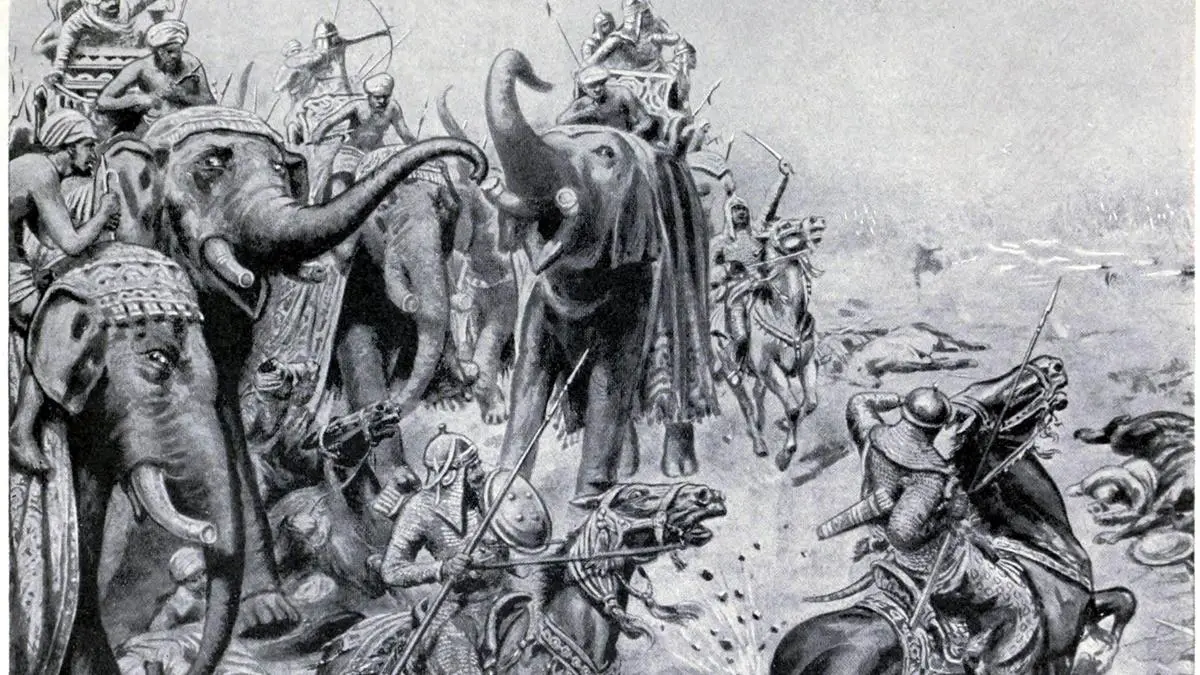
This battle not only reshaped India’s political landscape but also set the stage for centuries of Mughal rule, illustrating the profound implications of this historical encounter
The sultan was confident. His army easily outnumbered the adversary. And he had several hundreds of war elephants, a formidable force. Besides, he was on his home turf, while the enemy came from afar. The sultan was nonchalant, sensing a quick and easy victory.
He couldn’t have been more wrong. He had underestimated the adversary, who inherited a small kingdom, called Fergana at the age of 12 and spent all his teens in battles to keep it. War was in his blood — genes of fighting came from the great conqueror, Timur, from his father’s side and another great conqueror, Ghengis Khan, from his mother’s. At 21, he had taken an army and captured Kabul.
Maybe the sultan knew of his enemy’s history, maybe he didn’t. But the events of the battleground indicate that he knew little of the 43-year-old enemy’s war tactics.
By midday of April 21, 1526, Sultan Ibrahim Lodhi was killed; Zahir-ud-din Muhammad Babur seized Delhi, ending the 320-year-old Delhi Sultanate, and established the Mughal empire.
That was the First Battle of Panipat. Panipat, which lies 100 km north of Delhi in today’s Haryana — said to be one of the five cities (Prasthas) established by the Pandavas, it would become the site of two more famed battles named after — is geography-made for battles.
The vast expansive, open fields could house tens of thousands of soldiers and animals. 20km away, the Yamuna River provided enough water. Marauding invaders from the northwest had to pass through Panipat to reach Delhi; it was just at the right distance for Delhi rulers to stop them, while still not being far from home.
Historians such as Satish Chandra and V D Mahajan have accepted the descriptions and averments in Babur’s memoirs, Tuzuk-i-Baburi (aka Baburnama) as history. It is mostly from those memoirs that we get to know about the fateful First Battle of Panipat that turned the flow of Indian history.
Babur brought in a few battle tricks that Ibrahim Lodhi never expected. The first was field artillery — cannons and guns — behind a moving fortification of carts (araba) chained together. The thunder of the cannons panicked Lodi’s war elephants; faced with smoke, noise and the cart-protected gun line ahead, many turned back and ran straight into Lodi’s own ranks.
Alongside, Babur employed a tactic called tulughma, sending fast horsemen on the sides to encircle Lodhi’s army — an age-old strategy, but employed effectively.
In a matter of a few hours, the Delhi Sultanate, established by the Mamluk (Slave Dynasty) in 1206, crumbled, humbled by the underdogs.
Five centuries after, it is perhaps fun to reflect over the course that Indian history might have taken, if Babur had not come to India or had been defeated in the First Battle of Panipat.
First of all, there is little chance that he would not have come to India. Having tasted success in Kabul and made the city his base, Babur had been eyeing the rich Delhi Sultanate. But winds also blew in his favour. Historians Satish Chandra (“Medieval India”) and Abraham Eraly note that Ibrahim Lodhi was a very unpopular man. Afghan satraps under him, such as Daulat Khan Lodhi (the governor of Punjab) and Alam Khan Lodhi (Ibrahim’s uncle) resented the rigid ruler of Delhi — because of excessive Delhi control and their own ambitions. Like cats inviting a monkey to settle a division of bread, they invited Babur — apparently in the belief that the man from Kabul will defeat Ibrahim Lodhi and go back home.
So, if Babur had not come, the Delhi Sultanate would likely have broken into pieces, either during or after Ibrahim Lodhi, leaving room and time for regional powers and Rajput Indian kings. Consequently, the Maratha empire, which rose to resist the Mughals, might never have had a reason to rise — the Marathas, local chiefs under the Sultanate, are likely to have become several small kingdoms. Whether or not the situation would have led to the same conditions that made the British smack its lips looking at India, is a matter wide open to speculation.
Published on April 21, 2026
此内容由惯性聚合(RSS阅读器)自动聚合整理,仅供阅读参考。 原文来自 — 版权归原作者所有。