








No play moves faster from desire to ruin than Macbeth. A decorated soldier hears a promise and acts on it within days. The fall is just as quick. The Tragedy of Macbeth is a play by William Shakespeare, written around 1606 for the court of King James I. It is the shortest of the major tragedies and moves with rare speed. This guide covers the Macbeth plot summary, key characters, central themes, and famous quotes — and explains why the play still holds the stage.
Tragedy pacing
Macbeth is a tragedy about a Scottish general who kills his king after a prophecy says he will be king. The act gives him power but strips him of peace. The play tracks how one crime leads to many more.
Written by William Shakespeare around 1606, Macbeth follows a five-act structure and wastes no time. It is one of the most performed works in the world. Film and theatre return to it again and again because the story is simple and the ideas are timeless.
A complete Macbeth summary covers five acts, but the real story is a single unraveling decision.
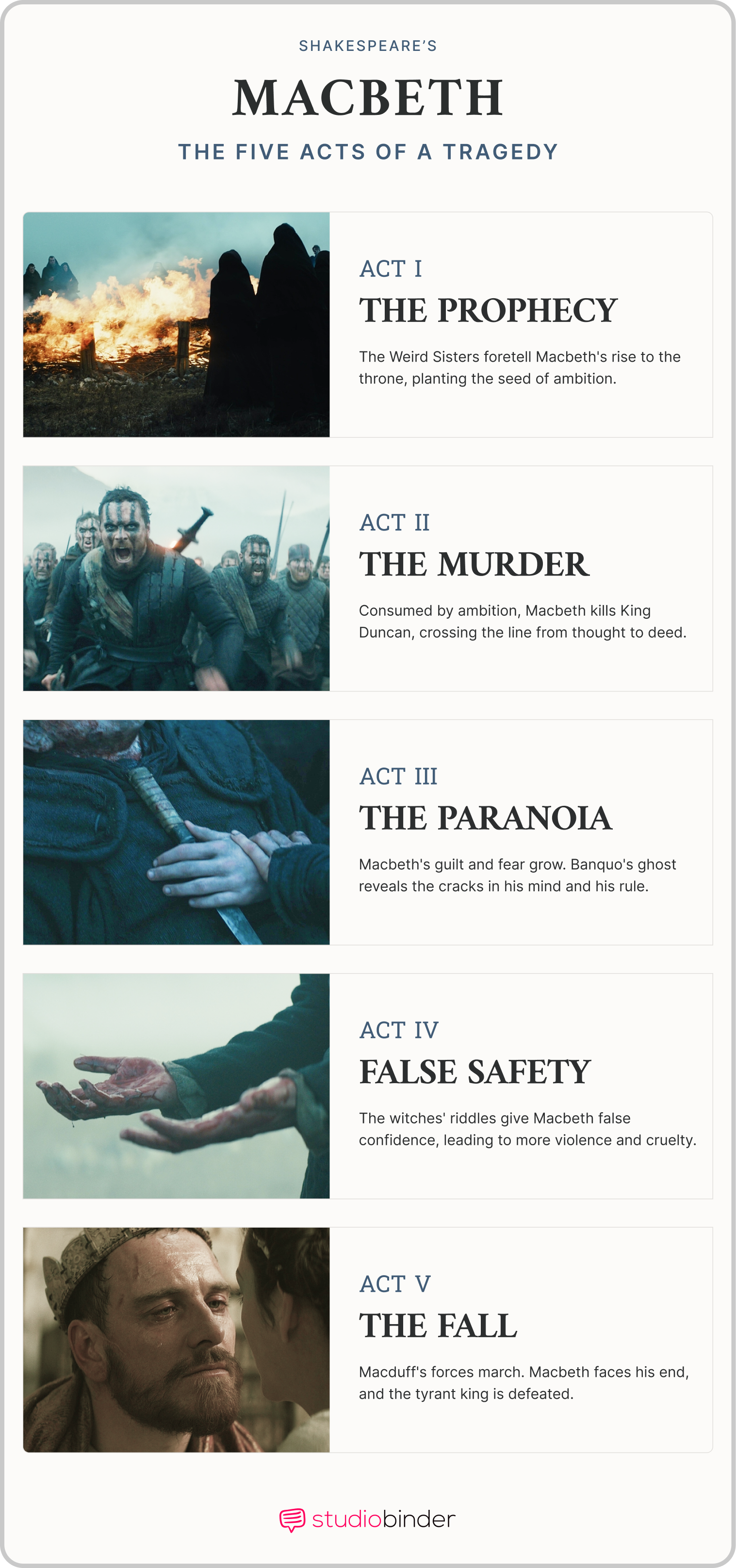
The Macbeth witches, also known as the Weird Sisters, meet on a heath. They speak in riddles and plan to meet Macbeth. After a battle, Macbeth and Banquo encounter them. They predict that Macbeth will become Thane of Cawdor and eventually be king, and that Banquo will father kings. Soon after, Macbeth is named Thane of Cawdor, and the link feels immediate. He writes to Lady Macbeth, who pushes him to act. When King Duncan visits their castle, they decide to kill him.
On the night of the visit, Macbeth sees a dagger that is not there. It leads him toward Duncan's room. He kills the king in his sleep and returns shaken. He cannot say a prayer. Lady Macbeth takes control and frames the guards. The next morning, the crime is discovered. Duncan's sons flee, which makes them look guilty.
Macbeth fears Banquo because of the prophecy about his line. He hires men to kill Banquo and his son, Fleance. Banquo dies but Fleance escapes. At a feast, Macbeth sees Banquo's ghost. No one else does. The vision breaks the event and exposes his fear. His rule now depends on violence.
Macbeth returns to the Weird Sisters. They offer visions that seem to promise safety, saying no one born of a woman can harm him and that he will not fall until Birnam Wood comes to Dunsinane. They warn him to fear Macduff. Macduff has gone to England, and Macbeth answers with cruelty. He orders the murder of Macduff's family.
Lady Macbeth sleepwalks and tries to clean blood that is not there. She dies soon after. Malcolm's forces march on Macbeth. Soldiers carry branches from Birnam Wood and the forest appears to move. In battle, Macduff reveals he was born by caesarean section. He kills Macbeth. Order returns.
Character hesitation
The Macbeth characters are some of the most psychologically complex figures Shakespeare ever wrote. In this brief Macbeth summary, you'll see how fast the protagonist falls and how the characters interact with him.
Macbeth
Macbeth begins as a trusted soldier, praised for his courage and loyalty. Others define him before he defines himself. That changes quickly.
He understands what he is about to do. Before killing Duncan, he lists clear reasons not to act. He knows the moral and political cost. He acts anyway. This is what makes him dangerous: he is not blind. He chooses to override his own judgment.
After the murder, his role shifts. He stops reacting and starts initiating. He orders Banquo's death. He orders the murder of Macduff's family. Ambition becomes control. His language reflects this shift. Early on, he questions and debates. Later, he speaks in short commands. Thought gives way to action. By the final act, he continues without belief. He moves forward because stopping is no longer an option.
Macbeth is a classic example of the soliloquy as dramatic device. His speeches let the audience inside a mind that is fully aware of its own failure.
Macbeth's character trajectory is one of the most studied in all of dramatic literature. Understanding his arc is essential to grasping what Macbeth Shakespeare intended as a study of moral collapse.
Lady Macbeth drives the early action. She sees what Macbeth wants and pushes him to act. Her strength is focus. She does not debate the morality of the act. She focuses on execution. When Macbeth hesitates, she reframes hesitation as weakness. This allows the crime to happen.
But her control does not last. After Duncan's murder, Macbeth begins to act without her. She loses influence over events. Her role shifts from cause to consequence. The sleepwalking scene shows this clearly. What she once dismissed returns in physical form. She tries to wash away blood that is not there. She cannot control what she helped create.
The Macbeth summary begins with three witches delivering a prophecy that sets everything in motion. The Macbeth witches, also known as the Weird Sisters, do not force action. They present a path. Macbeth chooses it. They introduce the central problem of the play but do not give orders. They give possibilities. Their language is indirect. They speak in riddles and reversals, which makes their meaning unstable.
They appear before any human action takes place, giving them a framing role. They shape how the audience reads the world. At the same time, they do not act for Macbeth. They seem to predict events, yet they also arrange to meet him. They sit between fate and action. They do not resolve the question of control. They make it harder to answer.
The witches' scenes are among the most studied examples of dramatic irony in Shakespeare. The audience knows more than the characters, and that gap creates dread.
Banquo is defined by restraint. He hears the same prophecy as Macbeth and does not act on it. This contrast matters. He shows that the prophecy does not force behavior. It offers a choice. As long as Banquo lives, Macbeth is not secure. After his death, Banquo returns as a ghost, which brings guilt into public space and exposes what Macbeth is trying to hide.
Duncan represents order. He rewards loyalty and punishes betrayal. His rule is stable. His weakness is trust. He misreads Macbeth completely, and that belief allows the crime to happen. His murder breaks more than a life. It breaks the system he represents. After his death, the world becomes unstable. Natural and political order collapse together.
Macduff is the force that restores balance. He operates outside Macbeth's system of power. His role becomes personal when Macbeth orders the murder of his family, turning Macduff into an avenger rather than just a political opponent. Unlike Macbeth, his actions are clear. He does not hesitate. He moves directly toward resolution. The prophecy closes through him: he is not born of a woman in the usual sense, and that detail ends the cycle of violence.
Dramatic momentum
You can't discuss the Macbeth summary without talking about the key themes, mayn of which showcase tragedy in a very real way throughout the play.
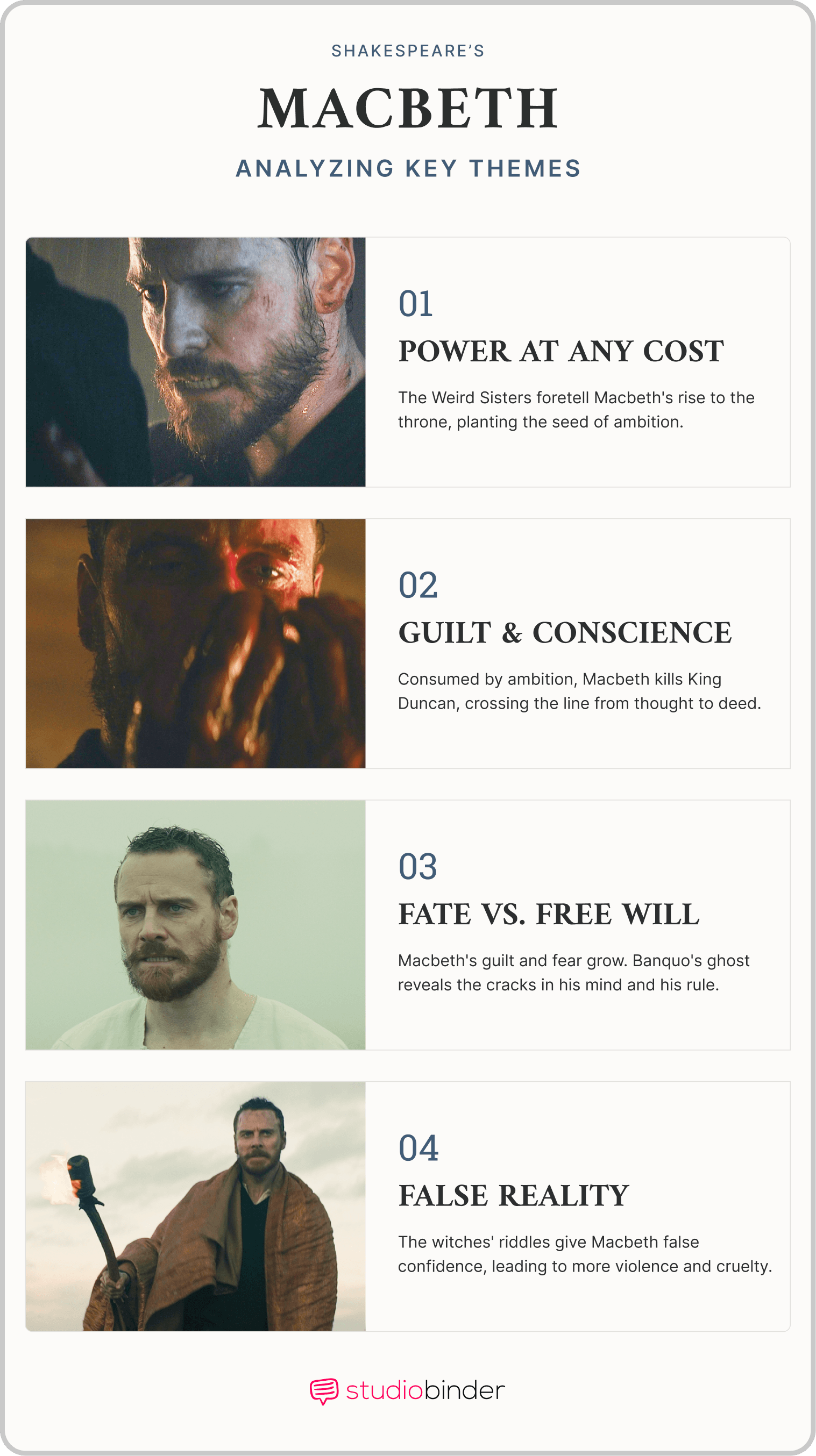
Ambition drives the action, but it does not begin as pure desire. At first, it appears as a thought. The Weird Sisters name a future. Macbeth does not reject it. He imagines it. That moment matters. Nothing has happened yet. The crown is still an idea.
He knows the act required to reach it is wrong. He says so. He lists the reasons not to kill Duncan. Duncan is a good king. He is also a guest. The act would break both moral and social order. Yet the thought remains. Macbeth calls it "vaulting ambition." The phrase is exact. It suggests a leap beyond what is allowed. It is not steady progress. It is overreach.
Lady Macbeth accelerates the process. She removes hesitation and reframes delay as weakness. But she does not create the desire. She makes it possible to act. Once Duncan is killed, ambition changes form. It is no longer about gaining power. That has been achieved. It becomes about keeping it. This is the turning point.
Macbeth cannot return to the man he was. The act has closed that path. From this point on, every decision is defensive. Each crime protects the first. He orders Banquo's murder because of a future that has not yet happened. He orders the death of Macduff's family because of fear, not strategy.
Power does not stabilize him. It destabilizes him. The more he secures his position, the less secure he feels. The crown does not settle him into rule. It isolates him. This is the corruption. Power gained through violence cannot be held without it. The system sustains itself. It demands repetition.
The language of the play reflects this shift. Early on, Macbeth debates. He weighs options. After the murder, he speaks in fragments. His thoughts are shorter. His reasoning collapses. Action replaces reflection. By the final act, ambition has emptied out. There is no longer a goal. There is only continuation.
This is why the tragedy lands with such force. Macbeth achieves what he wanted. The result is not fulfillment. It is erosion. Ambition begins as a possibility. It ends as compulsion.
Every Macbeth summary ends the same way: a man destroyed by the very ambition that drove him.
Guilt appears immediately. Macbeth hears a voice that says he will sleep no more. He cannot return to the scene. He cannot say a prayer. The body registers the crime before the mind can manage it.
Lady Macbeth seems immune at first. She tells him that a little water will clear them. She is wrong. Her control does not last. She sleepwalks. She tries to wash blood that is not there. The stain has moved from hand to mind. Guilt spreads. It cannot be contained. It returns in images, in sound, in sleep. The banquet scene shows this clearly. Macbeth sees Banquo's ghost and no one else does. The vision isolates him in public. The play suggests that conscience is not optional. It will surface, even when denied.
This is where the play becomes unstable. There is no mystery about the crime. We see the plan. We see the act. We know who is responsible. Yet the question of why remains open.
The Macbeth witches speak first. They appear before any human action. They seem to know what will happen. They even plan to meet Macbeth. Do they predict events, or do they shape them? The next scene shifts the ground. A wounded soldier reports on the battle. Some men are brave. Others are traitors. The king responds with clear judgment. This looks like a world of human choice.
Then the gap closes. The witches name Macbeth Thane of Cawdor. Moments later, messengers confirm it. For Macbeth, the link is immediate. Prophecy feels like power. For the audience, the sequence is different. We have already seen the king give the order. The witches seem to sit inside a chain of human action, not above it. But there is a complication. They arranged to meet Macbeth before any of this happened. That detail shifts the balance again. The play never resolves this tension. It holds both ideas at once. Macbeth chooses to act. But he acts in a world that seems prepared for him.
Nothing in the play is stable on the surface. Early lines set the tone. What looks fair may be foul. Duncan trusts Macbeth and is wrong. The witches speak in riddles that hide their meaning. Macbeth learns to perform. He hides intent behind politeness. He wears a role while planning violence. The result is a world where language cannot be trusted. Words promise safety and deliver the opposite. This theme of appearance vs. reality is one of the defining characteristics of Macbeth Shakespeare designed into every major scene.
What gives the play its force is not simplicity. It is pressure. Everything happens too quickly. Decisions are made before they can be understood. The play does not allow distance. It removes the usual comfort of uncertainty.
There is no mystery about the crime. We see the plan. We see the act. The focus shifts. The question is no longer what happened. It is how a person reaches the point of doing it. That shift changes the experience. Instead of suspense, the play creates involvement. The audience is not solving anything. It is watching a mind move toward action in real time. The speed matters. The play is shorter than the other tragedies, and that compression builds intensity. There is no release. Each scene tightens the pressure.
Meaning also comes from performance rather than plot. The same lines can feel controlled or unstable depending on delivery. A pause can change the weight of a decision. A look can shift responsibility. Because of this, the themes do not settle. Ambition does not stay abstract. Guilt does not stay internal. Fate does not resolve. The play does not offer a stable reading. It creates tension and holds it. That is why Macbeth continues to be staged.
The Macbeth summary is as relevant today as it was in 1606.
Fatal impulse
These Macbeth quotes are among the most widely known in English literature. Each one marks a key turn or idea in the tragedy. They are also among the most commonly cited Macbeth quotes in classrooms and productions.
"Double, double toil and trouble"
Said by the witches. Their chant has become part of common speech, appearing far outside its original context.
"Is this a dagger which I see before me"
Said by Macbeth before the murder. It shows his mind under strain, caught between vision and decision. This is one of Shakespeare's most famous soliloquy moments.
"Out, damned spot!"
Lady Macbeth, sleepwalking. She tries to clean blood that is not there. The line shows guilt breaking through the surface.
"Tomorrow and tomorrow and tomorrow"
Said by Macbeth after his wife's death. Life feels empty and without meaning. It is one of the best-known passages in all of dramatic irony and theatrical tradition.
"By the pricking of my thumbs, something wicked this way comes"
The witches sense Macbeth's arrival before he appears. The line shows how his transformation is visible even to supernatural forces.
"False face must hide what the false heart doth know"
Macbeth accepts the need to conceal his intent. It is a precise statement of the appearance vs. reality theme at the center of the play.
Storytelling structure
The play has a long life on screen. Each film version of Macbeth finds a new angle. The core story remains the same.
Orson Welles approached Macbeth as a problem of atmosphere. Without the budget for realism, he leaned into abstraction. The sets feel artificial. The lighting is heavy. Faces emerge from shadow rather than space. This creates a world that feels unstable from the start.
The Weird Sisters are especially effective here. Welles does not present them as individuals. They feel like part of the landscape, which supports the idea that the world is already shaped before Macbeth acts.
The pace reflects the structure of the play. Macbeth does not pause. He moves forward even when he knows he should stop.

The Welles version captures the Macbeth Shakespeare intended as a study in psychological disintegration. The world feels unstable from the first frame, mirroring Macbeth's eventual collapse.
Akira Kurosawa reimagines the story in feudal Japan. The structure remains, but the tone becomes colder and more controlled. The film translates the core Macbeth themes without relying on Shakespeare's language. Ambition, guilt, and prophecy all survive the cultural shift.
The climactic arrow sequence, in which Kurosawa replaces dialogue with physical inevitability, is one of cinema's most studied examples of how dramatic irony works on screen.

Kurosawa's adaptation is proof that the Macbeth plot summary transcends its original cultural context. The themes work in any setting where power, fear, and prophecy collide.
Roman Polanski's version is grounded and physical. Violence is not implied here. It is shown directly. The murder of Duncan is close and uncomfortable. This changes how the audience responds. In stage versions, the act can feel symbolic. Here, it feels immediate.
The world is also more realistic. Locations are detailed. Costumes feel lived in. There is no theatrical distance. This makes Macbeth's choices harder to abstract. He is not a figure in a moral play. He is a man making decisions. Lady Macbeth also shifts. Her control feels colder, and her breakdown feels more fragile because of it.

Polanski's version shows what happens when the Macbeth summary becomes physical reality rather than poetic abstraction. The realism makes the tragedy harder to dismiss.
Joel Coen strips the play down to its core elements. The film uses black and white, which removes distraction and reduces the world to shape, light, and movement. Sets are minimal. Spaces feel abstract. Walls are flat. Shadows are sharp. The result feels closer to theatre than film.
Performance becomes central. Denzel Washington plays Macbeth with control rather than excess. Frances McDormand plays Lady Macbeth with restraint. The Weird Sisters are reimagined as a single performer, which removes the sense of a group and replaces it with something more unified and strange.
Language is the focus. Lines are delivered with clarity. The rhythm of speech carries meaning. Coen returns the play to its structure and shows how little is needed when the foundation is strong.
The Tragedy of Macbeth is the film most attuned to what Macbeth Shakespeare wrote as a language play. Coen bets everything on the text, and the text holds.
These versions differ in style, tone, and setting. Yet the core remains intact. The Macbeth plot summary is simple. A man is told he will be king. He acts on it. The consequences follow. The themes are clear. Ambition, guilt, and power translate across cultures and centuries. The images are strong. Blood, darkness, sleep, and prophecy all work on screen. Because of this, Macbeth does not depend on one form. It can be staged, filmed, or reimagined without losing force.
The Macbeth summary is short by Shakespeare's standards, which is part of what makes it so relentless.
Unchecked ambition destroys the person who holds it. Macbeth gains power but loses stability. Each act that protects his position deepens his fall. The play is not a warning against desire. It is a study of what happens when desire overrides judgment.
The simple answer is ambition. A more precise answer is moral weakness. Macbeth knows what is right but chooses otherwise. Lady Macbeth amplifies this, but does not create it. His tragic flaw is the willingness to act on a desire he knows he should resist.
There was a real king named Mac Bethad mac Findlaich. He ruled from 1040 to 1057 and did kill Duncan. Shakespeare reshapes the story significantly for dramatic effect, compressing the timeline and heightening the supernatural elements.
The dagger Macbeth sees before Duncan's murder represents the conflict between desire and conscience. It is not real, but it points the way. It shows that Macbeth's mind has already made the decision before his body acts. The vision is a form of soliloquy made physical.
The Macbeth witches set the tragedy in motion but do not cause it. They offer predictions, not commands. Their importance is structural: they introduce the idea of a destined future and let the audience watch Macbeth choose it anyway. They hold the tension between fate and free will without resolving it.
Macbeth follows a five-act structure, which was standard for Shakespeare's tragedies. The play is notably short for a major tragedy, running roughly 2,100 lines. That compression is intentional. The speed of the action reflects the speed of Macbeth's fall.
Lady Macbeth is both catalyst and casualty. She drives Macbeth toward the murder when he hesitates, and her psychological strength makes the crime possible. But she cannot sustain that strength. Guilt breaks her before it breaks Macbeth, and her sleepwalking scene shows that suppressing conscience does not eliminate it.
Our Macbeth summary covers some of the most studied scenes in all of English literature. Macbeth shows what happens when action comes too quickly. A thought turns into a decision, and the decision cannot be undone. The play moves forward without pause, and that speed creates the tragedy.
Hamlet slows everything down. The same questions remain, but the response changes. Instead of acting, the central figure hesitates, questions, and delays. Read the full breakdown:
此内容由惯性聚合(RSS阅读器)自动聚合整理,仅供阅读参考。 原文来自 — 版权归原作者所有。