
惯性聚合 高效追踪和阅读你感兴趣的博客、新闻、科技资讯
阅读原文 在惯性聚合中打开

推荐订阅源

奇客Solidot–传递最新科技情报
奇客Solidot–传递最新科技情报
博客园_首页
大猫的无限游戏
大猫的无限游戏
让小产品的独立变现更简单 - ezindie.com
Apple Machine Learning Research
B
Blog
B
Blog RSS Feed
Cyber Security Advisories - MS-ISAC
P
Proofpoint News Feed
MyScale Blog
MyScale Blog
Engineering at Meta
Engineering at Meta
量子位
H
Hackread – Cybersecurity News, Data Breaches, AI and More
T
Tailwind CSS Blog
Stack Overflow Blog
Stack Overflow Blog
N
Netflix TechBlog - Medium
T
The Blog of Author Tim Ferriss
U
Unit 42
aimingoo的专栏
aimingoo的专栏
博客园 - 叶小钗
博客园 - 【当耐特】
云风的 BLOG
云风的 BLOG
博客园 - Franky
博客园 - 聂微东

JPost.com - Archaeology | The Jerusalem Post

What was the Qumran sect's mysterious calender used for? | The Jerusalem Post Ancient structure near Stonehenge may have inspired its solstice alignment | The Jerusalem Post Ancient tablet found at Roman fort bears Greek curse against enemies | The Jerusalem Post Archaeologists unearth ancient Byzantine-era city in Egypt’s Dakhla Oasis | The Jerusalem Post Ancient mosaics, coins to go on display in new exhibit in northern Israel | The Jerusalem Post Archaeologists find inscriptions of pharaohs, ancient deities in Egyptian temple | The Jerusalem Post Italy buys famed Etruscan tomb, displays it in Rome museum | The Jerusalem Post New AI project aims to uncover origins of the Dead Sea Scrolls | The Jerusalem Post Site of Alexander the Great’s battle with Persians under historic protection | The Jerusalem Post Previously unknown Iron Age grave found ahead of construction in Germany | The Jerusalem Post Collector finds rare Hebrew-inscribed Moroccan mortar in Jerusalem's Old City | The Jerusalem Post Stone from Tel Eton may hold evidence of ancient religious reforms, study claims | The Jerusalem Post Complete text of carbonized Herculaneum scroll unlocked for first time | The Jerusalem Post Study: New identification technique pushes back timeline of human fire use | The Jerusalem Post Over 3,000 artifacts from Stone Age to WWII found in Netherlands valley | The Jerusalem Post American family repatriates four ancient artifacts to Egypt | The Jerusalem Post Remains of Queen Elisenda, 24 others unearthed in Barcelona for study | The Jerusalem Post Two ancient statues uncovered during Israel Railways excavations near Haifa | The Jerusalem Post Marble bust believed to depict Roman goddess of love found during excavations at Alicante beach Ancient Greco-Roman cemetery unearthed at archaeological site in Egypt's Nile Delta Ancient jars unearthed at biblical Shiloh days before annual wine festival WATCH: A Paleolithic time capsule: Rare prehistoric cave discovered near highway outside of Haifa Ancient water reservoirs discovered at Red Sea's Port of Aydhab site near Egypt-Sudan border Collection of ancient Egyptian, Greek, Roman-era artifacts discovered at Egypt’s Heracleopolis First near-complete ancient Egyptian funerary set discovered at Heliopolis necropolis site WATCH: Norway recovers Chinese porcelain, European-made goods from 18th-century shipwreck Neanderthals' ancient toolkit included hammers, blades made from rhino teeth, study finds Evidence of ancient Native American life uncovered near Cape Canaveral Space Force Station Rare, intact ancient Roman burial unearthed during excavations in eastern Croatia - report Plaster-making technique attributed to Romans used at Motza some 8,000 years earlier, study shows
60,000-year-old ostrich eggshells reveal humanity’s first...
2026-03-23 · via JPost.com - Archaeology | The Jerusalem Post

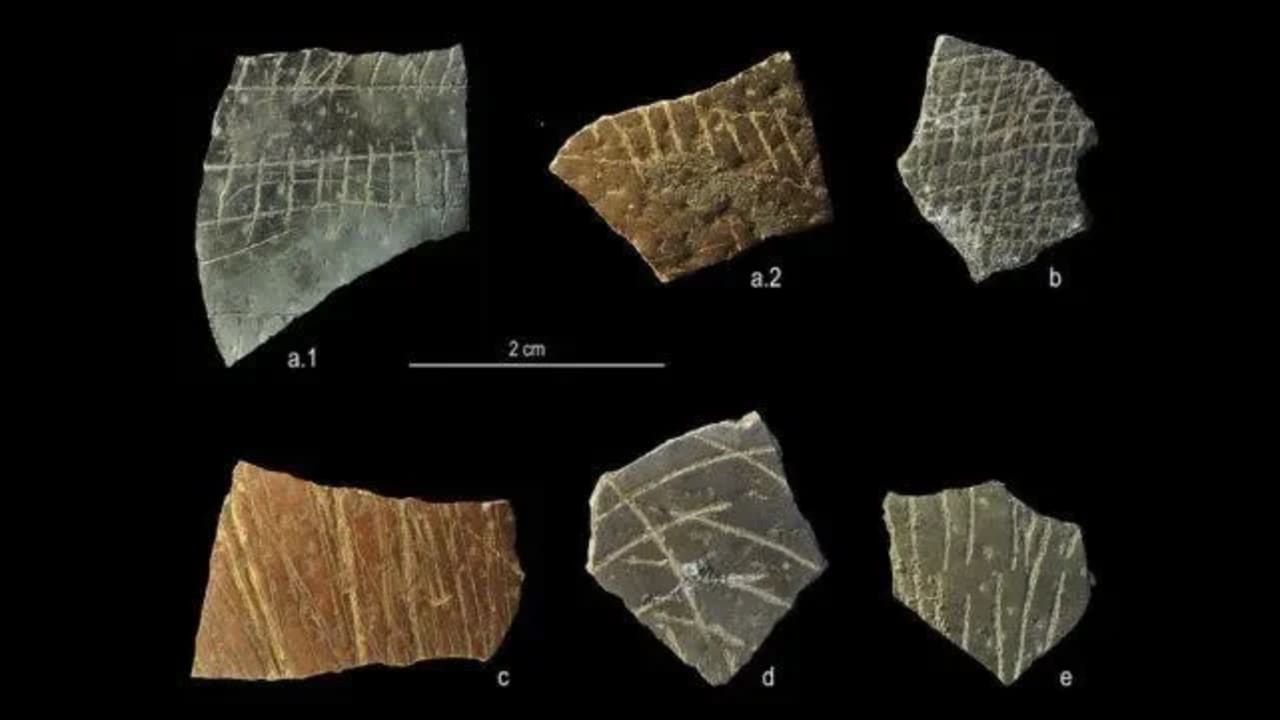
Archaeologist Silvia Ferrara described the organization of lines by recurring principles—parallelisms, grids, rotations, and systematic repetitions—as an embryonic visual grammar.

60,000-year-old ostrich eggshells.
(photo credit: Texier et al., J. Archaeol. Sci., 2013)
ByJERUSALEM POST STAFF
Updated:

Finely incised ostrich eggshell fragments from sites including Diepkloof, Klipdrift, and Apollo 11 in southern Africa and Namibia preserve geometric motifs such as grids, parallel lines, right angles, rhombuses, and complex cross-hatching. Researchers analyzing 112 engraved fragments found that more than 80% display coherent spatial organization and consistent regularities, indicating intentionality rather than random doodling. The findings have been interpreted as one of the earliest known instances of geometric thinking and suggesting the beginnings of abstract thought.

Archaeologist Silvia Ferrara described the organization of lines by recurring principles—parallelisms, grids, rotations, and systematic repetitions—as an embryonic visual grammar, according to Scienze Notizie. “These signs reveal a surprisingly structured and geometric way of thinking,” she said.

Systematic thought

Valentina Decembrini, a PhD student and first author of the study, noted that Homo sapiens 60,000 years ago already possessed a remarkable ability to organize visual space according to abstract principles, and that the results illuminate the evolution of the human mind.

The engraved ostrich eggshells were first described in 2010 and have since been recognized for their well-defined geometric patterns—notably grids and rhombuses—that place them among the world’s oldest examples of geometric reasoning. The precision of the lines is consistent with a stepwise procedure: setting a baseline or axis, reproducing parallel marks at measured intervals, and joining elements at deliberate right angles. Over time, the repetition of these methods appears to have produced families of motifs with shared rules.