
惯性聚合 高效追踪和阅读你感兴趣的博客、新闻、科技资讯
阅读原文 在惯性聚合中打开

推荐订阅源

aimingoo的专栏
aimingoo的专栏
Jina AI
Jina AI
WordPress大学
WordPress大学
Recent Announcements
G
Google Developers Blog
I
InfoQ
H
Hackread – Cybersecurity News, Data Breaches, AI and More
Google DeepMind News
P
Proofpoint News Feed
MyScale Blog
MyScale Blog
M
MIT News - Artificial intelligence
让小产品的独立变现更简单 - ezindie.com
C
Check Point Blog
J
Java Code Geeks
T
Tailwind CSS Blog
OSCHINA 社区最新新闻
OSCHINA 社区最新新闻
Microsoft Security Blog
MongoDB | Blog
MongoDB | Blog
V
Visual Studio Blog
人人都是产品经理
人人都是产品经理
量子位
A
About on SuperTechFans
D
DataBreaches.Net
钛媒体:引领未来商业与生活新知
钛媒体:引领未来商业与生活新知

JPost.com - Archaeology | The Jerusalem Post

What was the Qumran sect's mysterious calender used for? | The Jerusalem Post Ancient structure near Stonehenge may have inspired its solstice alignment | The Jerusalem Post Ancient tablet found at Roman fort bears Greek curse against enemies | The Jerusalem Post Archaeologists unearth ancient Byzantine-era city in Egypt’s Dakhla Oasis | The Jerusalem Post Ancient mosaics, coins to go on display in new exhibit in northern Israel | The Jerusalem Post Archaeologists find inscriptions of pharaohs, ancient deities in Egyptian temple | The Jerusalem Post Italy buys famed Etruscan tomb, displays it in Rome museum | The Jerusalem Post New AI project aims to uncover origins of the Dead Sea Scrolls | The Jerusalem Post Site of Alexander the Great’s battle with Persians under historic protection | The Jerusalem Post Previously unknown Iron Age grave found ahead of construction in Germany | The Jerusalem Post Collector finds rare Hebrew-inscribed Moroccan mortar in Jerusalem's Old City | The Jerusalem Post Stone from Tel Eton may hold evidence of ancient religious reforms, study claims | The Jerusalem Post Complete text of carbonized Herculaneum scroll unlocked for first time | The Jerusalem Post Study: New identification technique pushes back timeline of human fire use | The Jerusalem Post Over 3,000 artifacts from Stone Age to WWII found in Netherlands valley | The Jerusalem Post American family repatriates four ancient artifacts to Egypt | The Jerusalem Post Remains of Queen Elisenda, 24 others unearthed in Barcelona for study | The Jerusalem Post Two ancient statues uncovered during Israel Railways excavations near Haifa | The Jerusalem Post Marble bust believed to depict Roman goddess of love found during excavations at Alicante beach Ancient Greco-Roman cemetery unearthed at archaeological site in Egypt's Nile Delta Ancient jars unearthed at biblical Shiloh days before annual wine festival WATCH: A Paleolithic time capsule: Rare prehistoric cave discovered near highway outside of Haifa Ancient water reservoirs discovered at Red Sea's Port of Aydhab site near Egypt-Sudan border Collection of ancient Egyptian, Greek, Roman-era artifacts discovered at Egypt’s Heracleopolis First near-complete ancient Egyptian funerary set discovered at Heliopolis necropolis site WATCH: Norway recovers Chinese porcelain, European-made goods from 18th-century shipwreck Neanderthals' ancient toolkit included hammers, blades made from rhino teeth, study finds Evidence of ancient Native American life uncovered near Cape Canaveral Space Force Station Rare, intact ancient Roman burial unearthed during excavations in eastern Croatia - report Plaster-making technique attributed to Romans used at Motza some 8,000 years earlier, study shows
World's oldest plague mass grave found beneath Roman race...
MIRIAM SELA-EITAM · 2026-05-07 · via JPost.com - Archaeology | The Jerusalem Post

According to the study, the grave predates the Black Death burial pits from medieval Europe by approximately 800 years.
Follow us on Google
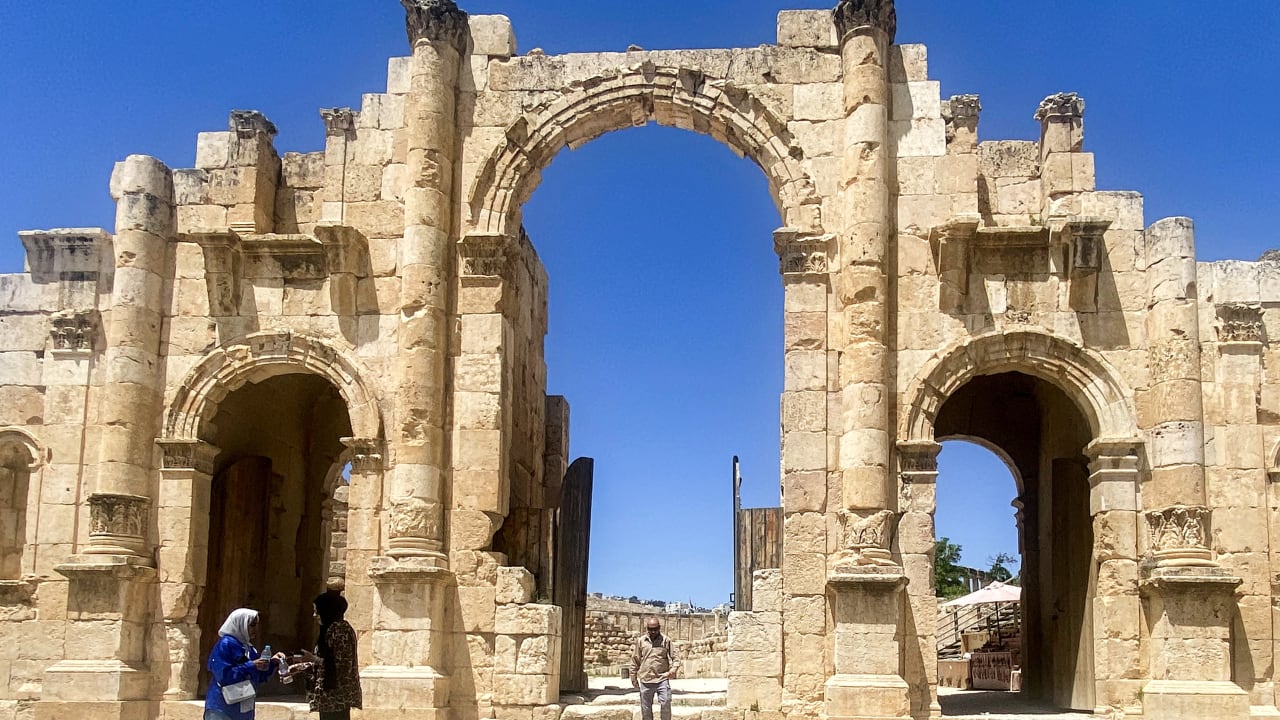
People stand before the Roman-era South Gate, was built in honour of the Roman Emperor Hadrian on the occasion of his visit circa 130 CE, is pictured at the Roman ruins of Jerash in northern Jordan on April 29, 2026.
(photo credit: Mussa HATTAR / AFP via Getty Images)
ByMIRIAM SELA-EITAM

A sixth century mass grave located in the Jordanian city of Jerash has been identified as the oldest genetically confirmed plague-related burial and the first of its kind in the Eastern Mediterranean, according to a study published in February in the Journal of Archaeological Science.

DNA extracted from the remains of more than 230 of those buried beneath Jerash's second century hippodrome tested positive for Yersinia pestis, the bacterium that caused the bubonic plague and the First Pandemic, also known as the Plague of Justinian, which spread across the Byzantine Empire between 541 and 750 CE.

Further analysis also confirmed that all Y. pestis genomes recovered from the site belonged to a single, uniform strain, the study noted, indicating that the victims died during a single outbreak rather than across several different ones.

Archaeological evidence has dated the burials to between 640 and 659 CE, and found that the grave had been sealed by an earthquake that collapsed the hippodrome's stone seating not long after.

According to the study, the grave predates the Black Death burial pits from medieval Europe by approximately 800 years.

A man walks along the 800-metre-long Cardo colonnade at the ancient Roman ruins of Jerash in northern Jordan on April 29, 2026.
A man walks along the 800-metre-long Cardo colonnade at the ancient Roman ruins of Jerash in northern Jordan on April 29, 2026. (credit: Mussa HATTAR / AFP via Getty Images)

"The earlier stories identified the plague organism,” explained lead researcher Rays H. Y. Jiang, an associate professor at the USF's College of Public Health. “The Jerash site turns that genetic signal into a human story about who died and how a city experienced crisis.''

According to the study, the bodies were buried within the hippodrome rapidly and with minimal funerary structure, consistent with accounts of mass-casualty events that overwhelm a city's normal burial capacity.

Archaeologists also found the remains compacted between layers of pottery fragments and collapsed masonry in two underground chambers, named W2 and W3, that are believed to have previously served as a ceramic workshop.

Site shows ancient societies' movement 

In addition to confirming historical record of the plague’s spread, the burial site at Jerash provided researchers with insight into the movements of ancient societies.

While historic and genetic data often presents the possibility of large groups moving between regions often, burial evidence often contradicts this, susggesting that communities remained local and did not travel as much as record claims.

The findings at Jerash show that both patterns coexisted, the study explained. Where in times of non-crisis, migration is a slower and more subtle event that takes place over the course of generations, during times of crisis, “individuals from more mobile backgrounds were brought together in one place, making those hidden connections visible,” the study explained.

"By linking biological evidence from the bodies to the archaeological setting, we can see how disease affected real people within their social and environmental context,'' Jiang said. "This helps us understand pandemics in history as lived human health events, not just outbreaks recorded in text.''

"Pandemics aren't just biological events, they're social events, and this study shows how disease intersects with daily life, movement and vulnerability. Because pandemics reveal who is vulnerable and why, those patterns still shape how disease affects societies today.''

Follow us on Google