
惯性聚合 高效追踪和阅读你感兴趣的博客、新闻、科技资讯
阅读原文 在惯性聚合中打开

推荐订阅源

腾讯CDC
IT之家
IT之家
有赞技术团队
有赞技术团队
WordPress大学
WordPress大学
Apple Machine Learning Research
OSCHINA 社区最新新闻
OSCHINA 社区最新新闻
人人都是产品经理
人人都是产品经理
The Cloudflare Blog
钛媒体:引领未来商业与生活新知
钛媒体:引领未来商业与生活新知
freeCodeCamp Programming Tutorials: Python, JavaScript, Git & More
博客园 - 【当耐特】
V
V2EX
Last Week in AI
Last Week in AI
H
Help Net Security
The GitHub Blog
The GitHub Blog
S
SegmentFault 最新的问题
F
Fortinet All Blogs
I
InfoQ
宝玉的分享
宝玉的分享
A
About on SuperTechFans
MongoDB | Blog
MongoDB | Blog
Microsoft Azure Blog
Blog — PlanetScale
Blog — PlanetScale
B
Blog

JPost.com - Archaeology | The Jerusalem Post

What was the Qumran sect's mysterious calender used for? | The Jerusalem Post Ancient structure near Stonehenge may have inspired its solstice alignment | The Jerusalem Post Ancient tablet found at Roman fort bears Greek curse against enemies | The Jerusalem Post Archaeologists unearth ancient Byzantine-era city in Egypt’s Dakhla Oasis | The Jerusalem Post Ancient mosaics, coins to go on display in new exhibit in northern Israel | The Jerusalem Post Archaeologists find inscriptions of pharaohs, ancient deities in Egyptian temple | The Jerusalem Post Italy buys famed Etruscan tomb, displays it in Rome museum | The Jerusalem Post New AI project aims to uncover origins of the Dead Sea Scrolls | The Jerusalem Post Site of Alexander the Great’s battle with Persians under historic protection | The Jerusalem Post Previously unknown Iron Age grave found ahead of construction in Germany | The Jerusalem Post Collector finds rare Hebrew-inscribed Moroccan mortar in Jerusalem's Old City | The Jerusalem Post Stone from Tel Eton may hold evidence of ancient religious reforms, study claims | The Jerusalem Post Complete text of carbonized Herculaneum scroll unlocked for first time | The Jerusalem Post Study: New identification technique pushes back timeline of human fire use | The Jerusalem Post Over 3,000 artifacts from Stone Age to WWII found in Netherlands valley | The Jerusalem Post American family repatriates four ancient artifacts to Egypt | The Jerusalem Post Remains of Queen Elisenda, 24 others unearthed in Barcelona for study | The Jerusalem Post Two ancient statues uncovered during Israel Railways excavations near Haifa | The Jerusalem Post Marble bust believed to depict Roman goddess of love found during excavations at Alicante beach Ancient Greco-Roman cemetery unearthed at archaeological site in Egypt's Nile Delta Ancient jars unearthed at biblical Shiloh days before annual wine festival WATCH: A Paleolithic time capsule: Rare prehistoric cave discovered near highway outside of Haifa Ancient water reservoirs discovered at Red Sea's Port of Aydhab site near Egypt-Sudan border Collection of ancient Egyptian, Greek, Roman-era artifacts discovered at Egypt’s Heracleopolis First near-complete ancient Egyptian funerary set discovered at Heliopolis necropolis site WATCH: Norway recovers Chinese porcelain, European-made goods from 18th-century shipwreck Neanderthals' ancient toolkit included hammers, blades made from rhino teeth, study finds Evidence of ancient Native American life uncovered near Cape Canaveral Space Force Station Rare, intact ancient Roman burial unearthed during excavations in eastern Croatia - report Plaster-making technique attributed to Romans used at Motza some 8,000 years earlier, study shows
Remains from Israel’s North show Neanderthal children gre...
MIRIAM SELA-EITAM · 2026-04-28 · via JPost.com - Archaeology | The Jerusalem Post

According to the study, Amud 7’s remains date to approximately 51,000 and 56,000 years ago and belong to the most complete skeleton of a Neanderthal infant ever found.
Follow us on Google
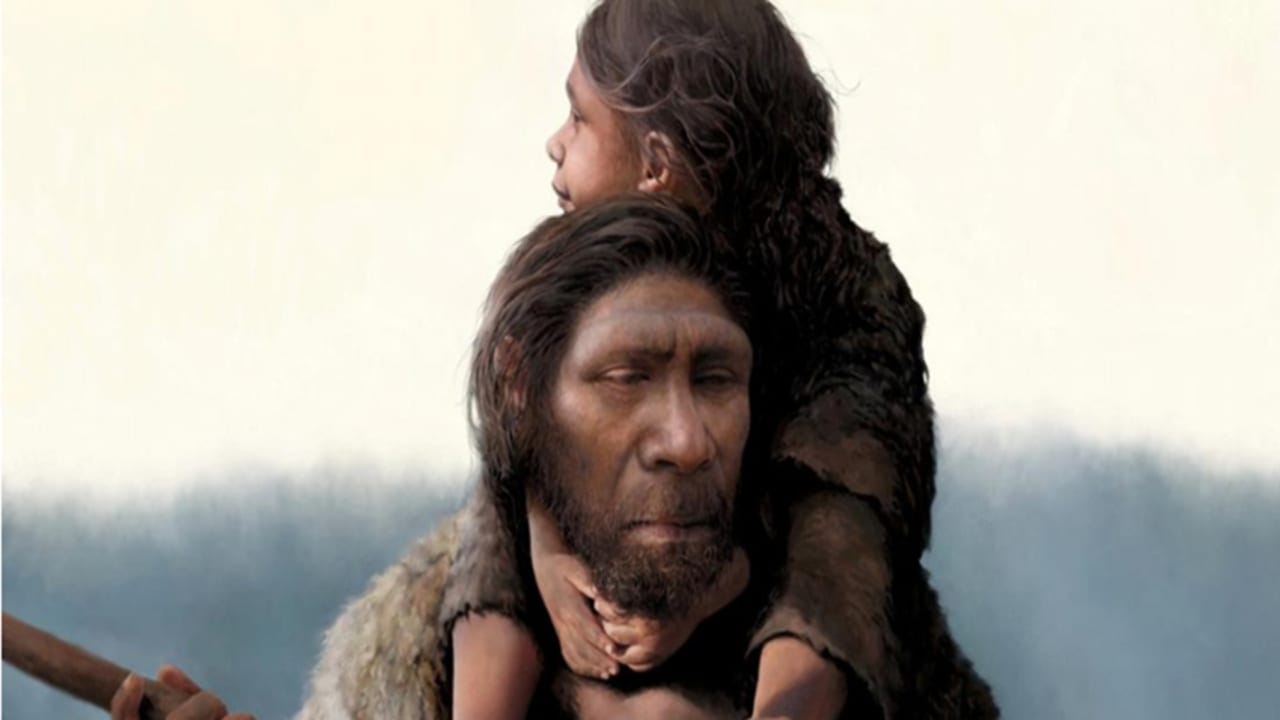
 World's oldest Neanderthal fingerprint found on 43,000-year-old pebble in Spain. Illustration.
World's oldest Neanderthal fingerprint found on 43,000-year-old pebble in Spain. Illustration.
(photo credit: Tom Bjorklund/Max Planck Institute for Evolutionary Anthropology)
ByMIRIAM SELA-EITAM

Neanderthal children developed at a much faster pace than modern humans, possibly as a way to adjust to the harsh environment of their surroundings, according to a recent study published in Current Biology.

The study analyzed the remains of a Neanderthal infant discovered during excavations in the Amud Cave in the Upper Galilee in the late 1900s, named by researchers as Amud 7, for the first time. They were found in situ in nearly 111 different fragments, tucked into a a niche in one of the cave’s walls under a red deer jaw. 

According to the study, Amud 7’s remains date to approximately 51,000 and 56,000 years ago and belong to the most complete skeleton of a Neanderthal infant ever found.

However, while researchers noted that the Neanderthal features were present in the skeletal remains, it was much more difficult for them to figure out what age the child had been when they died.

When attempted to analyze Amud 7's age based on its arm and leg bones, researchers found that Amud 7 appeared to be around 13.7 months of age. But, when analyzing their age using tooth histology, the microscopic study of enamel formation in the teeth, Amud 7 appeared to be much younger, closer to six months old.

File Photo: The remains of a prehistoric child skull and a lower Jaw, believed to be the earliest known human fossil showing a mixture of morphological traits of both Neanderthals and Homo Sapiens, August 19, 2025.
File Photo: The remains of a prehistoric child skull and a lower Jaw, believed to be the earliest known human fossil showing a mixture of morphological traits of both Neanderthals and Homo Sapiens, August 19, 2025. (credit: REUTERS/Ammar Awad)

Meaning, that Amud 7's body had grown to a size typically seen in a child roughly twice its dental age.

'Rare glimpse into Neanderthal development'

Based on this, researchers found that while newborn Neanderthals and modern human newborns share similar growth in tooth formation, tooth eruption and the lengths of the arm and leg bones, Neanderthal infants had much larger skulls then humans.

Then, when they are toddlers, Neanderthals’ bodies grow at a quicker rate than their teeth, contrasting the slower and more proportionate growth of modern human babies.

It is only afterwards that Neanderthal growth evened out to match modern human children’s growth trajectories.

Neanderthals and Homo sapiens began diverging around 600,000 years ago, “evolving mostly separately in Eurasia and Africa thereafter,” according to the study,

Further, it noted that despite the divergence, there have been proven cases of interbreeding between the two species during the Middle Paleolithic era, showing that even with the division, there was still compatibility.

“This suggests an evolutionary strategy emphasizing accelerated development in the early years of life, likely advantageous in the harsh environments Neanderthals inhabited,” the study concluded.

“The remains of Amud 7 provide a rare glimpse into Neanderthal development. Its distinct morphology and growth trajectory reveal that closely related species adopted different adaptive strategies in response to evolutionary pressures.”

Follow us on Google

