



Amazon Web Services Inc. is trying to get rid of the bottleneck between architectural planning and code execution with a number of upgrades to its artificial intelligence software development tool Kiro.
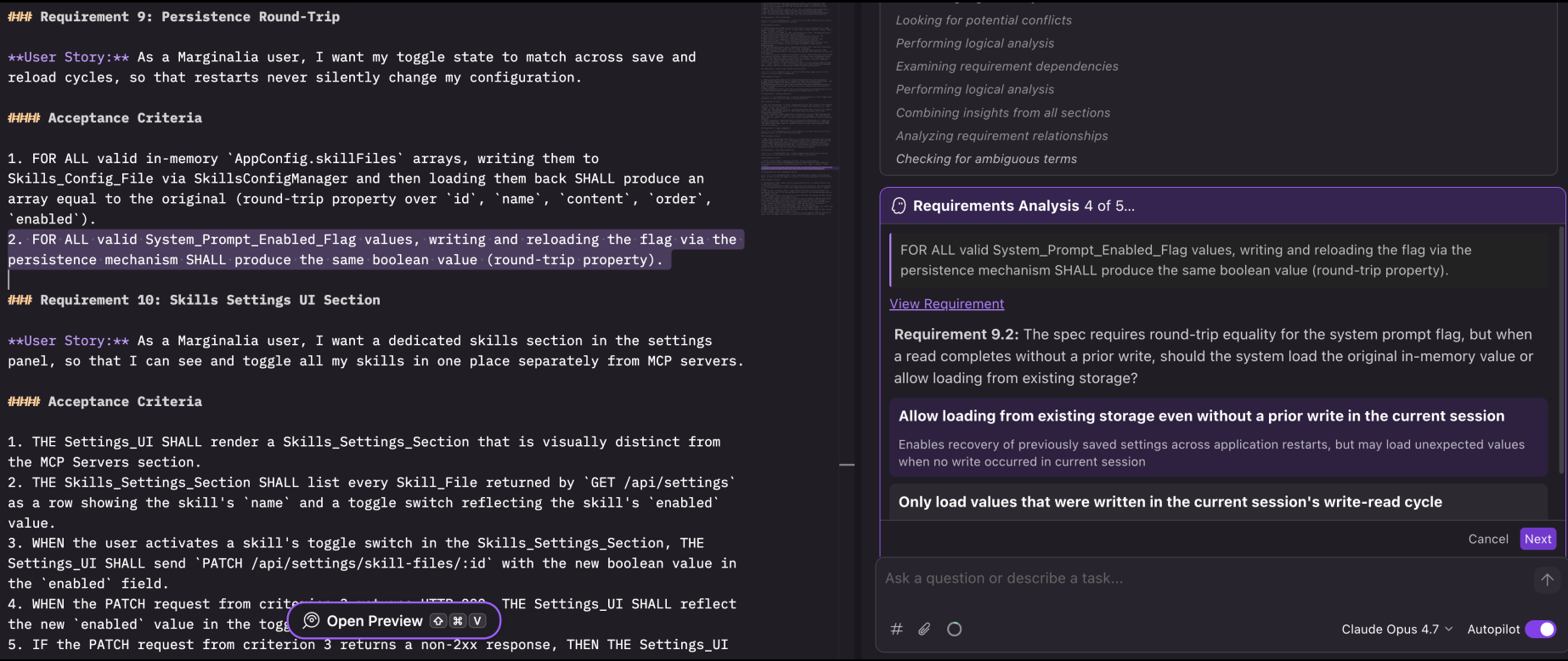
The upgrades, which are all rolling out today, include Parallel Task Execution and streamlined Quick Plan workflow capabilities designed to help developers move faster. They’re joined by a new Requirements Analysis engine designed to catch issues with the code before a single line is written.
In a blog post, AWS Product Manager Ankit Sharma and Principal Engineer Richard Threlkeld explained that Kiro is focused on “spec-driven development” that’s designed to deliver higher-quality code implementations. However, it’s a cautious approach that sacrifices something that many organizations prioritize – developer velocity.
For instance, if Kiro is fed a feature specification with 10 tasks and six of them are all independent of one another, with different endpoints, files and no shared state, it will complete them sequentially, one after another, rather than doing them all at once. Moreover, for projects where the user already knows the scope and constraints, Kiro’s step-by-step approval flow is probably overkill. But on the flip side, there are cases where a deceptively simple feature prompt “may include many unstated assumptions and ambiguities that can take the implementation in the wrong direction.”
Today’s updates represent an effort by AWS to streamline Kiro’s development process while making sure that implementations never end up going in the wrong direction. The new Requirements Analysis engine employs a three-stage neurosymbolic pipeline that begins with large language models rewriting the user’s vague requirements into testable criteria, which can then be translated into formal logic. That logic is then submitted to a Satisfiability Modulo Theories solver – essentially, an automated reasoning engine.
Unlike standard LLMs, which work by predicting the next word in a sequence, the SMT solver uses mathematics to prove if contradictions exist. If it discovers that two requirements are logically incompatible – for instance, if a rule on page one mandates a hard delete and a rule on page 10 implies a soft delete – the solver will identify that conflict as a mathematical impossibility. Kiro will then surface these findings in plain language that developers can understand, so they can quickly come up with a fix.
As for the Parallel Task Execution, it’s meant to solve the problem outlined above when Kiro is fed a specification with multiple independent tasks. It works by analyzing the dependency graph of each new project, identifying which tasks do not share a state, endpoints and files. These will then be run concurrently in isolated contexts, speeding up the overall development time for large specifications from more than an hour to as little as 15 minutes, AWS said.
To complement this, AWS has developed Quick Plan, which is a kind of fast-track mode for building well-understood features. Instead of asking for approvals step-by-step, Kiro will simply ask a bunch of clarifying questions up front, before heading off to generate the entire stack in one go.
Today’s updates could have significant implications for autonomous AI agents. By applying the same mathematical rigor used in hardware design to software engineering, Kiro should be able to eliminate many of the “hallucinations” that continue to plague AI development.
They should also help to make coding agents feel a bit smarter. In many ways, existing AI coding bots feel as if they lack any common sense. If a developer feeds it a blueprint that shows a staircase leading towards a solid brick wall, it won’t question that design, but just build it exactly as it’s shown. With the Requirement Analysis engine now present, coding bots can act more like structural engineers who will notice the problem before it even gets started on the foundations.
Support our mission to keep content open and free by engaging with theCUBE community. Join theCUBE’s Alumni Trust Network, where technology leaders connect, share intelligence and create opportunities.
About SiliconANGLE Media
SiliconANGLE Media is a recognized leader in digital media innovation, uniting breakthrough technology, strategic insights and real-time audience engagement. As the parent company of SiliconANGLE, theCUBE Network, theCUBE Research, CUBE365, theCUBE AI and theCUBE SuperStudios — with flagship locations in Silicon Valley and the New York Stock Exchange — SiliconANGLE Media operates at the intersection of media, technology and AI.
Founded by tech visionaries John Furrier and Dave Vellante, SiliconANGLE Media has built a dynamic ecosystem of industry-leading digital media brands that reach 15+ million elite tech professionals. Our new proprietary theCUBE AI Video Cloud is breaking ground in audience interaction, leveraging theCUBEai.com neural network to help technology companies make data-driven decisions and stay at the forefront of industry conversations.
此内容由惯性聚合(RSS阅读器)自动聚合整理,仅供阅读参考。 原文来自 — 版权归原作者所有。