







Amazon Web Services Inc. is trying to make sure enterprises that embrace artificial intelligent agents and automation aren’t getting lost in the curse of “agentic sprawl.”
The cloud computing giant is trying to prevent that from happening with the launch of AWS Agent Registry in preview today. It’s a new capability that acts like a centralized discovery and governance hub for AI agents, designed to help companies manage the explosion of AI agents, tools and skills across their entire cloud estates.
The AWS Agent Registry is part of the broader AWS AgentCore platform, acing as a single source of truth for agents and their operations. Developers can use the Registry to share and reuse existing agents, rather than spending time rebuilding them from scratch every time they want to automate a new business process or task.
In a blog post, the company explained that agent sprawl is a byproduct of the rapid adoption of AI agents by enterprises. As organizations scale up their automation drive from a few experimental bots to hundreds or even thousands of autonomous agents, they’re inevitably going to struggle to keep track of them, the company said. That will mean a loss of visibility and control, and it also will make it more difficult for them to be reused to perform other tasks.
Part of the problem is the siloed nature of AI development. In many organizations, there are different developer teams working on different projects, and they don’t always know what the others are doing. One team might have developed a sophisticated payment processing agent, while a team in another department starts working on the same thing.
Unless organizations have a centralized directory, these agents are essentially invisible, making them impossible to discover, govern or audit. The result is that teams can waste hours of time on duplicated effort. Compliance is another concern, as the lack of visibility can lead to unauthorized and unvetted agents being unleashed on business critical tasks.
The AWS Agent Registry is meant to prevent all that. It stores structured metadata for each agent, tool and agent skill that an organization has built. This metadata lists who built the agent, what its purpose is, the protocols it uses and how to invoke it.
What’s more, it’s platform-agnostic, meaning it can also index agents built on other cloud platforms and in on-premises environments. The metadata means users won’t just see a list of agents, but also real-time information on where they’re being used in production, their latency and uptime.
With the AWS Agent Registry, the company is trying to position itself as a kind of “control plane” for agentic AI. It’s similar to having a human resources department for AI agents and it should dramatically accelerate enterprise automation, enabling developers to quickly piece together pre-vetted and reusable skills and create bots for almost any task.
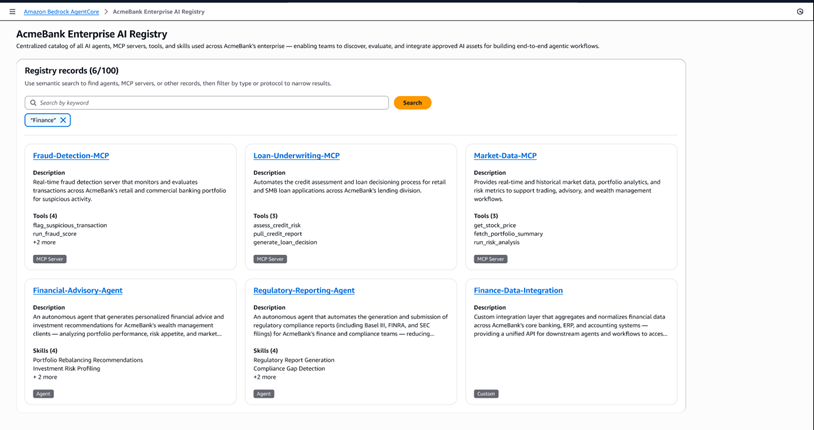
One of the highlighted features is a hybrid semantic search capability that makes AI agents discoverable. Instead of just matching keywords, the registry relies on natural language processing to help developers find suitable agents. If someone searches for “billing tools,” the Registry will understand that the “invoicing agent” is probably what they’re looking for, even if the search term used isn’t an exact match.
Meanwhile, there are approval workflows that can aid in governance. To prevent agents from running around out of control, each one begins as a “draft” when it’s first registered, and it must be vetted and approved before others in the organization can discover it. Developers can manually register each agent they build, or else just point the Registry to an endpoint and have it automatically pull in all of the technical details of each agent.
Companies such as Zuora Inc. and Southwest Airlines Co. have already been using the Registry to try to get a handle on their growing agentic fleets, and they claim to have been successful. “This will prevent agent sprawl across the organization while establishing the foundation for scaling thousands of agents with enterprise-grade governance from day one,” said Justin Bundick, Southwest Airlines’ vice president of AI and intelligent platforms.
AWS plans for the Registry to be more than just a simple library of AI agents. It wants it to become embedded into every corner of its cloud ecosystem, spanning the integrated development environments where developers create code to the business workspaces where employees interact with AI systems. In a future release, the company plans to enable automatic registration of any new agent that’s deployed via its own agentic services, together with its operational metadata.
To begin with, the AWS Agent Registry is being launched in five AWS regions, including US East (N. Virginia), US West (Oregon), Asia Pacific (Sydney), Asia Pacific (Tokyo) and Europe (Ireland).
Support our mission to keep content open and free by engaging with theCUBE community. Join theCUBE’s Alumni Trust Network, where technology leaders connect, share intelligence and create opportunities.
About SiliconANGLE Media
SiliconANGLE Media is a recognized leader in digital media innovation, uniting breakthrough technology, strategic insights and real-time audience engagement. As the parent company of SiliconANGLE, theCUBE Network, theCUBE Research, CUBE365, theCUBE AI and theCUBE SuperStudios — with flagship locations in Silicon Valley and the New York Stock Exchange — SiliconANGLE Media operates at the intersection of media, technology and AI.
Founded by tech visionaries John Furrier and Dave Vellante, SiliconANGLE Media has built a dynamic ecosystem of industry-leading digital media brands that reach 15+ million elite tech professionals. Our new proprietary theCUBE AI Video Cloud is breaking ground in audience interaction, leveraging theCUBEai.com neural network to help technology companies make data-driven decisions and stay at the forefront of industry conversations.
此内容由惯性聚合(RSS阅读器)自动聚合整理,仅供阅读参考。 原文来自 — 版权归原作者所有。