


Creative skills often seem shrouded in mystery. While math and languages may be difficult, at least they are somewhat straightforward. Getting good requires a lot of practice, but there are well-worn paths to take.
In contrast, creative skills have an aura of unlearnability to them. Either you have creative talent, or you don’t. But this isn’t true. Creative skills are as learnable as any other skill you’d like to master. In this essay, I’d like to show how.
Any creative skill you’d like to learn, whether it’s painting, writing, music, design or something else, has essentially two components:
Technical skills are those aspects of creativity which don’t actually require, well, creativity. Take my portrait drawing challenge as an example. Although I’m proud of what I was able to accomplish with one month’s work, there was zero creativity involved. The difficulty in this challenge was purely technical.
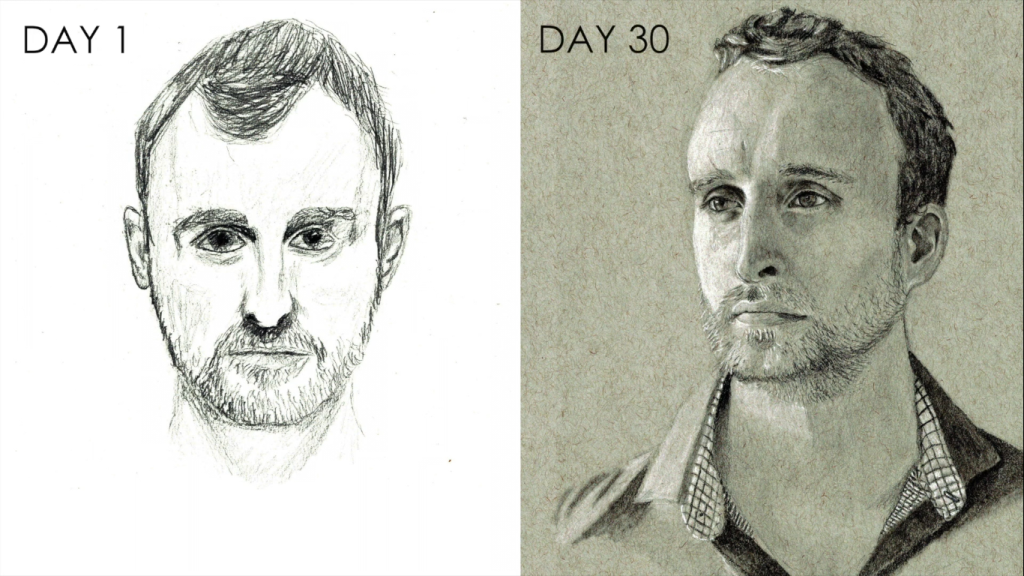
Technical skill is the aspect of creative expertise most impressive to non-artists. Being able to play a very difficult guitar solo flawlessly or render a compelling likeness of an image with paint or pencil is hard to do. But, strictly speaking, there isn’t much creativity required.
Ideational skills, in contrast, are more often what we refer to as creativity itself. What we think of as “creativity” is the ability to do something that is both valuable and original. Among practitioners, there’s usually a greater appreciation for these ideational skills, as technical skills often lose their aura of mysticism when you’ve spent enough time practicing them.
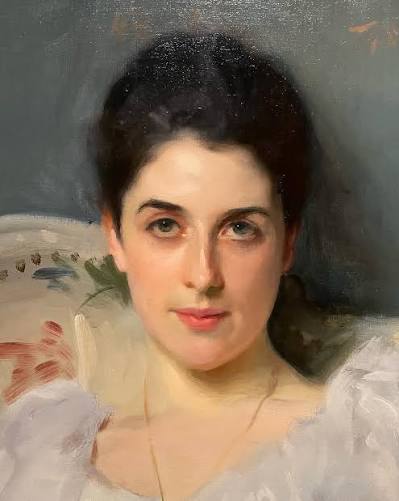
Great artists are usually good at both the technical and ideational components of creative skills, although some artists’s talents clearly lie more heavily on one side or the other. John Singer Sargent’s paintings are technically virtuosic—especially when you appreciate that most of his work was done alla prima, which means he did each painting largely in one go, rather than meticulously building up layers as was more common during the Renaissance:
In contrast, Vincent van Gogh is the best paradigm of an ideational genius with mediocre technical skills. He couldn’t keep up with the other artists in his Parisian atelier and eventually left. Even when he was in the mature phase of his painting, he frequently repeated the same subject multiple times because he struggled to get the details right:
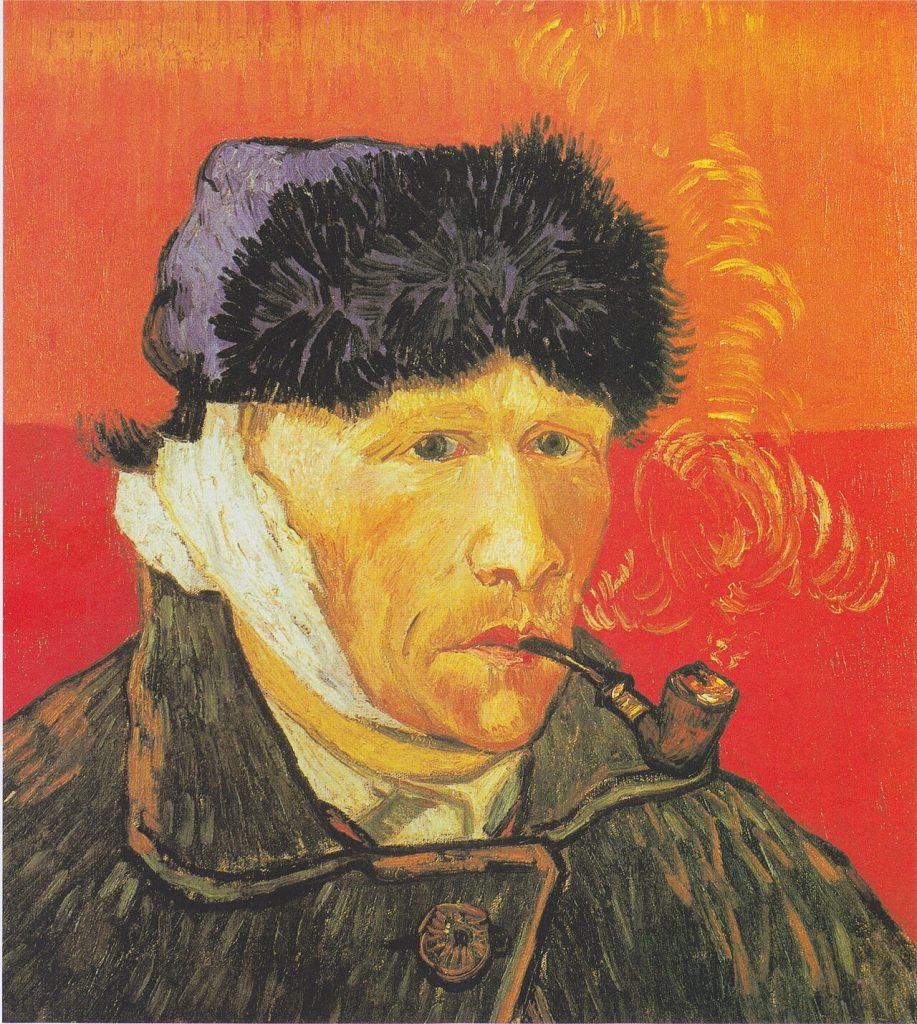
Still, as much as I’m a personal fan of Sargent’s, it’s clear that Van Gogh has had far more impact as a painter, in no small part due to his original and compelling style.
With this distinction in mind, let’s look at how how to get good at each aspect of creative skills.
Technical proficiency is the easier of the two to master. It’s hardly trivial, but technical skills are amenable to hard work and practice in a way that ideational genius often is not.
That being said, many people struggle to acquire technical proficiency in creative skills because they go about it the wrong way. All technical skills break down into three essential parts:
The first part is that to learn a creative skill you need to start with a method. This can be difficult because many artists have so overlearned their skills that they no longer appear to follow any particular method.
This was an aspect of portrait drawing that initially confounded me. Seeing street artists draw a good likeness in minutes or technically excellent artists render a likeness with a few flicks of their brush suggests that perhaps there isn’t a method at all, that success in art is simply an innate talent or intuition.
But this misunderstands the situation. Across many domains, researchers have found that nearly all expertise follows a similar pattern. Skills start out learned explicitly but, after more and more practice, parts of that explicit learning become automated—they become more like background intuition than a method you can easily articulate.1
When I started my portrait drawing challenge, for instance, I didn’t turn up very good methods. So I assumed that simply putting in a lot of bulk practice with feedback would be the key to improvement. I was right that high volumes of practice are essential, but I was wrong in assuming that methods were irrelevant.
The fact is, most portrait artists use a variety of methods to gain accuracy. Some of these are perceptual, using various means to overcome optical illusions or our natural sensory limitations to correctly assess the relative sizes, angles and tonal values in an image. Others are conceptual, building up from knowledge of lighting, geometry and anatomy to infer shapes that aren’t immediately visible.
The starting point for learning any technical skill is first to learn what the methods used are, and then practice them until they become second nature.
The next part of technical proficiency is less about rote practice and more about creating a mental model of the possibilities afforded by the medium and the constraints attached. I love this little clip discussing how Steven Spielberg achieved a scene in the movie Hook where one of the Lost Boys appears to bring down his sword quickly just a few millimeters from Robin Williams’s head.
In a pre-CGI world, Spielberg achieved this effect by filming the entire scene backwards, including the dialog of the actors, so that what appears to be a near-fatal sword strike is actually the sword lifting up quickly, in reverse.
The final key to technical virtuosity is an enormous amount of practice. Both precision and fluency matter here.
Precision, in the sense of adhering to accuracy afforded by the method you’ve adopted, is necessary because it is how you learn the underlying skill. Thus, whether you’re learning a method for drawing a portrait or playing a guitar solo, your practice will be ineffective if you permit yourself to make a ton of mistakes.
Fluency matters because motor skills, like the strumming of a guitar or the flicking of a paintbrush, will be completely different if they’re executed with different rhythms or movements. I used to struggle with the tension between precision and fluency. In visual arts, there’s often a contrast between “tighter” more controlled styles, and “looser” more expressive ones. Sometimes it feels like I need to slow down and get more precise to improve. Other times it feels like I’d do better to just loosen up. But I think this distinction is a bit of an illusion. Looser “expressive” movements are simply a different kind of motor skill than tightly controlled ones. Both of these movements need practice to master, but that doesn’t negate the need for broader technical proficiency. Like many skills in life, the solution is to practice both the movements and the methods that support them.
The other component of creative skills is having good, original ideas. Even this isn’t entirely removed from technical proficiency. If you want to understand the opportunities for expressing good, original ideas within a medium, you first have to understand what the medium affords and what it constrains. Creativity, then, is at least somewhat reliant on proficiency.
But it’s a mistake to simply collapse technical virtuosity down to creativity, because creativity relies on more than just being really good at the technical aspects of the craft.
Having really good, original ideas is a mixture of two different components:
Knowledge is the most important part. There’s good evidence that creativity itself is a largely random process. What separates more creative artists from less creative ones is less the ability to generate lots of random ideas (all of us have that ability), but that the more creative artists have better quality filters and thus can judge more reliably which ideas are actually good.
Vincent van Gogh is a case in point. Although he struggled technically, he was incredibly attuned to the artistic landscape of his time. His brother was an art dealer, and Van Gogh had a lot of contact with the emerging trends in the art world. So, even though he is often billed as an “outsider” compared to his Salon-trained contemporaries, he had insider knowledge.
Similarly, of my friends who are successful serial authors, I’m more impressed by their ability to quickly ascertain which ideas are likely to be popular and engaging than their writing skill.
Generally speaking, it’s a myth that successful creatives are outsiders to their fields.2 While the most creative works may come from the edges of a field, from those who are less invested in the dominant styles or paradigms, genuinely creative outsider art is practically non-existent.
This suggests that immersion in the social world that surrounds a creative endeavor is essential for truly successful creativity. That if you’re detached from the world that forms the fundamental judgements on what counts as good, original work, you’ll inevitably fail to produce something that qualifies.
The second aspect of creative idea generation is less about having creative ideas, and more about having the disposition to actually create them. Creativity, particularly original work, requires effort and risk-taking. You have to attempt something that may not work and, particularly in the case of many high-art pursuits, may not pay off financially either.
A lot of valuable creativity is suffocated not because the artist lacks original ideas, but because the pressure to conform to a particular style or genre is itself strong. As social psychologist Mihaly Csikszentmihalyi put it:
“The common belief is that if creativity is rare, it is because of supply-side limitations; in other words, because there are few geniuses. The truth seems to be that the limits to creativity lie on the demand-side. If there is too little creativity, it is because both individually and collectively we cannot change our cognitive structures rapidly enough to recognize and adopt new ideas.”3
Creative ideas succeed when they’re in the Goldilocks zone of originality—new enough that they’ll attract interest, but still comprehensible to the world of artistic taste.
Getting good at creative skills, of course, is easier said than done. To become an excellent painter, musician, writer or woodworker requires a ton of practice, learning, immersion and experimentation.
But even though the road may be long, it is much easier to persist in the endeavor if you have a map.
此内容由惯性聚合(RSS阅读器)自动聚合整理,仅供阅读参考。 原文来自 — 版权归原作者所有。