



惯性聚合 高效追踪和阅读你感兴趣的博客、新闻、科技资讯
阅读原文 在惯性聚合中打开

推荐订阅源

腾讯CDC
aimingoo的专栏
aimingoo的专栏
S
SegmentFault 最新的问题
A
About on SuperTechFans
Engineering at Meta
Engineering at Meta
宝玉的分享
宝玉的分享
freeCodeCamp Programming Tutorials: Python, JavaScript, Git & More
博客园 - 叶小钗
WordPress大学
WordPress大学
N
Netflix TechBlog - Medium
MyScale Blog
MyScale Blog
Stack Overflow Blog
Stack Overflow Blog
Microsoft Azure Blog
博客园 - 聂微东
M
MIT News - Artificial intelligence
F
Fortinet All Blogs
奇客Solidot–传递最新科技情报
奇客Solidot–传递最新科技情报
Blog — PlanetScale
Blog — PlanetScale
T
Tailwind CSS Blog
Recent Announcements
Jina AI
Jina AI
大猫的无限游戏
大猫的无限游戏
Apple Machine Learning Research
J
Java Code Geeks

Space - CBSNews.com

Full interview: NASA administrator Jared Isaacman on moon base plans, Artemis III, more Space station crew briefly moves to "safe haven" amid concerns over leaks Sun erupts with 3 huge solar flares, increasing chances of northern lights across U.S. NASA declares end of mission for long-lasting Mars orbiter Blue Origin vows to resume New Glenn launches before end of year in wake of massive explosion NASA taps 2 companies to develop buggies for its moon base program A look at lunar rovers for NASA's planned Moon Base Blue Origin explosion sparks space race concerns Blue Origin explosion could impact space race position against China Blue Origin explosion threatens to delay NASA's moon program Blue Origin rocket explodes in spectacular fireball A rare blue micromoon arrives this weekend and won't be back until December 2028. Here's what to expect. NASA's moon base plans include landers, buggies and drones for 2028 mission China launches Shenzhou 23 spacecraft carrying 3 astronauts, including 1 set to remain in space for a year SpaceX launches revamped Super Heavy-Starship rocket ahead of IPO SpaceX launches more powerful Super Heavy-Starship rocket on test flight Musk's SpaceX scrubs latest test launch of massive Starship rocket SpaceX launch of more powerful Super Heavy-Starship rocket scrubbed at last minute over technical issue SpaceX plans to explore "the true nature of the universe" as it preps for mega IPO SpaceX launches Dragon cargo ship on unpiloted flight to space station NASA maps show Earth's brightest and darkest regions at night NASA spacecraft to fly past Mars this week, on voyage to rare metal asteroid UFO files reveal Apollo 17 crew saw mysterious objects, lights during 1972 mission: Pentagon begins releasing new UFO files, unveiling dozens of photos, videos and documents The government Mysterious world beyond Pluto may have an atmosphere, astronomers say Inspiring and funny moments from Artemis II astronauts' town hall CBS News Things That Matter: A Town Hall with the Artemis Astronauts Artemis II crew gives 5-year-old aspiring astronaut Commander Jack a new spacesuit: "It says NASA!" What's next for the Artemis missions and potential return to the moon
"God of chaos" asteroid will pass close to Earth in 3 yea...
2026-04-16 · via Space - CBSNews.com

By

Emily Mae Czachor

News Editor

Emily Mae Czachor is a reporter and news editor at CBSNews.com. She typically covers breaking news, extreme weather and issues involving social justice. Emily Mae previously wrote for outlets like the Los Angeles Times, BuzzFeed and Newsweek.

Read Full Bio

/ CBS News

Add CBS News on Google

An asteroid the size of three football fields will pass near Earth in three years, giving scientists a rare chance to study a colossal space rock from close range.

Named Apophis — after the ancient Egyptian deity known as the "god of chaos" — the asteroid is expected to zoom past the planet on April 13, 2029, according to NASA. It will come within about 20,000 miles of Earth's surface, which is closer than many orbiting satellites, the agency said. The highest satellites typically orbit around 22,000 miles above the equator.

Scientists consider Apophis to be "a potentially hazardous asteroid," but NASA has reassured the public that it will safely clear Earth during its 2029 passage. After years of monitoring, scientists say they're confident that there's no risk of Earth impact for at least 100 years.

"There is no danger to Earth, to anyone or anything living on it, or to astronauts or satellites in space," the agency said. "But the event is an amazing and totally unprecedented opportunity to learn much more about Apophis and similar near-Earth asteroids."
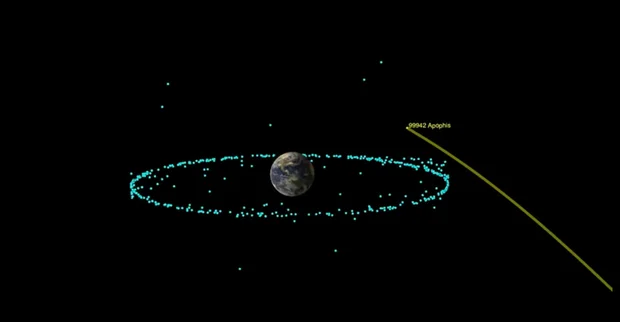
apophis.jpg
This screengrab, taken from an animation created by NASA, shows the asteroid Apophis' close approach with Earth in 2029. NASA

People on the ground in the Eastern Hemisphere will be able to observe the asteroid with their own eyes, weather permitting, according to NASA.

It's extremely uncommon for an asteroid as large as Apophis to pass as close to Earth. NASA estimates such events happen once every few thousand years on average. If that estimate is correct, then the asteroid's 2029 flyby will be the first of its kind in history to be closely observed with modern technology.

Although Apophis won't endanger people on the ground when it passes by, Earth's gravitational pull during the close encounter could potentially "stretch" and "squeeze" the asteroid, possibly triggering small landslides or other similar movements on its surface, NASA said. 

How the asteroid responds will help scientists better understand Apophis and its composition. NASA scientists believe it's made from leftover cosmic materials from the early solar system that were never part of any planets or moons.

Its mean diameter — a standardized measurement of the distance from one side of the rock to the other — is 1,115 feet, roughly the size of three football fields. The distance between the asteroid's two farthest points is quite a bit longer, at 1,480 feet or more, NASA said. Its shape is not known, but observations suggest it could look something like a peanut.

Apophis was first discovered on June 19, 2004, by astronomers Roy Tucker, David Tholen and Fabrizio Bernardi at Kitt Peak National Observatory in Arizona. Another group of astronomers caught sight of the asteroid again, later that same year, at an observatory in Australia.

In: