








Good morning premium subscribers! As ever, please ping me at ez@betteroffline.com if you have any questions.
Oracle has one of the strongest mythologies in the tech industry. Ask a regular person and they’ll tell you that it’s “incredibly profitable” and “growing fast,” that it’s “unstoppable,” and that Larry Ellison has the mandate of heaven with regard to the continual sales of software and hardware related to databases and AI.
And those people are completely and utterly wrong.
The original title of this article was “Is Oracle Dying?” because I assume, when I took a deeper look, that there’d be some sort of debate, some sort of bull case for a decades-old quasi-hyperscaler run by one of the more nakedly-evil CEOs in the history of tech. I assumed — incorrectly, I might add — that Oracle as a business was doing fine other than the ridiculous commitments it made to support the whims of Sam Altman and OpenAI via deals that I believed (and still believe) will kill Oracle.
Except it turns out that Oracle has already been on a death spiral for the best part of a decade (if not longer) and has only survived this long by screwing its customers, taking on masses of debt, and — most importantly — more than $85 billion in acquisitions over the last 23 years. Pretty much every major product line outside of databases is a hodge-podge of other people’s innovation stapled together with a legendary contempt for the customer. These acquisitions (and continual price increases) are the only thing keeping the reaper from Oracle’s door other than margin-destroying GPUs.
And that’s why Oracle’s revenue looks like this:
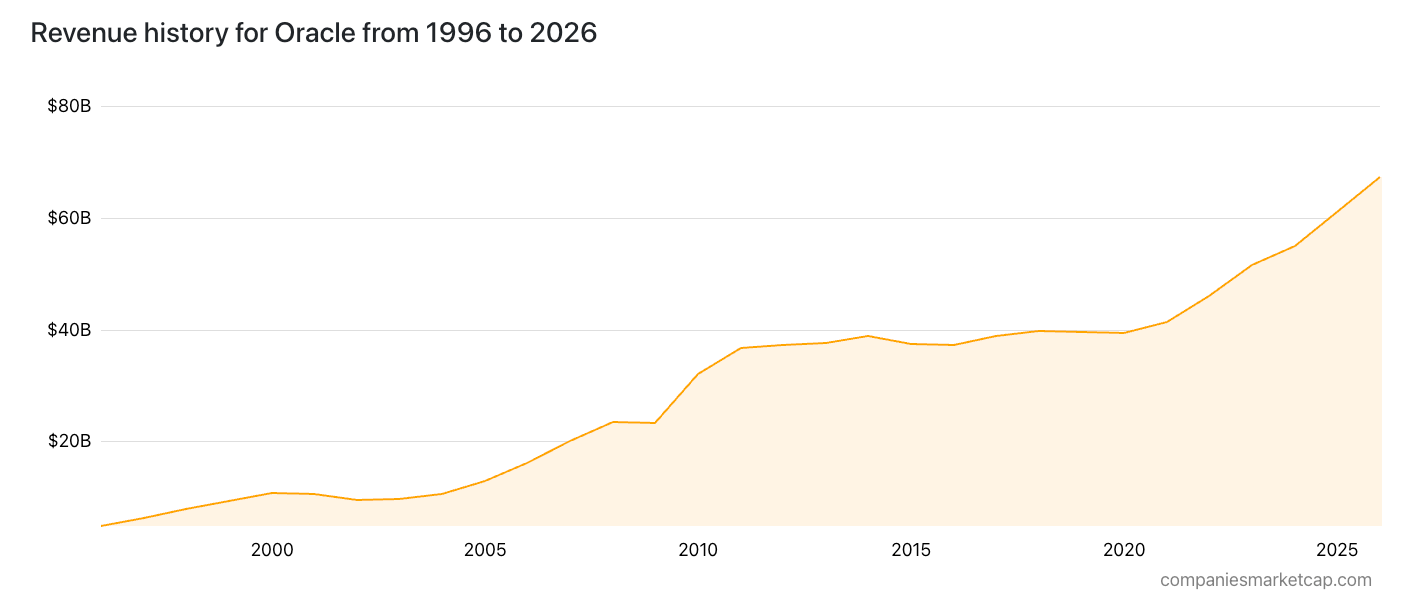
After April 2009’s $5.7 billion acquisition of Sun Microsystems, Oracle’s revenues barely kept pace with inflation until December 2021’s $28.3 billion acquisition of Cerner allowed it to create Oracle Health, adding about $6 billion in annual revenue that had 40% lower margins (about 21.7%) than Oracle’s other businesses, though Oracle immediately started closing offices and brutal layoffs to try and bring them up.
And as I mentioned above, Oracle’s other plan was to sink a little over $99 billion in capital expenditures since the middle of calendar year 2020 into AI GPUs.
Anyway, let’s see what that’s done to margins-OH MY GOD!
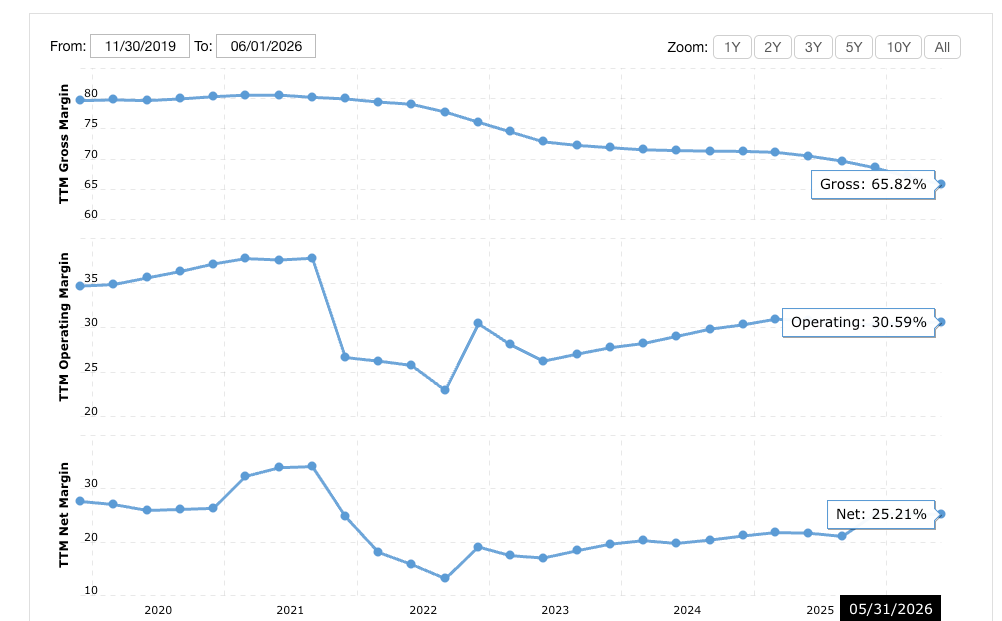
Oracle is a decades-long mission to keep reapplying lipstick to a pig. Billions of dollars of acquisitions have, for the most part, only succeeded in keeping the company’s revenue growth from going negative, and as noted by forensic accountant Howard M. Schilit, this is one of the most well-documented cases of accounting shenanigans being used to cover up that a business is in decline.
Today’s newsletter is a sequel to the Hater’s Guide To Oracle, where I told the sordid tale of how Larry Ellison grew a massive, lucrative business out of a database business that one reporter once told me was a “law firm with a database company attached,” an Enterprise Resource Planning (ERP) product that competes with SAP to create the most-annoying way to run a large company, and a business built around licensing Java that exists mostly to email people and say “you need to pay us for Java or we’ll sue you.”
Then, as I’ve mentioned, there’s Oracle’s cloud infrastructure business, a decade-old also-ran that was meant to compete with Microsoft Azure and Amazon Web Services, but only managed to catch up following the advent of AI GPUs and a movement where all it took to party was buying billions of GPUs and saying “gosh darn, we love AI.”
I originally started drafting this as a much tamer piece where I’d ask whether Oracle was dying, but as my editor and I started digging into the research, it became obvious that not only is Oracle dying, it’s been dying for years, kept alive through decades of acquisitions and a desperate and dangerous commitment to generative AI.
And AI, I believe, will be what eventually kills Oracle dead.
In the past, all Oracle had to do to survive was buy somebody else’s company and replace its flagging revenues with theirs, turning the screws on their customers and laying off as many people as necessary to balance the books. While chaotic and decaying, Oracle’s empire has kept above water by never overextending itself, always keeping a positive free cashflow, and generally avoiding buying into industry hype cycles outside of whatever SaaS vehicle might potentially plug the gap in its earnings.
Yet with AI, Oracle broke its long-standing trend of letting someone else figure out the innovation, choosing instead to build its own cloud infrastructure, spending more in capex in its last fiscal year ($55.6 billion) than it did in the previous nine years combined ($50.4 billion), tripling its debt from $56.91 billion in FY2017 to $167.4 billion in FY2026, a year that ended with its free cashflow sitting at negative $23.69 billion.
For comparison, Oracle has had positive free cashflow every single year since 2001, including the Great Financial Crisis and COVID.
Oracle has doomed itself with its commitment to the AI bubble. It has committed to building 7.1GW of data center capacity for one company — OpenAI — as part of a $300 billion, five-year-long contract that requires it to build an impossible amount of capacity in an impossible period of time for a client that could never afford the $70 billion or more in annual costs to make any of it worth it.
Today I am going to talk trash on what I consider to be one of the single-worst companies in the tech industry that’s survived only through financial engineering and never, ever overextending itself.
With revenue plateauing and customers in revolt, Oracle’s future already looked murky, but with the power of AI — and $95 billion in FY2027 capex — it’s becoming increasingly clear that this may be Larry Ellison’s last dance with Silicon Valley.
This is the Hater’s Guide To Oracle Part 2, or AIpoaclypse Now.
此内容由惯性聚合(RSS阅读器)自动聚合整理,仅供阅读参考。 原文来自 — 版权归原作者所有。