






Children’s Hospital of Philadelphia is using open source AI tools to model children’s hearts in seconds — with the goal of enabling safer, more precise care for kids with congenital heart disease.
About 1% of all live births involve a congenital heart defect — and no two are alike.
A child born with a hole between the lower chambers of their heart, or a leaking valve in the single pumping chamber keeping them alive, needs care that fits their exact anatomy. Historically, the devices surgeons reach for were almost never designed with that specific child in mind.
“You’ve got a one-of-a-kind kid and an off-the-shelf device,” said Dr. Matthew Jolley, a cardiologist and researcher at Children’s Hospital of Philadelphia, or CHOP. “Our job is to find what fits — and modeling lets us do that before anyone goes into the cath lab or operating room.”
CHOP’s cardiac modeling service, built on MONAI — an open source medical imaging framework cofounded by NVIDIA — takes the images a child’s care team already has, such as CT scans, MRI and 3D ultrasound, and produces anatomically precise heart models in just seconds. A workflow that once required four hours of work by a skilled researcher now completes fast enough for routine clinical use.
The approach is spreading.
More than 20 children’s hospitals across the U.S. now run cardiac modeling programs. At Boston Children’s Hospital, modeling supports more than half of all cardiac surgeries — roughly 500 cases a year. CHOP expects to reach about 200 modeled cases this year. Where this work began in cardiac care, CHOP is now aiming to apply the same tools across multiple disciplines through the IDEA Lab, part of the hospital’s Morgan Center for Research and Innovation.
When Jolley joined CHOP in 2015, 3D echocardiography was just coming online. There were tools for modeling adult valves, but almost nothing built for the complex, small anatomies he was treating.
His lab worked with the open source community to build SlicerHeart — an extension of 3D Slicer open source software for visualizing, segmenting and analyzing 3D medical images — and began developing workflows to model pediatric hearts and valves from multiple imaging modalities.
For years, producing a single model meant a skilled research assistant spending hours at a workstation. Machine learning changed that.
Using MONAI Label and NVIDIA’s Auto3DSeg implementation, Jolley’s team trained segmentation networks on pairs of prior images and models. The output meets the same quality standard a trained human would produce — in seconds rather than hours.
“Machine learning has become just bread and butter,” Jolley said. “As soon as we’ve made 10 or 20 image-model pairs, we train a model and start applying it.”
Using MONAI, CHOP can compare how two different artificial valves will fit in a patient’s heart to improve surgery planning. Coloring shows the stress on the cardiac walls created by the two different valves.
The clinical impact was seen quickly. For complex ventricular septal defects — holes between the heart’s lower chambers — CHOP now models routinely before surgery.
One early case made the value clear: A child had already undergone two failed repair attempts, with surgeons unable to locate the defect with traditional methods. The 3D model clarified the anatomy. The repair succeeded on the first try.
For cases like these, Jolley said, cardiac modeling has moved from research to standard of care.
Visualization alone isn’t the end goal. Jolley’s team wants to know not just what a child’s heart looks like, but what will happen when a device is deployed inside it — before any procedure begins. That’s where Newton comes in.
Newton is an open source physics engine built on the NVIDIA Warp Python framework that runs physics simulations on GPUs. CHOP is working with NVIDIA and the open source community to build biomechanics-focused simulation frameworks with Warp that can be brought into Newton, originally intended for simulation-based AI robot training.
These frameworks, once integrated with 3D Slicer and SlicerHeart, can help doctors understand tissue material properties that determine how a device will deploy in a given patient. With GPU acceleration, they can reduce the time needed for cardiac device simulation from up to four hours — or a full overnight run for multiple configurations — to near real time.
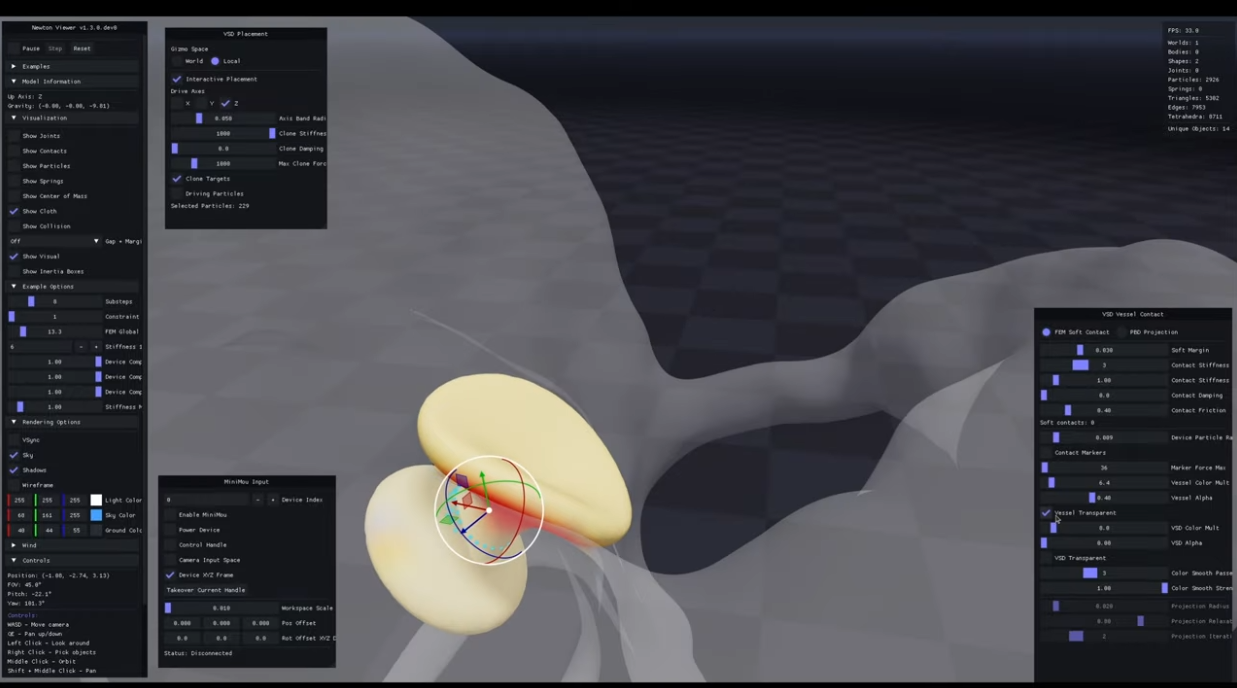
CHOP has started implementing features built on NVIDIA Warp and Newton to understand how a device will work in a patient’s heart.
In practice, a clinician could compare how different devices fit a child’s specific anatomy and get results fast enough to inform a same-day decision.
CHOP has begun to implement features built on Warp and Newton for the closure devices used to seal holes in children’s hearts — and hopes to apply similar methods for simulations of transcatheter valves. The open source architecture of Warp and Newton is being connected with SlicerHeart, with the long-term goal of bringing real-time simulations into clinical workflows.
A coupler using SlicerHeart and NVIDIA Omniverse digital twins, powered by OpenUSD, is also in development. OpenUSD’s open source 3D interoperability allows diverse data and solvers to be integrated into simulations built from patient images. These simulations can then flow into virtual reality environments and harness embedded vision-language models (VLMs), allowing clinicians to intuitively query and interact with a child’s cardiac anatomy in simulation before acting on it.
About 2.4 million people in the U.S. live with congenital heart disease. Historically, this has been a population too rare and too diverse to attract traditional device-company investment at the scale families need. No single company has built the tools Jolley’s team requires. No single institution could build them alone.
Open source is the workaround.
SlicerHeart’s tools are free to use and build on. Researchers at Stanford and Boston Children’s contribute additional tools alongside CHOP. A national consortium of children’s hospitals is now forming to build the next generation of shared modeling infrastructure, with open source as the connective tissue across institutions.
One of CHOP’s research collaborations simulates how heart valves interact with blood flow. Understanding these dynamics is critical for predicting disease progression, planning repairs, and evaluating new devices.
“It’s too small a population to support traditional commercial development by normal economics,” Jolley said. “But it’s such an important problem that between the research community and philanthropy, people are getting behind it. Open source defies traditional economics for small and heterogenous populations by allowing collaboration and progress without barriers.”
NVIDIA’s investment and active collaboration with others in developing open platforms — MONAI for medical imaging AI, Newton for physics simulation, OpenUSD for 3D interoperability and virtual reality — gives teams like Jolley’s access to infrastructure maintained at industrial scale. A lab at a children’s hospital can now quickly harness tools that would otherwise require a company-sized engineering team to build and sustain, while benefiting from the continued innovation of a broad open source community.
Learn how MONAI is advancing medical imaging AI.
此内容由惯性聚合(RSS阅读器)自动聚合整理,仅供阅读参考。 原文来自 — 版权归原作者所有。