

惯性聚合 高效追踪和阅读你感兴趣的博客、新闻、科技资讯
阅读原文 在惯性聚合中打开

推荐订阅源

大猫的无限游戏
大猫的无限游戏
N
News | PayPal Newsroom
cs.AI updates on arXiv.org
P
Palo Alto Networks Blog
P
Privacy & Cybersecurity Law Blog
H
Hacker News: Front Page
Vercel News
Vercel News
阮一峰的网络日志
阮一峰的网络日志
博客园 - 叶小钗
IT之家
IT之家
B
Blog
Google DeepMind News
U
Unit 42
cs.CV updates on arXiv.org
Attack and Defense Labs
美团技术团队
Y
Y Combinator Blog
爱范儿
爱范儿
L
Lohrmann on Cybersecurity
O
OpenAI News
酷 壳 – CoolShell
酷 壳 – CoolShell
W
WeLiveSecurity
Microsoft Azure Blog
H
Help Net Security
T
Threatpost
Application and Cybersecurity Blog
TaoSecurity Blog
TaoSecurity Blog
Simon Willison's Weblog
Security Archives - TechRepublic
M
MIT News - Artificial intelligence
Last Week in AI
Last Week in AI
Apple Machine Learning Research
AWS News Blog
AWS News Blog
D
Darknet – Hacking Tools, Hacker News & Cyber Security
T
Tenable Blog
The GitHub Blog
The GitHub Blog
Google DeepMind News
Help Net Security
Help Net Security
小众软件
小众软件
罗磊的独立博客
B
Blog RSS Feed
S
SegmentFault 最新的问题
L
LINUX DO - 热门话题
Scott Helme
Scott Helme
G
GRAHAM CLULEY
Martin Fowler
Martin Fowler
Exploit-DB.com RSS Feed
The Last Watchdog
The Last Watchdog
P
Proofpoint News Feed
Security Latest
Security Latest

Changelog — PlanetScale

Replica connections graph — PlanetScale Branch start maintenance webhook now available for Vitess enterprise customers — PlanetScale Deploy request UI updates — PlanetScale PostgreSQL CPU and I/O tracking — PlanetScale Branch start maintenance webhook — PlanetScale Cloudflare Workers integration — PlanetScale PlanetScale for Postgres is now Generally Available — PlanetScale PostgreSQL Schema Recommendations — PlanetScale Postgres maintenance windows — PlanetScale Support for 10 new Postgres extensions — PlanetScale 2025 PCI DSS reporting now available — PlanetScale AWS PrivateLink for Postgres — PlanetScale Google Cloud Provider support for Postgres databases — PlanetScale Insights: percent runtime — PlanetScale New region: AWS ca-central-1 (Montreal) — PlanetScale Postgres event triggers are now supported — PlanetScale New Postgres extension: pg_squeeze — PlanetScale Provisioned IOPS display for Metal clusters — PlanetScale Insights: max query latency graphs — PlanetScale Pinned databases update — PlanetScale New Postgres extensions: pg_cron and pg_partman_bgw — PlanetScale pscale shell now supports Postgres databases — PlanetScale Migration guides for Aurora, Neon, and Supabase — PlanetScale New pscale role commands for CLI — PlanetScale Postgres migration guides and scripts — PlanetScale Postgres role management — PlanetScale Expanded Postgres network-attached storage I/O configuration — PlanetScale 2025 SOC 1 Type 2 & SOC 2 Type 2 reports now available — PlanetScale Prometheus Metrics Additions: vstreamer events and errors — PlanetScale Postgres network-attached storage configuration — PlanetScale PlanetScale for Postgres — PlanetScale Metal storage estimation for deploy requests — PlanetScale SSO support for multiple organizations — PlanetScale New keyspace VSchema API endpoints — PlanetScale Aggressive deploy request cutover — PlanetScale Postgres migration scripts — PlanetScale Access request webhook — PlanetScale Webhook API endpoints — PlanetScale Storage webhook — PlanetScale Edge metrics are now available for Single Tenant and Managed customers — PlanetScale Insights: time range and refresh interval updates — PlanetScale Model Context Protocol support — PlanetScale PlanetScale workflows is now GA — PlanetScale Prometheus metrics are now available — PlanetScale Restore backups with a cluster size — PlanetScale Keyspace replication settings — PlanetScale Advanced workflow settings — PlanetScale You can now configure max VTGates — PlanetScale SLA commitment improvement — PlanetScale Metal instances are now available — PlanetScale You can now configure your VTGates in the dashboard — PlanetScale Adjusting the number of shards in a sharded keyspace — PlanetScale Infrastructure diagram: per-shard rollout status — PlanetScale Deploying changes to sharded keyspaces — PlanetScale Throttling deploy requests — PlanetScale PlanetScale vectors now supports quantization — PlanetScale PlanetScale workflows — PlanetScale Insights sparklines — PlanetScale Service tokens: all database permissions — PlanetScale Cluster configuration — PlanetScale Brownout notice: legacy connection strings — PlanetScale 2024 PCI DSS reporting now available — PlanetScale Instant deployments — PlanetScale Timezone display preferences — PlanetScale Service token permissions: branch creation — PlanetScale Insights: max latency reporting — PlanetScale Branching: rename and replace default branch — PlanetScale Insights: index usage tracking — PlanetScale Prevent backup deletion — PlanetScale 2024 SOC 2+ HIPAA — PlanetScale Insights: increased graph resolution — PlanetScale Insights: absolute x-axis time — PlanetScale Webhooks: New pending_cutover event for deploy requests — PlanetScale Deploy requests: auto-delete branch — PlanetScale Deprecation: legacy connection strings — PlanetScale Deploy requests: solo admins may now self-approve — PlanetScale Reason for closing a schema recommendation — PlanetScale Webhook payload update — PlanetScale New audit logs API endpoint — PlanetScale Deprecating old versions of the PlanetScale CLI — PlanetScale Branch cluster size updates now available via the API — PlanetScale New side navigation layout — PlanetScale VTGate errors are now in DataDog — PlanetScale Pin frequently used databases — PlanetScale Billing data now available via the API — PlanetScale Connecting to PlanetScale privately on GCP — PlanetScale Connecting to PlanetScale privately on AWS — PlanetScale Insights query latency percentile filtering — PlanetScale Character set and collation upgrade recommendations — PlanetScale Global replica credentials — PlanetScale Webhooks are now generally available — PlanetScale Hobby plan deprecation — PlanetScale Insights anomaly webhook — PlanetScale Deploy requests: remember auto-apply — PlanetScale Monthly spend alerts — PlanetScale Deprecating the Hobby plan — PlanetScale CPU and memory metrics now in Datadog — PlanetScale Schema recommendations — PlanetScale Safe migrations on development branches — PlanetScale Deprecating Scaler plan — PlanetScale
Single-node databases are now generally available — PlanetScale
2025-11-14 · via Changelog — PlanetScale

Single node Postgres databases are now available to all customers, starting at just $5 per month. Single node databases are a cost-effective option for early-stage projects, testing, development, and proof of concepts.

When creating or resizing a Postgres database, you have the option to choose between two types of production databases:

  • A highly available (HA) configuration with 1 primary and at least two replicas (the default).
  • A single-node, non-HA configuration.

Single-node databases do not come with replicas for high availability, but you can easily switch from non-HA mode to HA mode with just a couple clicks on your Clusters page.

This release also includes our new PS-5 database size and lower prices for PS-DEV Postgres development branches.
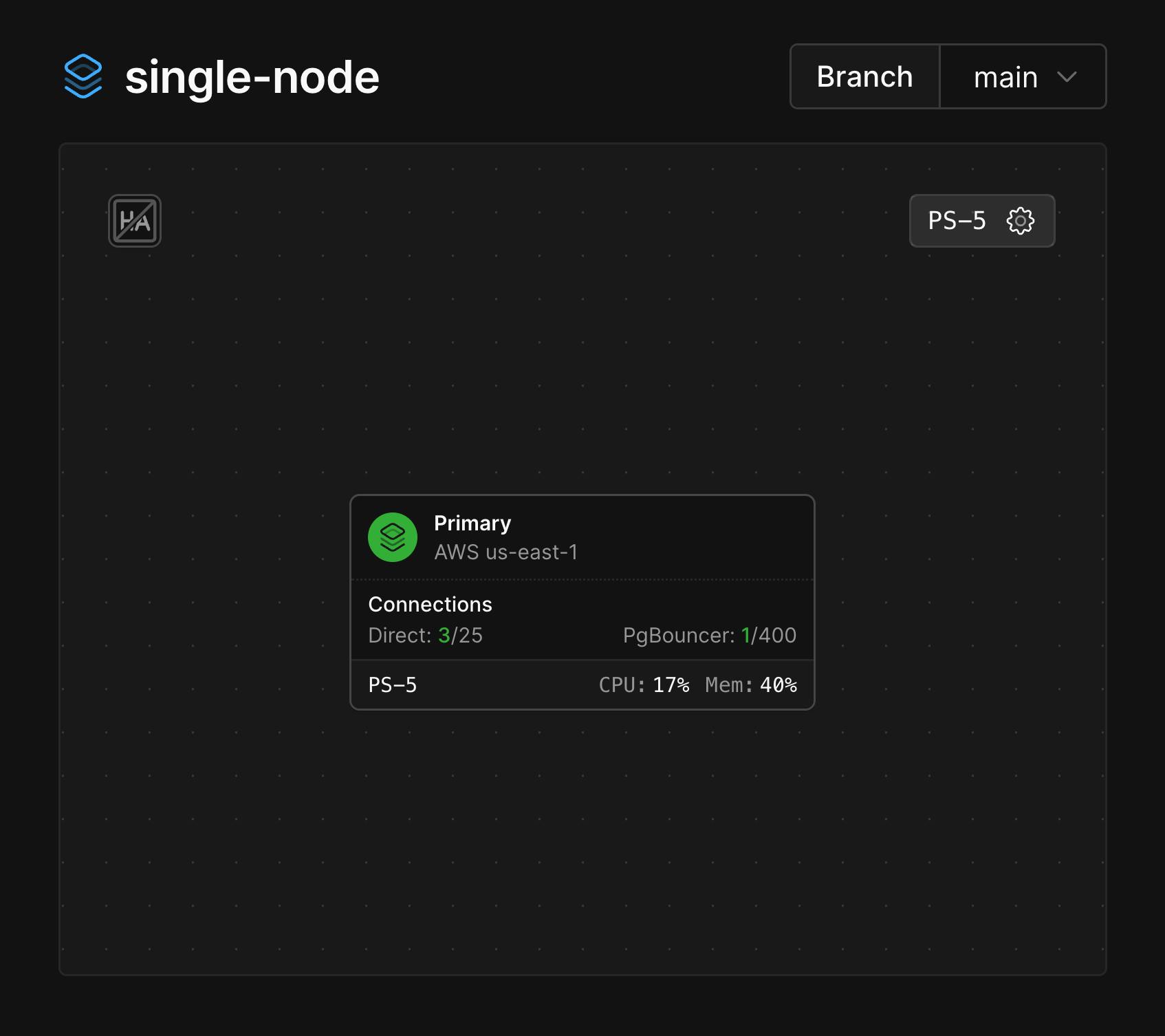
Single node Postgres database

Learn more about single-node databases in the announcement blog and in the documentation.