



惯性聚合 高效追踪和阅读你感兴趣的博客、新闻、科技资讯
阅读原文 在惯性聚合中打开

推荐订阅源

Help Net Security
Help Net Security
U
Unit 42
T
Tailwind CSS Blog
Y
Y Combinator Blog
阮一峰的网络日志
阮一峰的网络日志
博客园_首页
云风的 BLOG
云风的 BLOG
博客园 - Franky
D
DataBreaches.Net
Last Week in AI
Last Week in AI
人人都是产品经理
人人都是产品经理
Cisco Talos Blog
Cisco Talos Blog
Threat Intelligence Blog | Flashpoint
Blog — PlanetScale
Blog — PlanetScale
Know Your Adversary
Know Your Adversary
宝玉的分享
宝玉的分享
V
Visual Studio Blog
AWS News Blog
AWS News Blog
NISL@THU
NISL@THU
I
Intezer
freeCodeCamp Programming Tutorials: Python, JavaScript, Git & More
P
Privacy International News Feed
T
Tor Project blog
S
Securelist
Microsoft Security Blog
C
Cybersecurity and Infrastructure Security Agency CISA
Recorded Future
Recorded Future
C
Cisco Blogs
P
Palo Alto Networks Blog
Hacker News: Ask HN
Hacker News: Ask HN
Cyber Security Advisories - MS-ISAC
Recent Commits to openclaw:main
月光博客
月光博客
T
Threat Research - Cisco Blogs
N
News and Events Feed by Topic
AI
AI
Cyberwarzone
Cyberwarzone
cs.AI updates on arXiv.org
奇客Solidot–传递最新科技情报
奇客Solidot–传递最新科技情报
MongoDB | Blog
MongoDB | Blog
Microsoft Azure Blog
Scott Helme
Scott Helme
K
KPMG report finds enterprise disconnect between AI and its ROI | CIO
Martin Fowler
Martin Fowler
量子位
L
LINUX DO - 热门话题
H
Heimdal Security Blog
GbyAI
GbyAI
P
Privacy & Cybersecurity Law Blog
博客园 - 【当耐特】

The Microsoft Cloud Blog

The AI Strategy Roadmap: Five drivers of successful AI transformation | The Microsoft Cloud Blog Small and medium businesses aren't waiting for an AI invitation—they're already leading | The Microsoft Cloud Blog The 2026 Agent Confidence Index: Where 300 builders see real momentum | The Microsoft Cloud Blog 4 paths to Frontier Transformation: From AI experimentation to real business value | The Microsoft Cloud Blog Achieving success with AI - The Official Microsoft Blog Scaling AI with 8 to 20x energy efficiency | The Microsoft Cloud Blog The CMO on the frontier: From AI experimentation to AI at work AI amplifies creativity by removing friction You’re not late to AI—you’re early to Frontier Transformation From AI ambition to Frontier Transformation: Readiness defines the leaders Your AI steering committee’s 2026 checklist: Sovereignty How Frontier Firms are rebuilding the operating model for the age of AI Cricket Australia uses AI Insights to bring fans closer to the action - Source Asia Your AI steering committee's 2026 checklist: Observability | The Microsoft Cloud Blog Frontier Transformation is powering growth and innovation across industries | The Microsoft Cloud Blog The New York Jets are happy to have a 'Titan' in their corner at the NFL Draft - Source AI Decision Brief: How leaders can drive Frontier Transformation Navigating digital sovereignty at the frontier of transformation How to introduce agents into your workforce: 5 actions leaders can take María Almenara: The First Data-Driven Peruvian Bakery Introducing the First Frontier Suite built on Intelligence + Trust Unify. Simplify. Scale: Microsoft Dragon Copilot meets the moment at HIMSS 2026 | The Microsoft Cloud Blog How to bring human expertise and AI together: 3 impactful initiatives A new study explores how AI shapes what you can trust online  | Microsoft Signal Blog | Microsoft Microsoft Azure achieves GxP milestone, reinforcing trust for regulated workloads | The Microsoft Cloud Blog Microsoft meets 2025 renewable energy goal with global projects and community impact A milestone achievement in our journey to carbon negative
AI needs more than intelligence—it needs humanity
Jeana Jorgensen · 2026-05-22 · via The Microsoft Cloud Blog

AI is moving faster than any technology we’ve seen before, and organizations are under pressure to show results. And yet, the question remains: Why doesn’t progress match the promise?

The answer isn’t more tools. It’s what people are enabled to do with them.

The friction we see is that many people are unsure how to use AI to their greatest benefit. Companies often struggle to measure the impact of their AI investments because they likely haven’t yet demonstrated return on investment for their employees.

Progress comes when employees actively adopt AI and see meaningful impact on their work—when they’re confident about questioning outputs, applying judgment, and integrating it into their real work.

But there’s another layer to that friction.

Alongside the industry’s excitement and expectations, there’s real hesitation. AI still feels uncertain: Where do I start? Am I already behind? What if I get this wrong?

That hesitation is a signal that access alone isn’t enough; people need to feel confident that AI will elevate their work, not detract from it, or worse, make them irrelevant.

You aren’t behind; you just need to get started. And you do that by learning one new skill at a time. Even skeptics can become strong advocates if they start by learning how to use AI to do the traditional task they dislike most. Once they feel the inevitable benefit, they’re highly likely to try the next task they don’t like doing. From there, we often see a path of continuous learning.

Here’s what too few people realize: technology alone isn’t going to elevate their performance. When everyone knows how to use the tools, the differentiator will be their uniquely human skills that no AI tool can replace.

Human skills aren’t “soft”—they’re foundational

In the New York Times bestselling book Open to Work: How to Get Ahead in the Age of AI, the authors describe five human capabilities that no machine can replace: curiosity, compassion, creativity, courage, and communication.

That same idea extends beyond the individual—organizations aren’t abstract systems; they’re made of people.

What we often call “organizational skills” are simply human skills, practiced consistently and scaled intentionally.

From human potential to organizational capability

A new IDC InfoBrief sponsored by Microsoft, Powering Up: Human Skills for the AI Era,1 highlights a familiar gap: organizations are investing heavily in AI tools but far less in the capabilities needed to turn them into value.

These capabilities span cognitive, collaborative, leadership, ethical, and business domains.

How do these skills scale? They come together across three levels:

  1. Individual. How people think, decide, take risks, and act—especially when working with AI.
  2. Teams. How those capabilities show up in collaboration and workflows.
  3. Organization. What leaders reinforce through culture, systems, and governance.

This is where personal capability becomes organizational advantage.
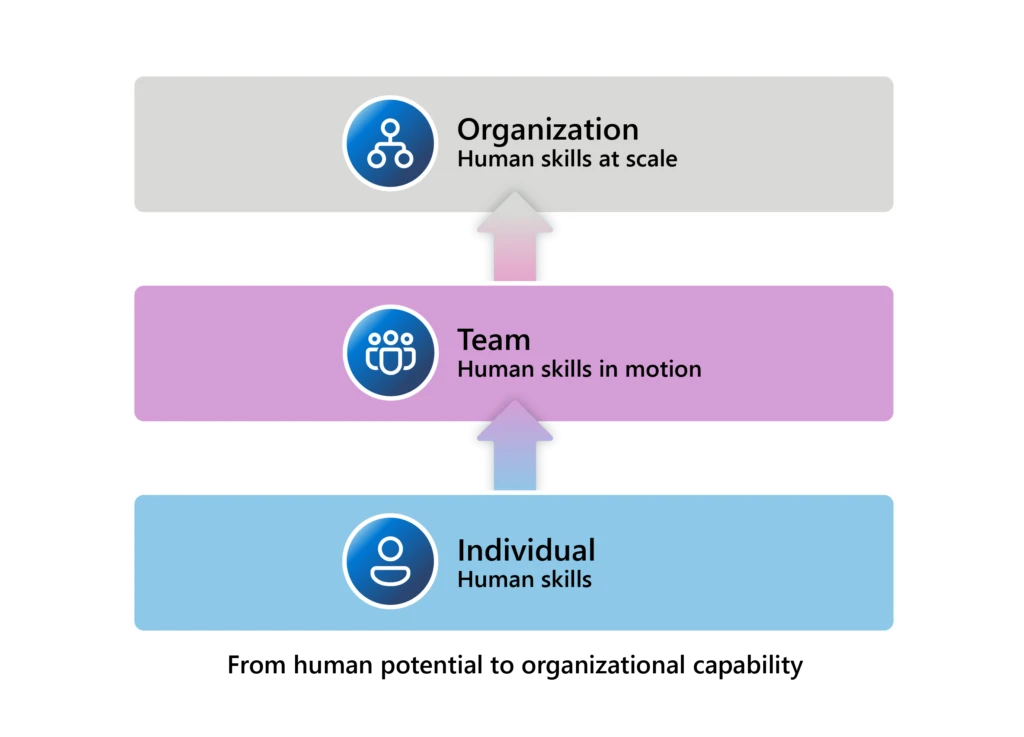
How human skills scale in the AI era

The human skills explored in Open to Work don’t disappear at the organizational level; they show up differently at scale.

1. Curiosity: Cognitive and collaborative capability

At the individual level, curiosity starts with a desire to explore and learn what’s possible. At scale, this shows up as:

  • Asking better questions to challenge assumptions.
  • Exploring different approaches beyond the first answer.
  • Sharing learnings across teams.

2. Compassion: Ethical and leadership capability

Compassion is empathy and awareness of impact. At scale, this shows up as:

  • Applying ethical judgment and accountability.
  • Identifying and addressing bias.
  • Practicing responsible data use.

3. Creativity: Cognitive and business capability

Creativity isn’t about aesthetics. It’s about imagining what doesn’t yet exist. At scale, this shows up as:

  • Framing problems more effectively.
  • Creating new sources of value.
  • Driving innovation beyond efficiency.

AI can optimize what exists. Humans decide what’s worth building next.

4. Courage: Cognitive and leadership capability

Courage starts with acting even when outcomes aren’t certain. At scale, this shows up as:

  • Applying critical thinking and judgment.
  • Making decisions in complex environments.
  • Leading change without guaranteed outcomes.

5. Communication: Leadership and business capability

Communication starts with clarity and listening. At scale, this shows up as:

  • Setting a clear vision for AI transformation.
  • Translating technical capability into business meaning.
  • Aligning teams across functions.

What leaders should consider next

Taken together, these examples point to a clear pattern: personal strengths become organizational advantage when they’re built at scale.

If human skills are the differentiator, how do we design for them intentionally? Three mindset adjustments matter most—especially in a moment where excitement about AI is often matched by hesitation about where to begin:

  1. Focus on the work, not just the training
    • Human skills develop through real decisions, real collaboration, and real accountability—not one-off courses.
  2. Model the behaviors consistently
    • What leaders practice signals what’s safe. Judgment, curiosity, empathy, and learning must be seen, not just stated.
  3. Measure what actually changes outcomes
    • Beyond adoption, organizations need to track decision quality, trust and confidence, and cross-functional outcomes.

The real opportunity of AI

AI won’t make organizations less human—but it will raise expectations for how people think, decide, and work.

The organizations that succeed won’t be the most automated. They’ll be the ones that invest in people as intentionally as they invest in technology.

That’s the opportunity—and the work—in front of us.

Continue learning at Microsoft AI Skills Fest

If you’re looking for a practical way to build AI and human skills, no matter your role, join us for Microsoft AI Skills Fest, June 8–12, 2026. It’s a week of free, guided, digital learning designed to make skilling more approachable and relevant, with options for leaders, business users, technical roles, and developers.

On the AI Skills Fest Mainstage, human skills will be a prominent theme. I’ll be hosting a conversation with Aneesh Raman, co-author of Open to Work, and Gina Smith, PhD, co-author of Powering Up: Human Skills for the AI Era. Together we’ll unpack what it takes to build human capability alongside AI—from individual habits to team practices to organization-wide norms.

To go deeper, we’ll also have a dedicated session with Dr. Michael Gervais, sport performance psychologist and founder of Finding Mastery, to help you develop the mindsets and human skills that will help you thrive as AI reshapes how we work.

We hope to see you there.

1IDC InfoBrief, sponsored by Microsoft, Powering Up: Human Skills for the AI Era, Doc. US54451326-IB, May 2026.