


惯性聚合 高效追踪和阅读你感兴趣的博客、新闻、科技资讯
阅读原文 在惯性聚合中打开

推荐订阅源

WordPress大学
WordPress大学
B
Blog RSS Feed
The GitHub Blog
The GitHub Blog
爱范儿
爱范儿
博客园 - 司徒正美
J
Java Code Geeks
酷 壳 – CoolShell
酷 壳 – CoolShell
Engineering at Meta
Engineering at Meta
大猫的无限游戏
大猫的无限游戏
D
Docker
Blog — PlanetScale
Blog — PlanetScale
Recent Announcements
罗磊的独立博客
Microsoft Azure Blog
博客园 - 聂微东
奇客Solidot–传递最新科技情报
奇客Solidot–传递最新科技情报
人人都是产品经理
人人都是产品经理
Stack Overflow Blog
Stack Overflow Blog
M
MIT News - Artificial intelligence
腾讯CDC
T
The Blog of Author Tim Ferriss
小众软件
小众软件
U
Unit 42
T
Tailwind CSS Blog

Cerbos - All Posts

Authentik vs Keycloak: Self-hosted IdP comparison Mapping business requirements to authorization policy for automotive Fine-grained authorization for AI gateways EIC 2026: Stop counting agents, protect what they can touch Agent skill for writing authorization policies in Claude Desktop Identity security in 2026 EIC 2026 takeaways: the identity stack built for humans will not hold up for AI agents Already have authentication? Here's the authorization layer you still need. Tokens are authorization decisions: a guide to policy-driven token issuance What is a Runtime Authorization Platform It's a dimmer switch, not a kill switch. How CISOs are rethinking AI agent governance From maps to bitmaps (and from bitmaps to bitmaps) AuthZEN, Shared Signals, SCIM Events, IPSIE: Notes from the OpenID Enterprise Panel How do you update authorization policies without redeploying your application? IIW42 recap: Where agent authorization got real Cerbos PDP v0.52.0/v0.53.0: Engine performance, security hardening, and CEL path functions Authorization Management Platforms: what they do, how they work, and where they fit PocketOS AI coding agent deleted a production database in 9 seconds Non-Human Identity management still has a blind spot Supabase alternative in 2026: Best open source auth options Benefits of on-premise authorization: Why enterprises are moving toward self-hosted Authorization policies: How to write, test, and validate them (faster with AI) Agent skill for writing authorization policies How much does it cost to build authorization in-house? Why centralized authorization governance reduces incident response time OPA alternative Why AI agents make authorization a right now problem Modernizing legacy application authorization: why it’s your biggest security blind spot How to add authorization to legacy applications without code changes 5 authorization blind spots auditors find, and how to fix them
Tooling, Performance, .NET SDK, JS SDK, Playground - Cerb...
Alex Olivier · 2022-06-16 · via Cerbos - All Posts

The latest release of Cerbos, v0.18, includes performance and tooling improvements, a new .NET SDK, a major upgrade to the JavaScript SDK, and the addition of viewing the Query Plan in the Playground.

We have been working closely with users of Cerbos such as Utility Warehouse, 9fin, Salesroom, Refine, and Doorfeed on this release and can’t wait to hear more on what you would like to see in future releases - join our Slack community to join the conversation.

Tooling & Performance

Cerbos v0.18 has been focused on a number of tooling updates and optimizations.

  • The cerbosctl utility is now available as a container. It makes it easier to provision Cerbos on container orchestration systems using native constructs (for example, init containers on Kubernetes).
  • Cerbos now caches the verification state of JWTs in memory to avoid repeating the expensive cryptographic operations on each and every request. The tokens are still validated each time to ensure that they haven’t expired and are valid for use.
  • There are several improvements to the PlanResources API.
    • An optimization pass has been introduced to simplify some of the logical expressions in the query plan and eliminate redundant conditions.
    • All aliases, such as R for request.resource, are expanded to their long-form in the plan output to help make the API response predictable.
    • The output of the filterDebug field in the query plan response is standardized to use S-expression format to ensure that it is easily verifiable by automated tools.
  • Calls to the PlanResources API are now captured by the audit logger and written to the decision log with the full serialized request and response.
  • Cerbos now reports metrics about store synchronization attempts and any failures encountered. They can be used to create alerts to detect when the policy store is drifting from the remote source due to network issues or credential expiry.
  • Distributed traces received in any of W3C trace context, B3, or Baggage propagation formats are now automatically detected and handled by the Cerbos server.
  • Also included are a number of other updates around how hidden directories are handled and schema ID generation when using the Admin API.

You can find the full release notes here.

.NET SDK

Continuing on from the last release, a new .NET SDK is now available via NuGet and GitHub.

The Cerbos SDKs make calling and interacting with Cerbos a much more streamlined experience and provide native methods for constructing calls out to check authorization in your codebase. As with everything else with Cerbos, they are open-source and can be found on GitHub.

Next up is a PHP SDK which will be released in the coming weeks.

JavaScript SDK

The Node SDK has been re-written from scratch to make use of a common core that is built off the protobuf definitions of the Cerbos API and implements a gRPC and HTTP client which can be used interchangeably depending on your implementation.

This revision includes methods for fetching a query plan via the PlanResources API as well as the typical authorization check.

The move to use gRPC on the server-side implementation results in a significant performance increase due to the inherently lower overhead of gRPC+protobuf over a more traditional JSON-based HTTP interface.

As this is a breaking change, the new SDK is published under @cerbos/http and @cerbos/grpc - documentation can be found on GitHub.
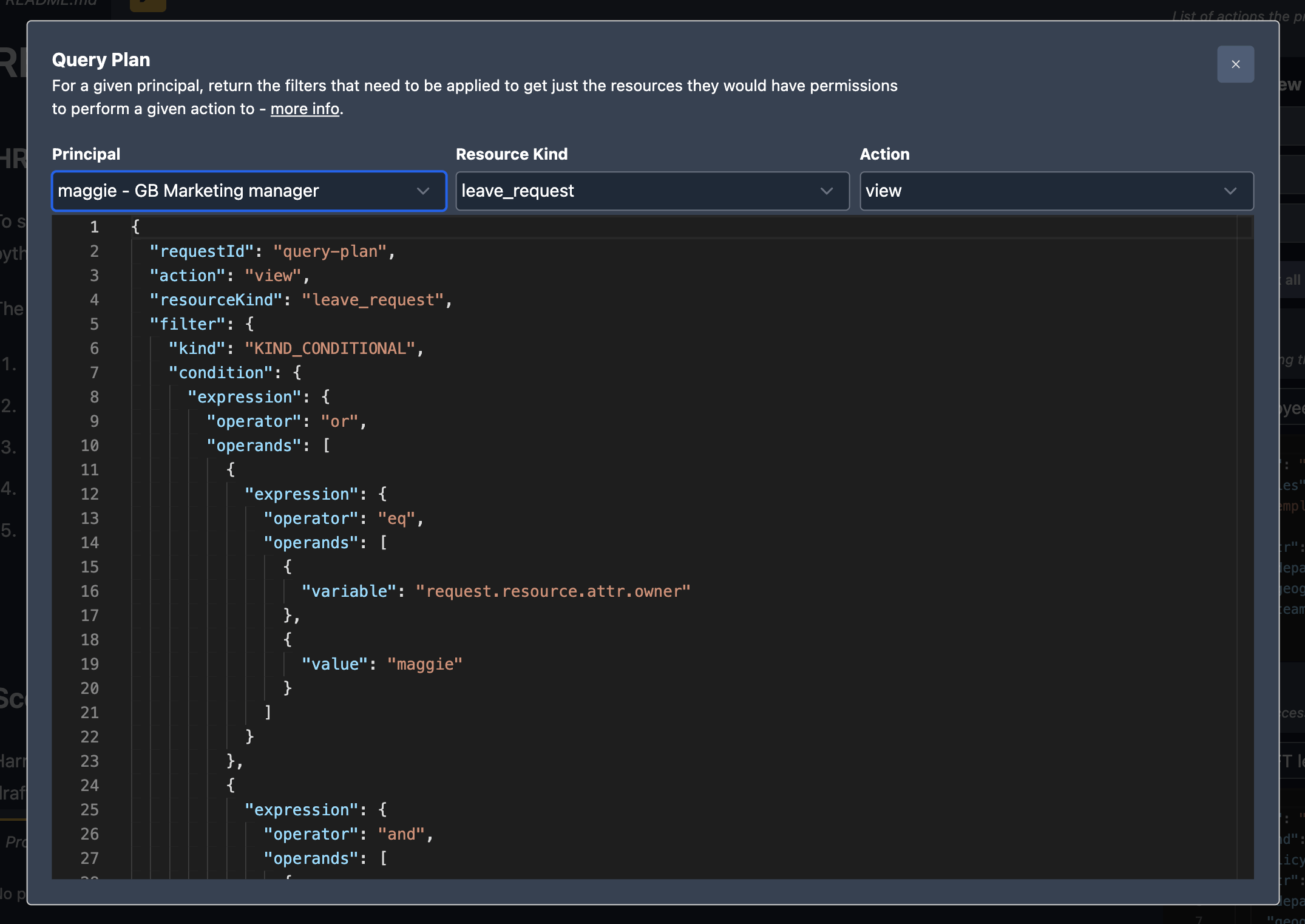
Playground: Query Plan

query plan

The Cerbos Playground now includes a new mode to view the query plan for a specific principal, resource kind, and action. This mode enables you to see the conditions which need to be met when fetching resources from your data storage to select only the instances that the user is authorized to access. You can find out more about query plans here.

You can find the full release notes here and if you have any questions join our Slack community.