Agentic engineering in an old codebase is about making hidden constraints visible and cheap changes trustworthy. Let’s talk what to do in brownfield codebases.
During my career I’ve worked on teams whose codebases had been around a long time. Those are brownfield systems: the repository is no longer a complete description of how the thing actually behaves. Institutional knowledge, duct tape, legacy services, and expectations other teams depend on live outside the tree. You have to learn those constraints before you write new code, and you have to prove a change didn’t break them. I love coding with agents, but throw them at an older brownfield codebase unsupervised and you may end up with something that “works” but with the wrong system design and brittle tests.
Even in teams that wanted to do modernization efforts pre-AI, you often had to take things very, very piecemeal, with strong testing in place, a strong layer of confidence to make sure that you weren’t breaking things. You kind of knew that on top of actual user journey testing, any migrations you were making had to keep things working as intended via a barrage of repeatable tests. These days some folks may say that as soon as an agent drops code you didn’t author decision-by-decision, you’re already in a brownfield project. Regardless, you want to optimize for cheap changes being made safely.
And these days, especially in the last, I would say, maybe five to ten years, this idea of caring more about testing, caring more about verification, caring more about how you make changes in a way that is not going to break things, I feel has gotten more attention. But that doesn’t change the fact that if you’re doing a lot of work trying to introduce agentic engineering, and then software factories and all of these other kinds of patterns for autonomously working through these large codebases, you have to put quite a bit of additional mindfulness in place otherwise you risk signing up for a world of technical debt.
Before we dive in, let’s assume that the code should be the source of truth. Anything we add on top to help brownfield is what can’t be easily inferred. I want to talk about this in terms of zones, blast radius and a few other patterns I think will help.
If I’m going into an older codebase that’s been around for a while, I probably want to get a sense of what code shouldn’t I be touching. You can consider these zones. E.g. Green zone = safe/good tests/isolated, yellow = mixed quality, red = sensitive/auth/billing/permissions.
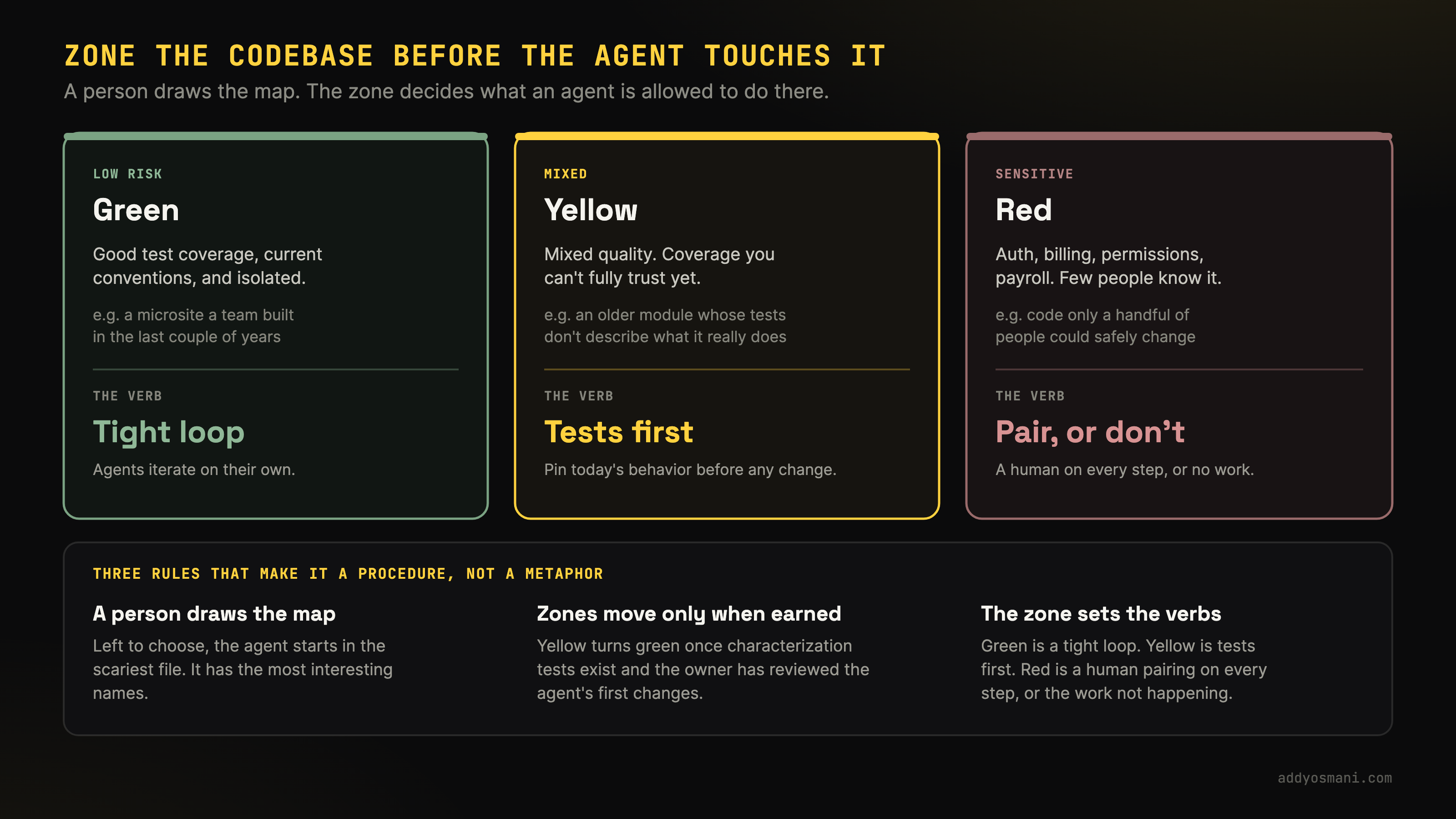
What are the parts of the codebase that are very, very sensitive, or that not everybody understands well? And maybe you would draw those with different zones. Maybe you have a green area that’s got very good test coverage, and is using modern conventions that are current, and has good isolation. And for those parts of the system, agents can go off and work on that in a tight loop.
There are sites, especially commerce sites that I’ve worked with, where you could easily have five or six departments all with their own microsites, when the entire experience to the end user is going to feel like a single thing. And there’s actually a lot of inherent complexity underneath the surface. One team might have really good test coverage for their stuff; maybe it was built in the last couple of years. Other teams may not. So you have this green zone.
Maybe you have yellow, which is mixed quality, maybe it’s a mix of things, and agents can change code there after characterization tests have been written.
And then you can have red areas, where you’ve got sensitive stuff like authentication, billing, permissions, payroll, anything that you wouldn’t normally touch and make some hasty changes to. For example, if only a small number of people understand how it all works. You don’t want unsupervised rewrites in that kind of system.
Three rules make the zones an operating procedure instead of a metaphor. A person draws the map, not the agent; left to choose, the agent starts in the scariest file, because the scariest file has the most interesting names. Zones only move when it’s earned: yellow becomes green once characterization tests exist and the module’s owner has reviewed the agent’s first changes. And the zone sets the verbs: green is a tight loop, yellow is tests first, red is a human pairing on every step or the work not happening.
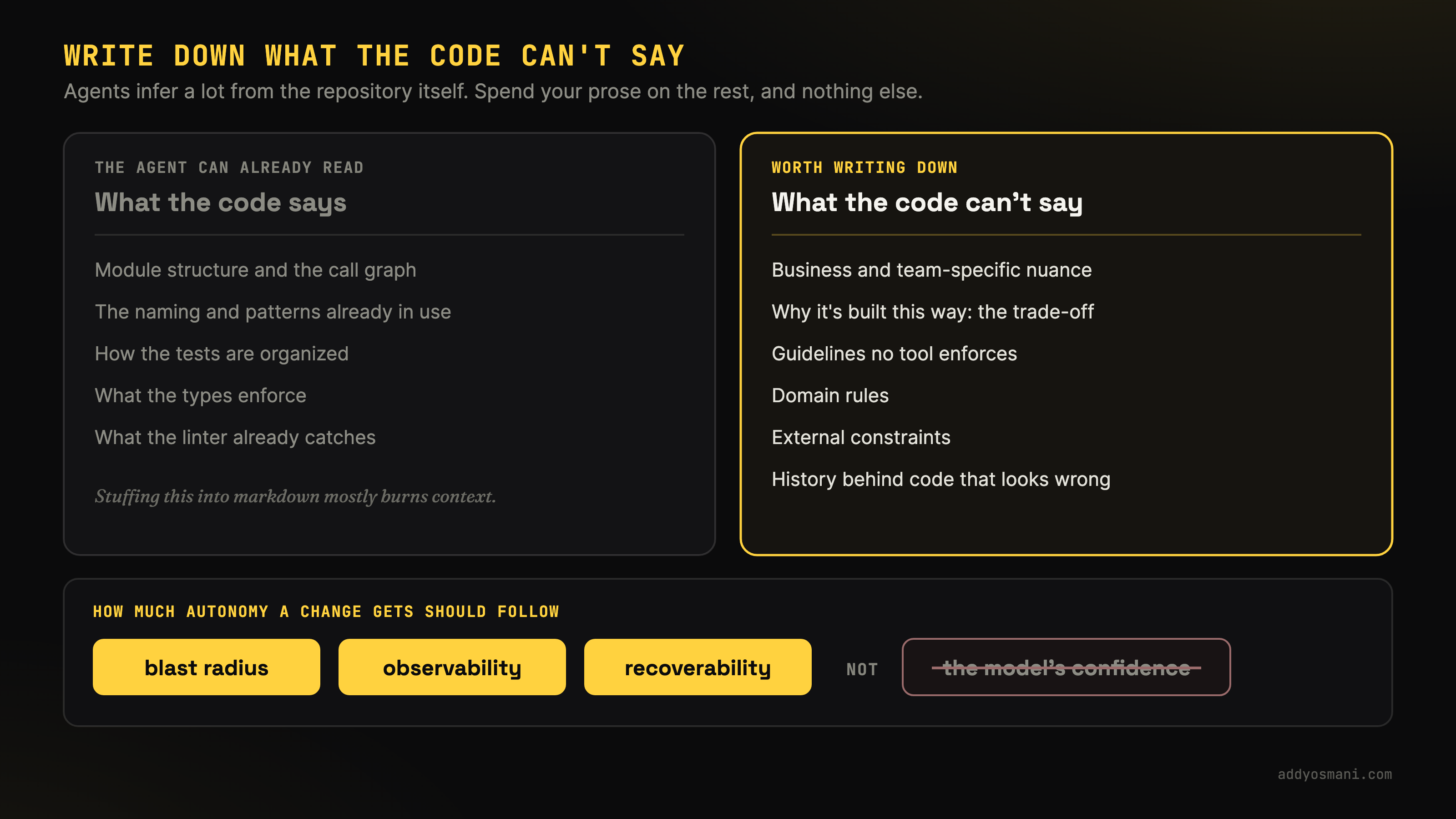
Autonomy should follow blast radius, observability, and recoverability. A model’s confidence is a poor guide.
So I think it makes sense to have at least a sense of, how do you think about the map of the world, and what can the agent infer itself from the codebase? Agents can actually infer quite a lot from the code itself. There was this period of time when people would try to include markdown files for absolutely everything, and then they’d stuff them in their context windows. Agents are actually pretty good at understanding the map of the system. What you want to give them is the stuff that is not obvious from the code itself. Are there conventions? Are there patterns? Are there nuances that are not in there? I think that’s important.
Concretely, that means: business or team specific nuance, trade-offs that explain why the system is structured a certain way, guidelines that aren’t explicitly enforced by static analysis or tooling, domain-specific domain rules, external constraints and historical context behind counter-intuitive implementations and so on.
Write down what the code can’t say, and nothing else.
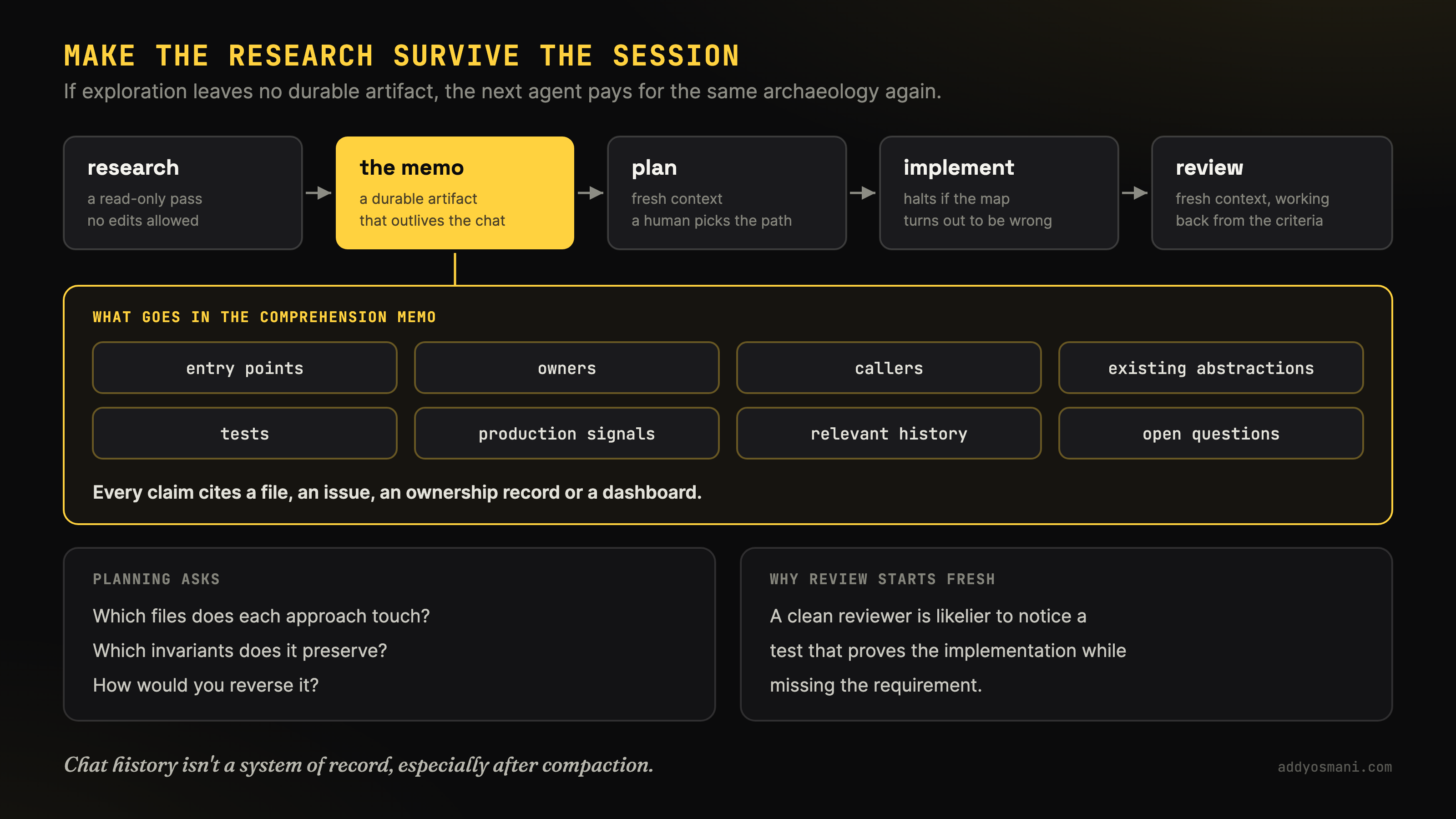
If your agent’s exploration produces no durable artifact, the next agent pays for the same archaeology again.
One piece I would add to that map is a durable research artifact. For yellow and red work, I like a separate read-only pass that produces a short comprehension memo: entry points, owners, callers, existing abstractions, tests, production signals, relevant history, and open questions. Claims should cite a file, issue, ownership record, or dashboard.
The default loop otherwise wastes its research. The agent works out how the auth flow behaves, completes the task, and loses that model when the session ends. Chat history isn’t a great system of record, especially after compaction.
After research, I would start planning with a clean context. Ask which files the plausible approaches touch, which invariants they preserve, and how you would reverse them. A human picks the path. Implementation should stop if it discovers the map was wrong. Review starts fresh and works backward from the acceptance criteria. A clean reviewer is more likely to notice when a test proves the implementation while missing the requirement.
Every repeated correction is a missing piece of the harness.
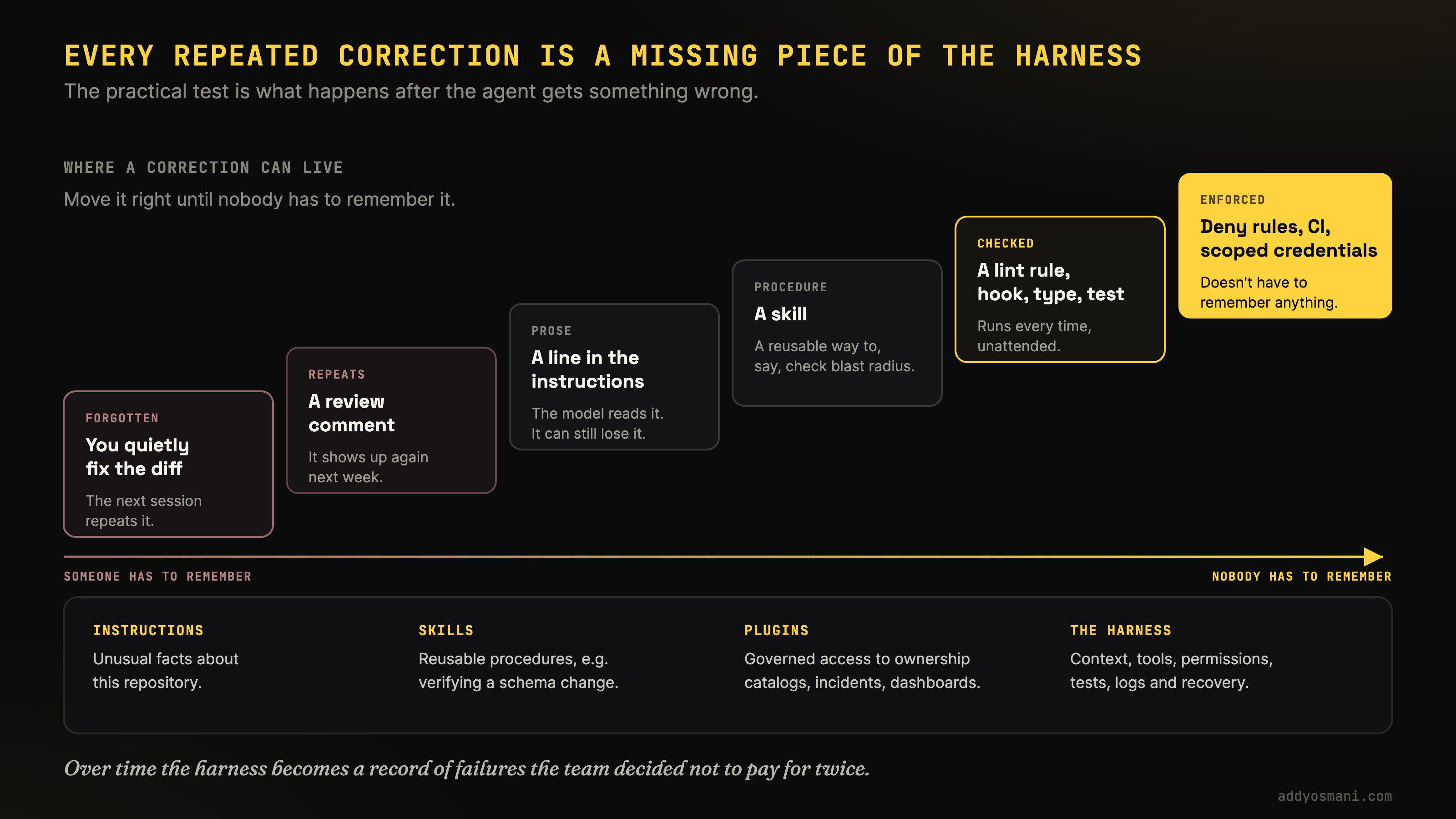
It is useful to be precise about where the pieces fit. Instructions record unusual facts about a repository. Skills package reusable procedures such as checking blast radius or verifying a schema change. Plugins can provide governed access to the ownership catalog, incident archive, or dashboards.
The harness is the working environment around the agent: context, tools, permissions, tests, logs, and recovery. A factory schedules many dependable loops, keeps durable state, and hands novel cases back to people.
The practical test is what happens when the agent gets something wrong. If you quietly repair the diff, the next session can repeat it. When the same review comment appears again, move it into a lint rule, hook, type, test, or skill. Keep prose for constraints that cannot be enforced mechanically.
A deny rule, scoped credential, or CI check doesn’t have to remember. Over time the harness becomes a record of failures the team has decided not to pay for twice.
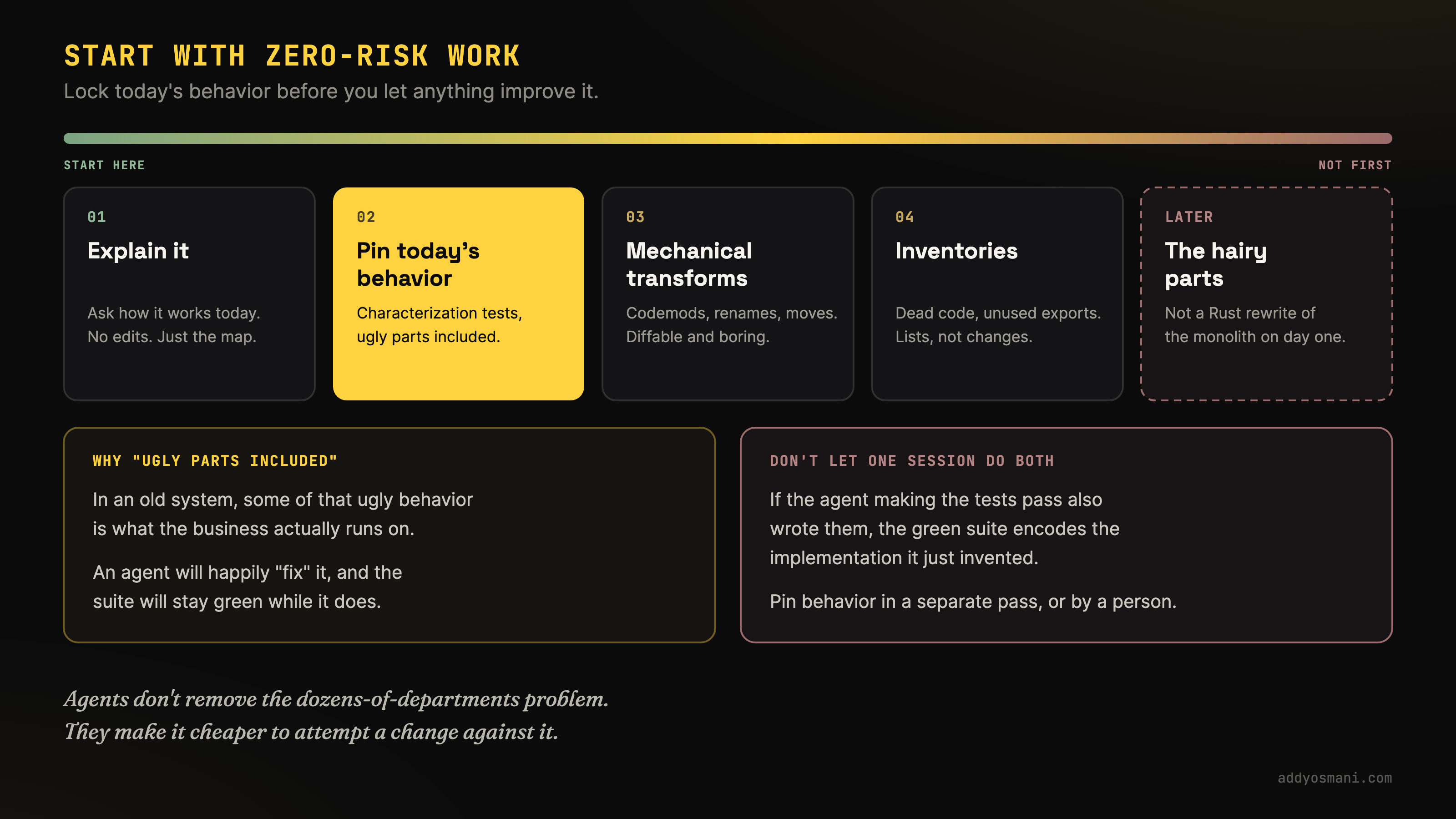
Lock today’s behavior before you let anything improve it.
If you’re bringing agents into an existing codebase, it’s very similar to other kinds of modernization efforts. Maybe you begin with zero-risk work. It shouldn’t be like, hey, let’s rewrite this monolith in Rust or something like that. Maybe it’s, first explain how the things work.
Generate characterization tests that can lock that current behavior.
Characterization tests are automated tests used to document a system’s actual current behavior so you can safely refactor or change legacy code
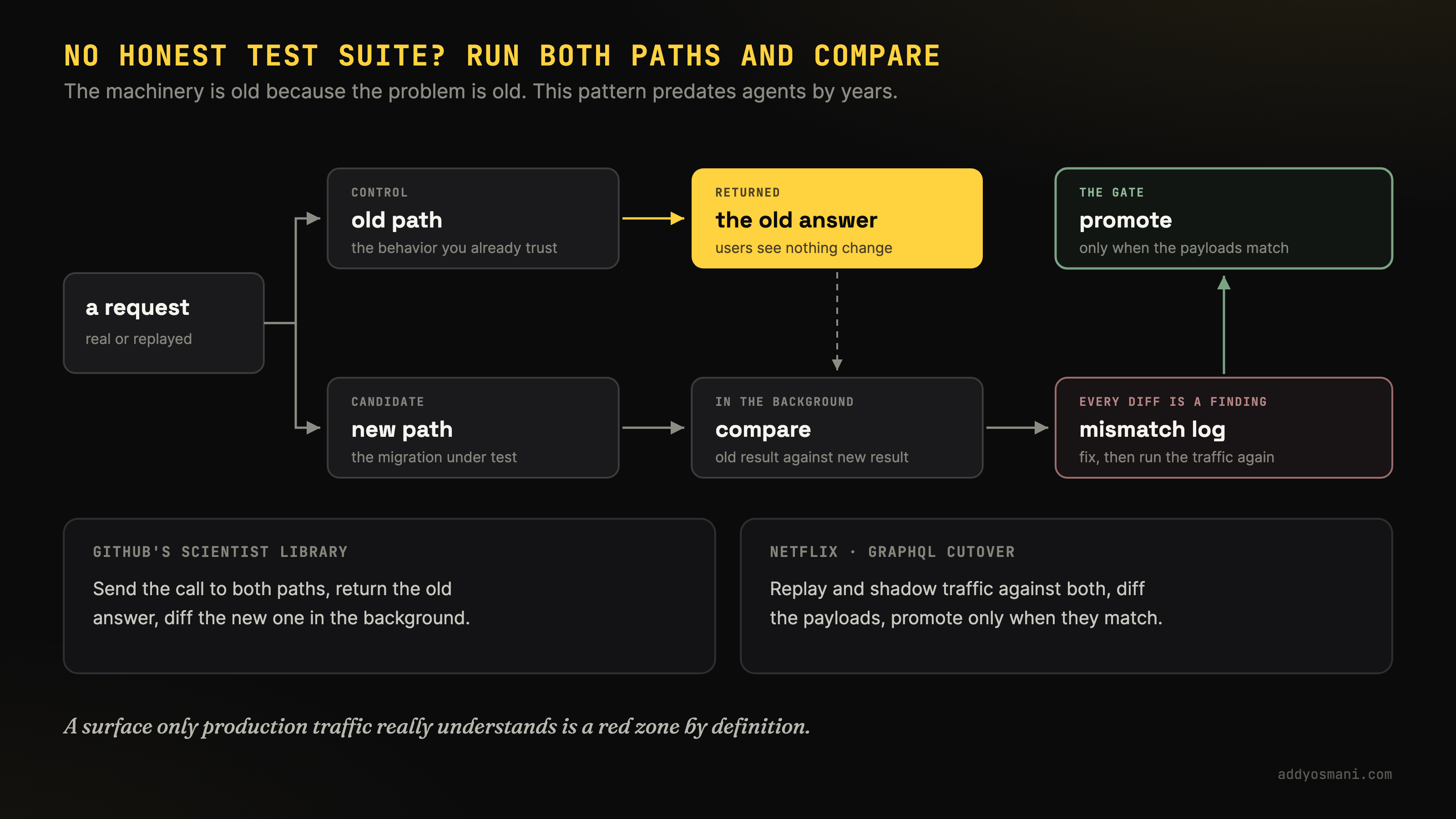
By characterization tests I mean tests that pin down what the module does today, ugly parts included, because in an old system some of that ugly behavior is what the business runs on, and an agent will happily “fix” it behind a green suite. The machinery is old because the problem is old. Netflix used the same idea at production scale in its GraphQL cutover - replay and shadow traffic against the old and new paths, diff the payloads, promote only when they match. That is the promotion path when a homepage-class surface has no honest unit suite: don’t guess; run both and compare.
When an agent is the one making them pass, don’t let that same session be the only author of the tests. Pin the behavior first, in a separate pass or by a person; then let the agent work. Otherwise you get a green suite that encodes the implementation you just invented.
And then you start down the path of doing mechanical transforms. You can do dead code and unused export inventories. You don’t want to start with the trickiest or hairiest parts of the system. And ultimately you want to have that confidence with any of these migrations.
I remember working on a number of different kinds of migrations over my time on large codebases, and people exercising a great deal of care, even when fixing things that were broken.
One of the older codebases I worked on was at AOL. There was a day when I was supposed to be off, and I was visiting a comic book store near the office, and as it so happened, my boss dropped me a text and asked if there was any way I could swing by. The AOL.com homepage was completely broken, and we didn’t have enough JavaScript experts around to go and figure it out. So I said, okay, sure, I’ll come in and take a look. And you would think these days, oh, a homepage, how complicated can it be? But when you have dozens and dozens of departments of people that can own lots of different components, lots of different criteria, lots of different scripts, A/B tests, all of these things, you want to avoid breaking the world for everybody else, because you’re not necessarily going to have test coverage all over the place in the same way that you would like. In that case I was able to get it fixed, but we basically had to at least user-test the things that didn’t have their own unit tests. How well were things working, without breaking for everybody? So that was kind of important.
That’s still the job. Agents don’t remove the dozens-of-departments problem; they make it cheaper to attempt a change against it. A surface that only production traffic really understands is a red zone by definition, and until you’ve built a stand-in for that traffic, the user-testing I did on my day off is still the gate.
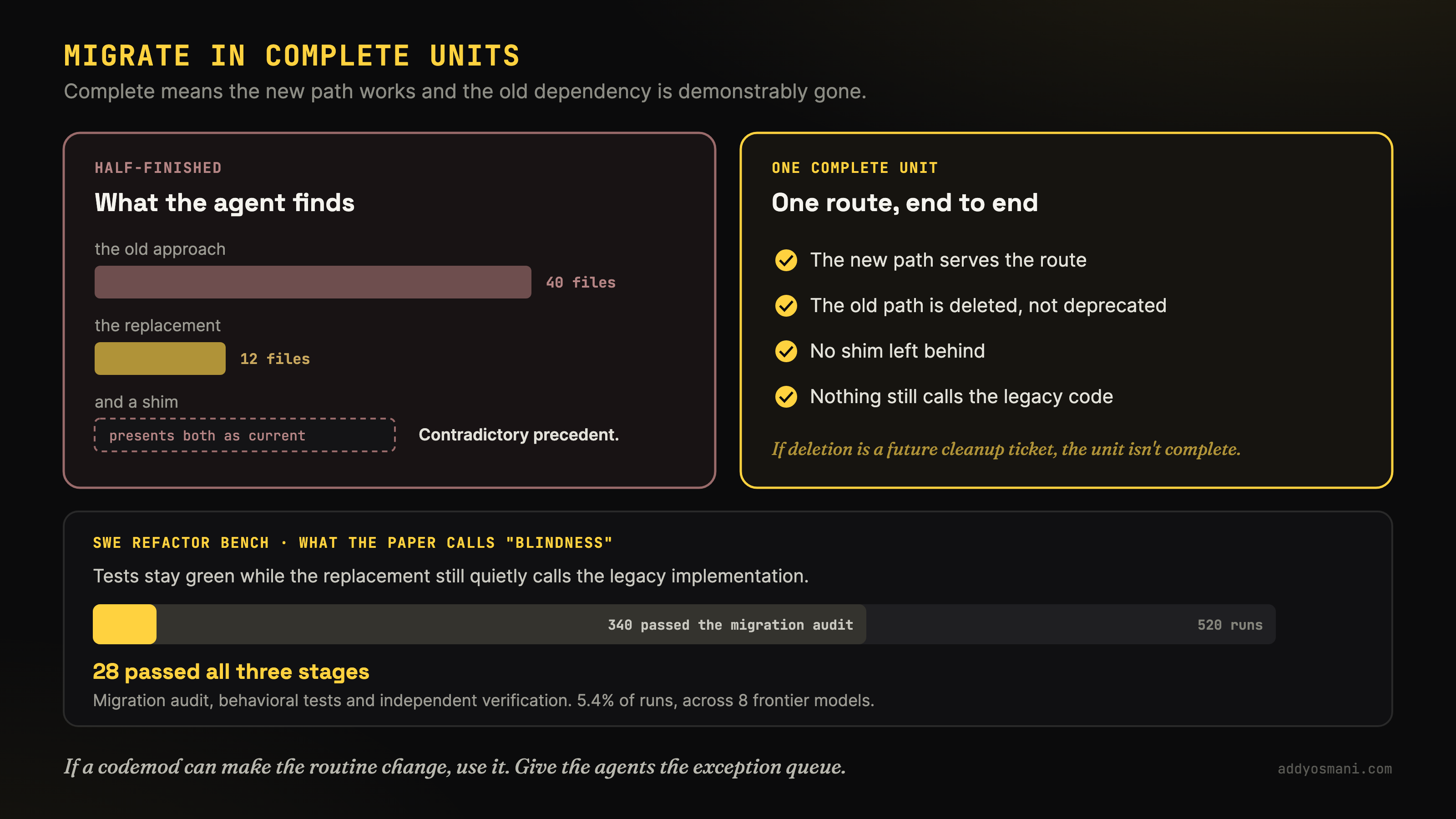
A migration is complete when the new path works and the old dependency is demonstrably gone.
Half-finished migrations are particularly confusing to agents. Search returns the old approach in forty files, the replacement in twelve, and a shim that presents both as current. The agent sees contradictory precedent.
I would rather finish one route end to end, including removing the old path, than convert thirty files and leave both patterns alive. If deletion is a future cleanup ticket, the migration unit is not complete.
Tests can stay green while a replacement still calls the legacy implementation. SWE Refactor Bench calls this migration “Blindness.” Across 520 agent runs, only 28 passed its migration audit, behavioral tests, and independent verification.
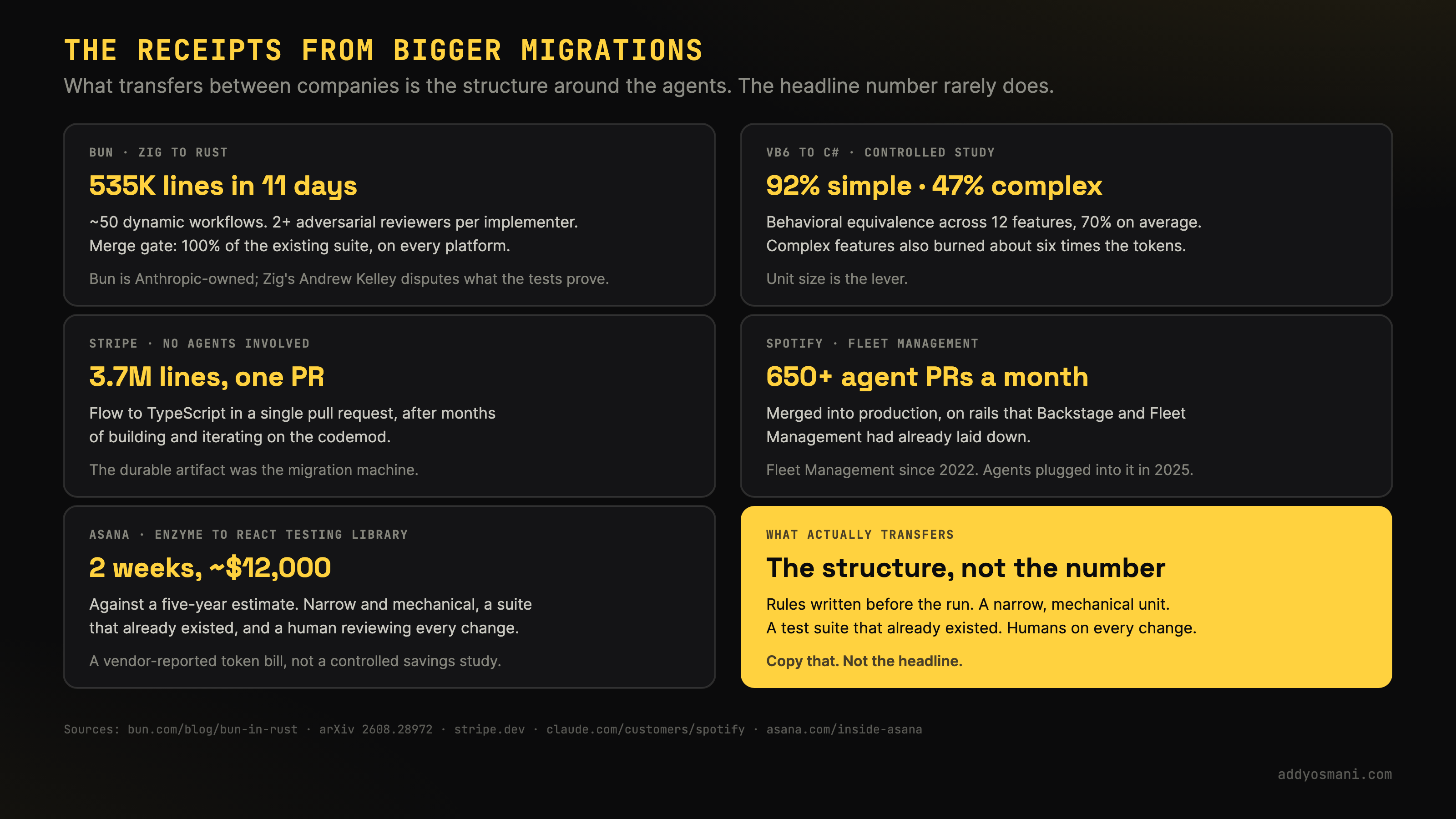
If a codemod can make the routine change, use the agent to help write and check it. Give agents the exception queue. Stripe’s migration is useful here precisely because no agents were involved: the durable artifact was the migration machine.
Bun’s Zig-to-Rust port ran about 50 workflows over 11 days from a 535,000-line codebase, with two adversarial reviewers on every generated unit and the entire pre-existing test suite as the merge gate; the part worth copying is that hours went into a porting guide mapping Zig idioms to Rust before any agent ran. Anthropic’s own migration process stress-tests its rulebook on a disposable mini-migration and throws the trial output away before the broad run begins.
A controlled VB6-to-C# study measured 92% behavioral equivalence on simple features and 47% on complex ones: unit size is the lever. The shape predates agents entirely: Stripe moved 3.7 million lines to TypeScript in one PR through months of codemod work, with no agents involved, and Google’s large-scale-changes chapter explains why atomic changes shrink as codebases grow. Spotify now reports 650-plus agent PRs merged monthly on rails Backstage built years earlier.
Asana cleared a multi-year Enzyme backlog in two calendar weeks for about $12,000 in model and infrastructure cost. That $12,000 is just a token bill but not a substitute for the five-year staffing estimate they had on the books; treat it as a vendor-reported cost of generation, not a controlled savings study. The transferable part is the same as Bun: a narrow mechanical migration, a pre-existing suite, humans still reviewing every change
What transfers between companies is the structure around the agents.
Agents have changed the price of trying several plausible implementations. They haven’t changed the evidence required to choose one.
And then I think you’ve probably seen, this year we’re beginning to read more and more cases of well-established companies who are using agents to do big rewrites. I’ve talked to CTOs who are allowing teams to have agents try multiple rewrites in different languages or frameworks because its now feasible to do so more cheaply and evaluate the trade-offs.
Shopify rebuilt the Shop consumer app from React Native to native Swift and Kotlin in twelve weeks with a small team and agent-gated, screen-sized checkpoints. The much larger merchant app is still the brownfield problem: hundreds of screens, deep platform integration, same gates, longer clock.
You’ve seen other examples of rewrites to Rust. You’ve seen people do framework-level migrations. There have been all kinds of migrations that have been done. And in many cases, these are migrations people would have done on a much longer timeframe. These days, if you have enough tokens, you can just actually have agents go and attempt to complete a migration across a range of different stacks or languages.
You can try to have your agents actually implement something in a number of different competing options. Rather than having one team choose a single option that you go all in on, what you do is you have them implement all of them. They can all check against your unit tests. You can performance profile all of them, and then make a decision, which is much, much cheaper in some cases than it otherwise would have been. And that’s a completely different ball game, I think, for teams these days.
More generated code should lead to more selective human review, not less human ownership. Seriously consider what will setup your brownfield project for success before you go down the path of thinking about the loops/goals/parallelization.
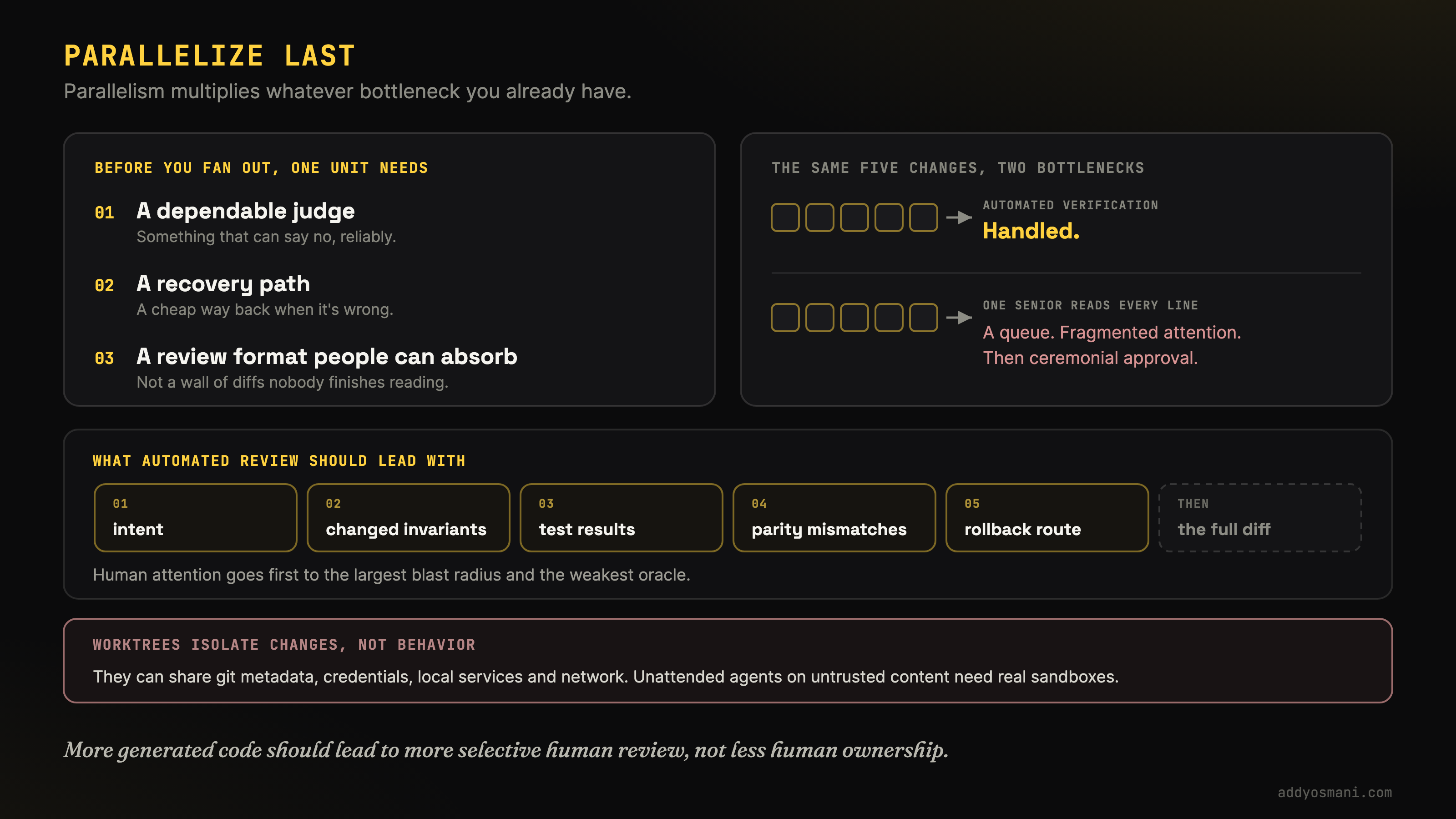
Software factories can run many changes at once. I would copy that part only after one unit has a dependable judge, recovery path, and review format people can absorb.
Parallelism multiplies the bottleneck you already have. Automated verification can handle five checked changes. One senior reading every line gets a queue, fragmented attention, and eventually ceremonial approval.
I prefer automated review to lead with intent, changed invariants, test results, parity mismatches, and the rollback route. The complete diff remains available. Human attention goes first to the largest blast radius and weakest oracle.
Worktrees isolate changes, not behavior. They may share Git metadata, credentials, local services, and network access. Trusted work may accept that tradeoff. Unattended agents consuming untrusted content need stronger sandboxes and scoped credentials.
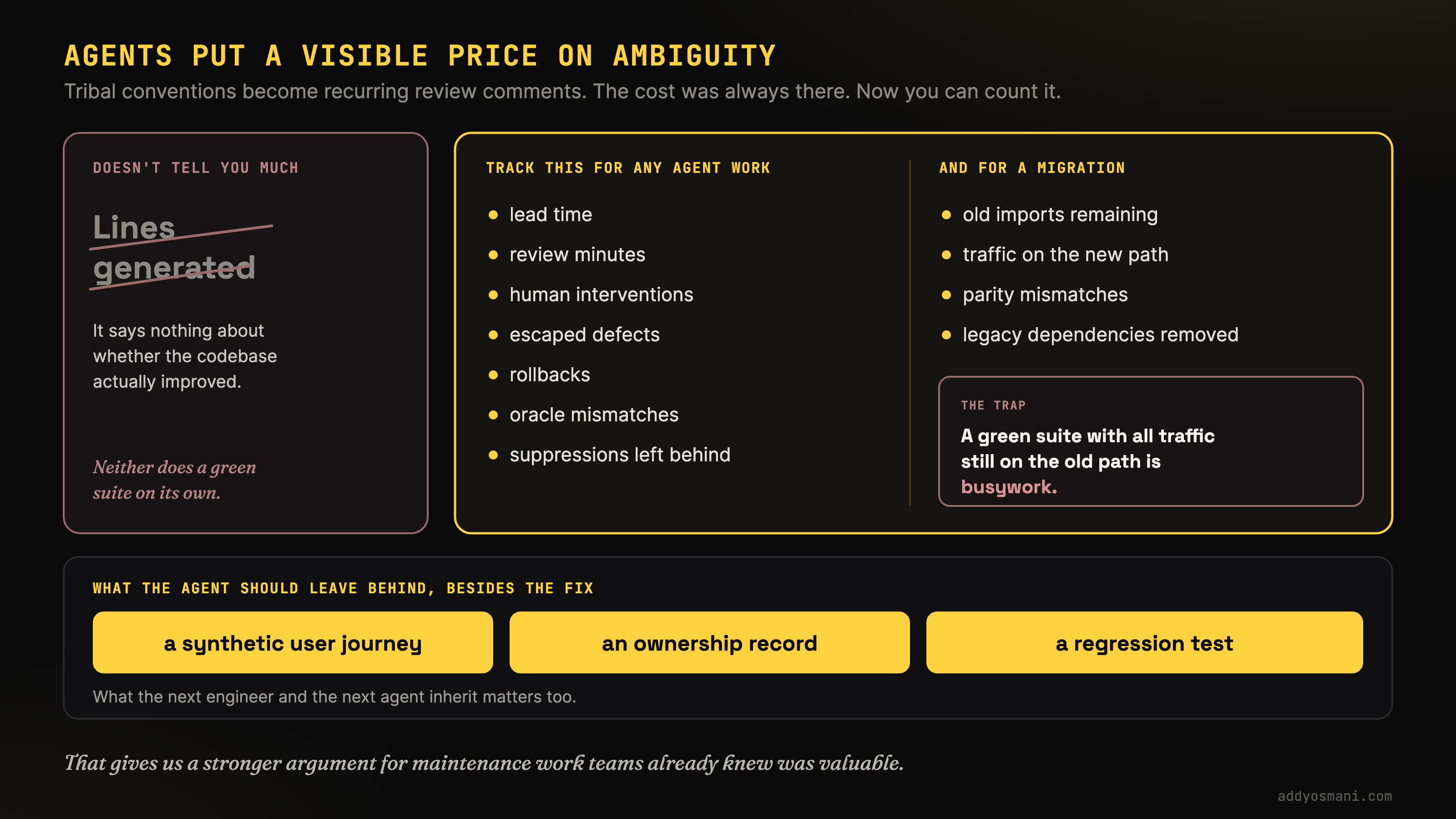
Lines generated don’t tell you whether the codebase improved. I would track lead time, review minutes, human interventions, escaped defects, rollbacks, oracle mismatches, and suppressions left behind.
For a migration, track remaining old imports, traffic served by the new path, parity mismatches, and legacy dependencies removed. A green suite with all traffic still taking the old path is busywork.
Agents put a visible price on ambiguity. Tribal conventions become recurring review comments.
That cost was always there, paid during onboarding, review, and incident recovery. Agents make more of it countable. That gives us a stronger argument for maintenance work teams already knew was valuable.
The next time an agent works on the homepage equivalent, I would want it to leave behind more than the repair: a synthetic user journey, an ownership record, and a regression test.
What the next engineer and agent inherits matters too.
Thank you for reading Elevate so far! I hope it’s been of value. I’m starting a new job this month and am making changes to the newsletter around aspects such as sponsorship and presentation which will be rolled out shortly. I hope to continue bringing you write-ups on agentic engineering and software here and want to thank you for continuing to read.