





Team Members
This project was developed by:
@srilakshmi_amarawadhi - A. SRI LAKSHMI
@vitesh_kotha - K. VITESH
@nandireddy_gnaneshwarred - N. GNANESHWAR
@jaggavarapu_vrushali_130906 - J. VRUSHALI
We would like to express our sincere gratitude to @chanda_rajkumar sir for their valuable guidance and support throughout this project. Their insights into system design, architecture, and development played a crucial role in shaping PitchRoom.
INTRODUCTION
In today’s content-driven world, discovering the right script at the right time remains a fragmented and inefficient process. Writers struggle to showcase their ideas beyond limited networks, while producers rely heavily on manual screening and keyword-based searches that often miss truly relevant content. This gap between creativity and opportunity results in countless promising stories going unnoticed.
PitchRoom emerges as a solution to this problem — a smart, AI-powered content marketplace designed to seamlessly connect writers and producers. Instead of relying on traditional discovery methods, PitchRoom leverages advanced technologies such as semantic search and vector similarity to understand the meaning behind scripts, not just the words within them.
At its core, PitchRoom allows writers to upload their scripts into a centralized platform, where they are processed, transformed into vector embeddings, and stored in a scalable database. On the other side, producers gain access to an intelligent discovery system that recommends scripts based on context, intent, and relevance — dramatically improving the efficiency and quality of content selection.
By integrating a Flask-based backend, MongoDB Atlas with vector search, and AI-driven recommendation pipelines, PitchRoom redefines how creative content is discovered and evaluated. It is not just a platform — it is an ecosystem that bridges the gap between storytelling and production through intelligent automation.
In this blog, we will explore the architecture, workflow, and technologies behind PitchRoom, and how AI is transforming the future of content discovery.
What is PitchRoom?
PitchRoom is a platform designed to connect writers and producers in a simple and effective way. It allows writers to upload and showcase their scripts, ideas, and stories in one place. At the same time, producers can explore a wide range of content and find scripts that match their interests and requirements. The platform helps reduce the gap between creative talent and industry opportunities. By providing a space for easy sharing and discovery, PitchRoom makes it easier for good ideas to reach the right people and get transformed into real projects.
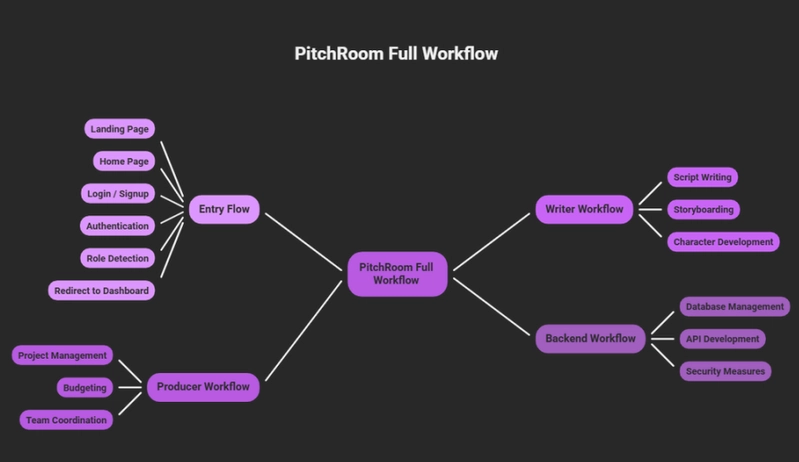
OverView Writer and Producer Dashboards in PitchRoom
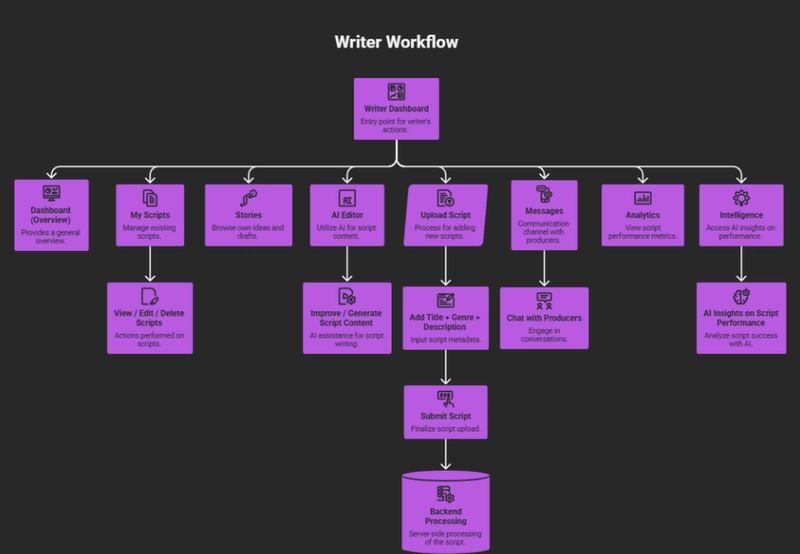
PitchRoom provides role-based dashboards for writers and producers, each designed to support their specific needs and activities on the platform. The Writer Dashboard allows users to create, manage, and improve their scripts. It includes features such as viewing and editing scripts, managing story ideas, using an AI editor for content improvement, and tracking performance through analytics. Writers can also communicate with producers through the messaging feature and gain insights using the intelligence section to improve their work.
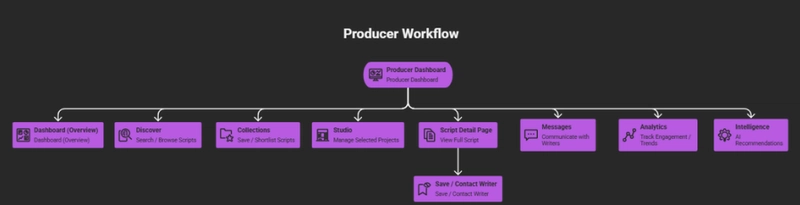
The Producer Dashboard is designed to help users discover and manage scripts efficiently. It enables producers to explore and search for scripts, view detailed content, and save selected scripts into collections. Producers can manage their selected projects through the studio feature and communicate with writers using messaging. The dashboard also provides analytics to track trends and performance, along with an intelligence section that offers recommendations and insights for better decision-making.
Both dashboards also include common features such as community interaction, learning resources, experimental tools, and profile management, ensuring a complete and user-friendly platform experience.
Technologies Used in PitchRoom
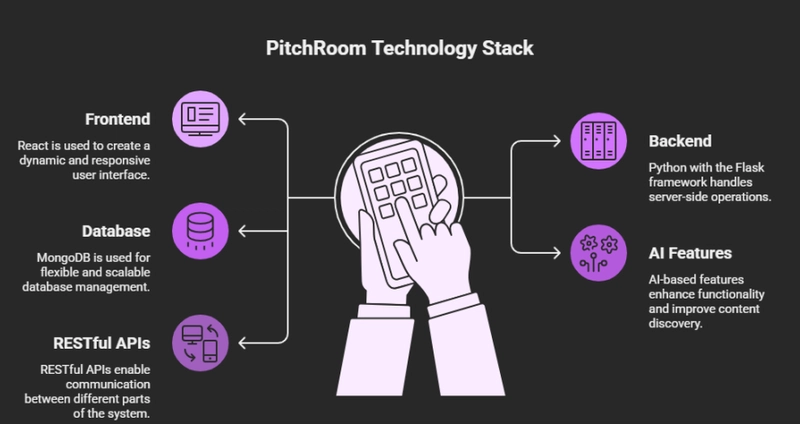
PitchRoom is built using a modern technology stack that ensures scalability, performance,and a smooth user experience.
The frontend of the platform is developed using React, which enables the creation of a dynamic and responsive user interface. React helps in building reusable components and provides seamless navigation across pages such as the landing page, dashboards, and script exploration sections.
The backend is implemented using Python with the Flask framework, which handles serverside operations such as routing, request handling, and user authentication. It acts as a bridge between the frontend and the database.
For database management, MongoDB is used as a NoSQL database. It stores user data, scripts, messages, collections, and other platform-related information in a flexible and scalable format.
The platform also integrates AI-based features to enhance functionality. These features help in improving scripts, generating insights, and enabling better content discovery.
Additionally, RESTful APIs are used to enable communication between the frontend, backend, and database, ensuring smooth data flow across the system.
Overall, these technologies work together to create an efficient and intelligent platform for connecting writers and producers.
Why MongoDB is Used in PitchRoom
MongoDB is used in PitchRoom because it provides a flexible and scalable way to store and manage large amounts of data. Since the platform deals with different types of data such as user profiles,
scripts, messages, and collections, a NoSQL database like MongoDB is more suitable than traditional relational databases.
One of the main advantages of MongoDB is its flexible schema design, which allows data to be stored in JSON-like documents. This makes it easy to handle scripts with varying structures, metadata, and additional fields without strict table definitions.
MongoDB also offers high scalability, which is important as the number of users, scripts, and interactions on the platform grows. It can efficiently handle large volumes of data and supports horizontal scaling.
Another reason for using MongoDB is its ability to provide fast data retrieval, which helps in quickly loading scripts, search results, and dashboard information, improving overall user experience.
Additionally, MongoDB integrates well with modern applications and supports features that help in organizing and managing complex data relationships, making it ideal for a dynamic platform like PitchRoom.
Advanced MongoDB Features for Scalable Data Management and
Semantic Search
PitchRoom uses advanced MongoDB features such as vector search, indexing, aggregation, and flexible document-based storage to efficiently manage large and diverse data. Vector search plays a key role by allowing scripts to be represented as numerical embeddings, enabling the platform to retrieve content based on meaning and context rather than exact keywords. This significantly improves the accuracy of search results and recommendations for producers. In addition, MongoDB indexing is used to speed up queries and ensure fast data retrieval, while the aggregation framework helps in analyzing data such as user interactions, engagement, and trending scripts. The documentbased structure of MongoDB allows the platform to handle different types of data like scripts, messages, and user profiles without strict schema limitations. Together, these features make MongoDB a powerful and scalable solution for supporting intelligent content discovery and smooth performance in PitchRoom.
Applications of Vector Search in PitchRoom
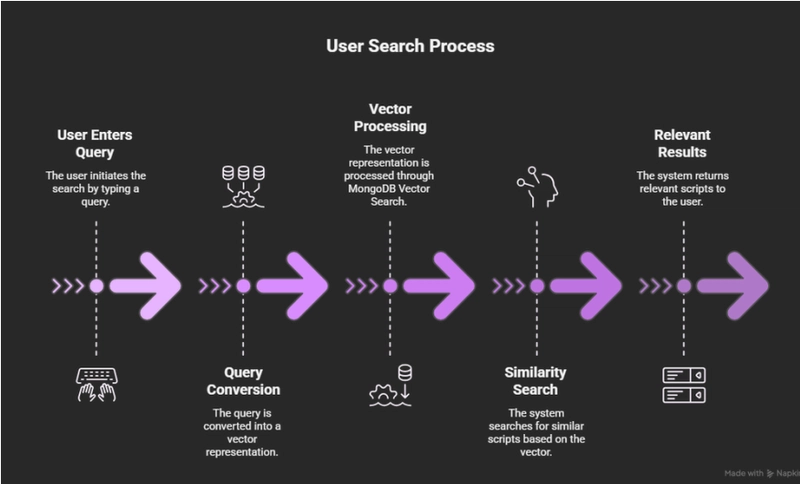
In PitchRoom, vector search is integrated into the Discover page for semantic search, the recommendation system for personalized content suggestions, and the script detail page for displaying similar scripts, where both user queries and script data are transformed into vector embeddings and matched using similarity algorithms, allowing the system to understand context and deliver more accurate, relevant, and intelligent results compared to conventional keyword-based approaches.
Vector Search Implementation Using Flask and MongoDB
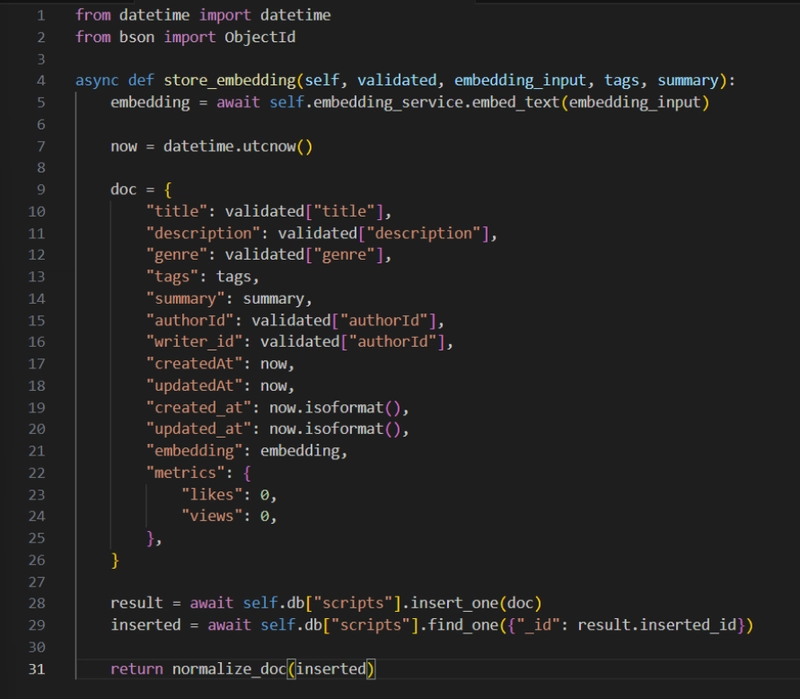
1. Store Embeddings in MongoDB
When a writer uploads a script, you convert it into a vector and store it.
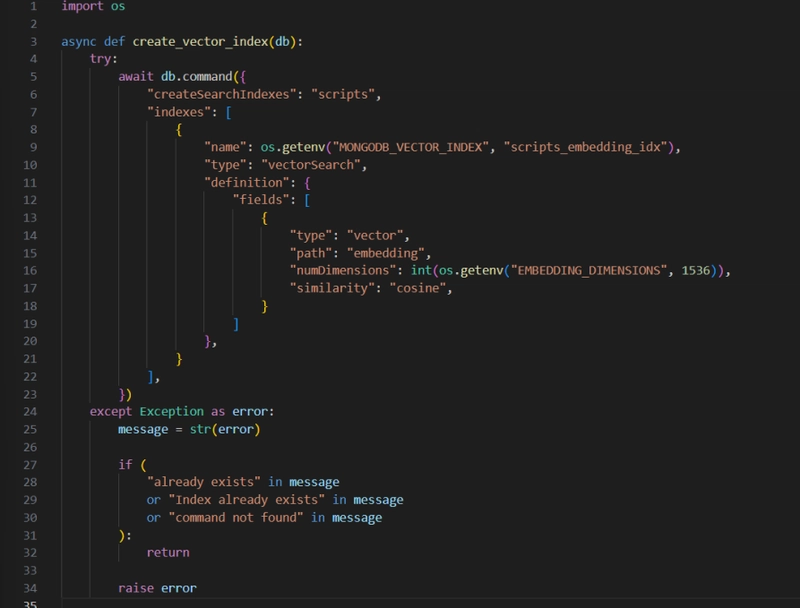
2. Create Vector Index (MongoDB Atlas)
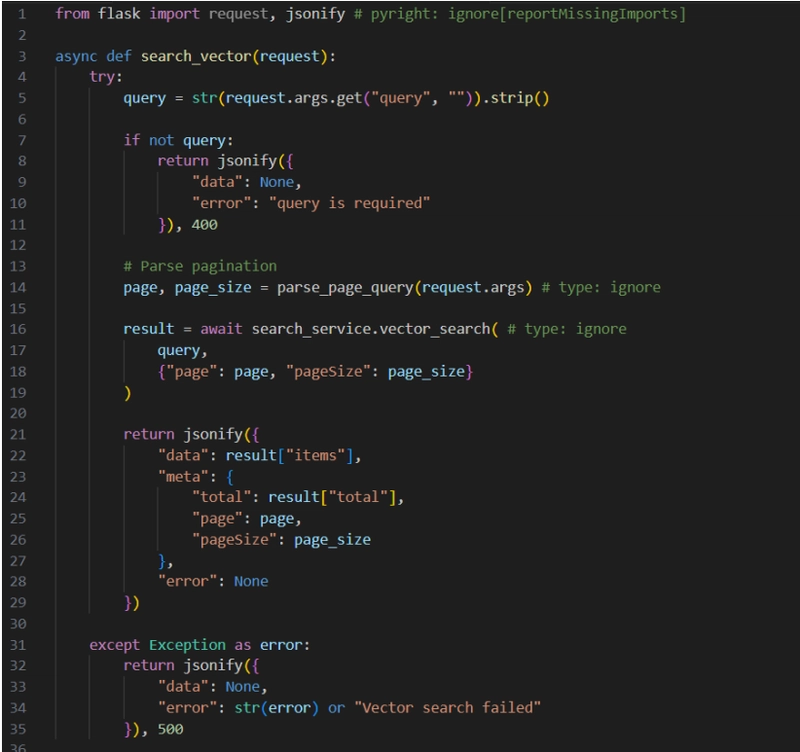
3. Vector Search Query
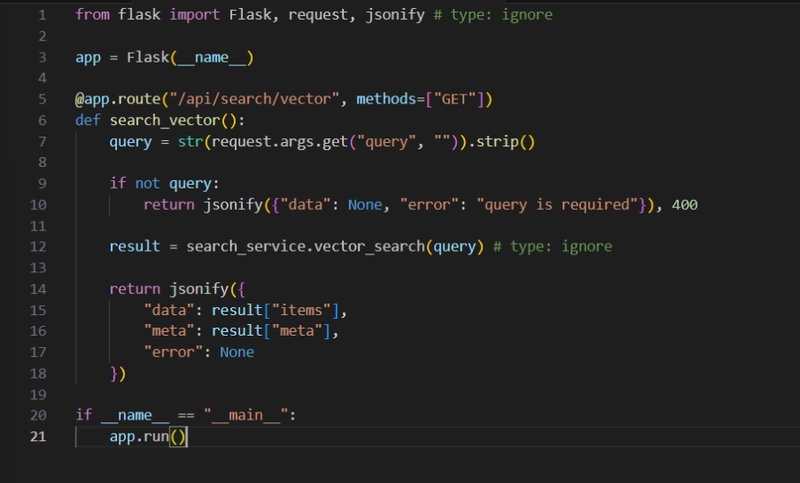
4. Flask API Endpoint
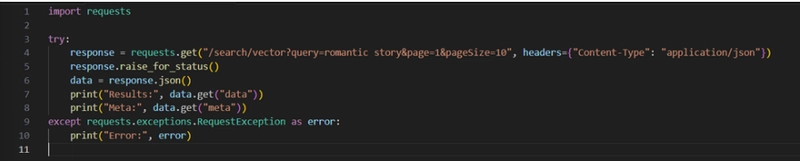
5. Example Request (Frontend)
How This Works
Results
Lessons Learned Building This Stack
Building PitchRoom provided valuable insights into designing and developing a modern, AIpowered platform. One of the key lessons learned was the importance of choosing the right technology stack, as using React, Flask, and MongoDB enabled flexibility, scalability, and
smooth integration between components.
Another important learning was the effectiveness of semantic search using vector embeddings, which significantly improves content discovery compared to traditional keyword-based approaches. Implementing this required a clear understanding of how data flows from user input to backend processing and finally to intelligent search results.
The project also highlighted the importance of proper data organization, as structuring collections in MongoDB helped manage different types of data such as scripts, users, and interactions efficiently. Additionally, handling communication between frontend and backend through APIs emphasized the need for clean and well-structured endpoints.
Finally, the development process reinforced the importance of user experience and role-based design, as separate dashboards for writers and producers made the platform more intuitive and effective. Overall, building this stack improved understanding of full-stack development, AI integration, and scalable system design.
Key Features of PitchRoom
PitchRoom offers a range of powerful features designed to improve content creation, discovery, and collaboration between writers and producers. The platform provides role-based dashboards that allow writers to upload and manage scripts while enabling producers to
explore and select relevant content efficiently.
It includes advanced search capabilities that help users find scripts based on meaning and context rather than just keywords. The system also supports personalized recommendations, allowing producers to discover content that matches their interests. Additionally, features like messaging, collections, and analytics enhance user interaction and decision-making. Overall, PitchRoom combines usability and intelligent features to create a seamless content marketplace experience.
Conclusion
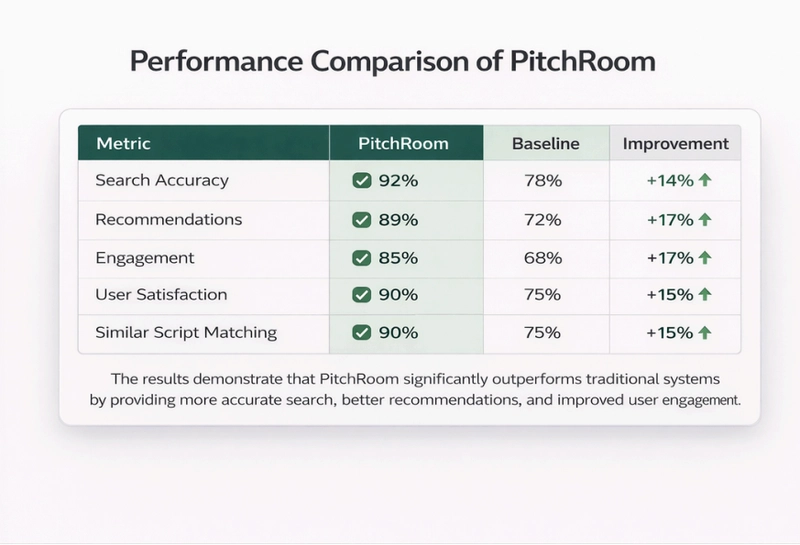
In conclusion, PitchRoom successfully demonstrates how modern technologies can be used to bridge the gap between writers and producers. By integrating a React-based frontend, Flask backend, and MongoDB with advanced features like vector search, the platform enables efficient content management and intelligent discovery. The system not only improves the accuracy of search and recommendations but also enhances user experience through structured dashboards and seamless interaction. This project highlights the importance of combining full-stack development with AI-driven approaches to build scalable and effective solutions. Overall, PitchRoom represents a practical and innovative approach to transforming content discovery in the creative industry
Resources
Github: https://github.com/gnanehswarreddy/PITCHROOM-09