

惯性聚合 高效追踪和阅读你感兴趣的博客、新闻、科技资讯
阅读原文 在惯性聚合中打开

推荐订阅源

IT之家
IT之家
腾讯CDC
博客园 - Franky
S
SegmentFault 最新的问题
美团技术团队
阮一峰的网络日志
阮一峰的网络日志
J
Java Code Geeks
Y
Y Combinator Blog
Engineering at Meta
Engineering at Meta
Microsoft Security Blog
MongoDB | Blog
MongoDB | Blog
I
InfoQ
T
Tailwind CSS Blog
Hugging Face - Blog
Hugging Face - Blog
B
Blog RSS Feed
博客园 - 叶小钗
博客园_首页
有赞技术团队
有赞技术团队
雷峰网
雷峰网
量子位
小众软件
小众软件
月光博客
月光博客
U
Unit 42
D
DataBreaches.Net

DEV Community

Authentication Security Deep Dive: From Brute Force to Salted Hashing (With Java Examples) Why AI Systems Don’t Fail — They Drift Spilling beans for how i learn for exam😁"Reinforcement Learning Cheat Sheet" I Replaced Chrome with Safari for AI Browser Automation. Here's What Broke (and What Finally Worked) How Python Borrows Other People's Work The $40 Architecture: Processing 1 Billion API Requests with 99.99% Uptime Vibe Coding: A Workflow Guide (From Zero to SaaS) Most webhook security guides protect the wrong side. The scary part is delivery. Headless CMS for TanStack Start: Build a Blog with Cosmic EU Age Verification App "Hacked in 2 Minutes" — What Actually Happened Comfy Cloud’s delete function does not actually remove files Running AI Models on GPU Cloud Servers: A Beginner Guide Event-driven media intelligence with AWS Step Functions and Bedrock I scored 500 AI prompts across 8 quality dimensions — here's what broke How to Call Google Gemini API from Next.js (Free Tier, No Backend Needed) The Portal Protocol: Reclaiming Human Connection in the Age of AI How to Fix Your Team's Scattered Knowledge Problem With a Self-Hosted Forum Intro to tc Cloud Functors: A Graph-First Mental Model for the Modern Cloud Designing Multi-Tenant Backends With Both Ownership and Team Access I Built a Neumorphic CSS Library with 77+ Components — Here's What I Learned PostgreSQL Performance Optimization: Why Connection Pooling Is Critical at Scale Cómo construí un SaaS multi-rubro para gestionar expensas en Argentina con FastAPI + Vue 3 🚀 I Built an Ethical Hacking Scanner Tool – Open Source Project I Replaced /usage and /context in Claude Code With a Single Statusline A Pythonic Way to Handle Emails (IMAP/SMTP) with Auto-Discovery and AI-Ready Design I Collected 8.9 Million Polymarket Price Points — Here's What I Found About How Markets Really Move EcoTrack AI — Carbon Footprint Tracker & Dashboard Everyone's Using AI. No One Agrees How. 5 self-hosted ebook managers worth trying in 2026 Building Your First AI Agent with LangChain: From Chatbot to Autonomous Assistant
Guardrails in AI: Keeping LLMs Safe
Sowjanya San · 2026-04-28 · via DEV Community

Sowjanya Sankara

🤔 Imagine asking an AI agent to generate a database query…
and it returns something wrong — or worse, unsafe.

The problem isn’t just intelligence.
It’s control.

That’s where guardrails come in.


⚡ What are Guardrails in AI?

Guardrails are checks and controls added around an AI system to ensure it behaves correctly, safely, and reliably.

They don’t make the model smarter.
They make the system trustworthy.

Guardrails don’t change what the model knows — they control how it behaves.

Think of guardrails as:

  • Filters before the model runs
  • Validators after the model responds
  • Rules that guide system behavior

⚙️ Where Do Guardrails Fit?

AI systems are not just:
User → Model → Response ❌

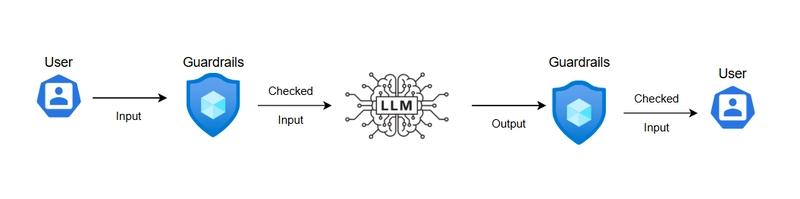
They actually work like this:
User → Input Guardrails → Model → Output Guardrails → Final Response ✅

Before the model → validate input
After the model → validate output

Guardrails sit outside the model, not inside it.


🧩 Types of Guardrails

🔹 Input Guardrails
Ensure the user input is safe and valid.

  1. Block harmful or malicious prompts
  2. Prevent prompt injection attempts
  3. Validate structure of input

👉 Example:
User tries to override system instructions → blocked

🔹 Output Guardrails
Ensure the model output is usable and correct.

  1. Validate format (JSON, query, etc.)
  2. Filter unsafe or irrelevant content
  3. Check for missing or incorrect fields

👉 Example:
LLM generates an invalid MongoDB query → rejected or retried
guardrails image


🔄 Guardrails in AI Agents

In agent systems, guardrails are applied at multiple steps:

Before understanding the query
Before calling a tool
After generating a response

Guardrails are not a single step — they are layered across the system.


⚠️ Why Guardrails Matter

Without guardrails:

Models can hallucinate
Outputs can be incorrect
Systems can behave unpredictably

With guardrails:

Responses become reliable
Systems become safer
Results become consistent

💡An AI system without guardrails is not ready for real-world use.


🔍 Real-World Example

User asks:
“Find transfer passengers under 24 hours”

🔹 Before the model (Input Guardrails)
Check if the request is valid
Ensure required conditions are present (like time constraint)
Prevent unsafe or irrelevant instructions

👉 Input is cleaned and structured before reaching the model

🔹 After the model (Output Guardrails)
Validate the generated query format
Ensure required filters (like “under 24 hours”) are applied
Check logic before execution

👉 Output is verified before being used


Conclusion

Building AI isn’t just about generating outputs.
It’s about making sure those outputs are correct, safe, and usable.

That’s what guardrails enable.