









Your microservice calls an external API. It fails.
You add Resilience4j. Now you have 10 transitive dependencies, a 500KB JAR, 3 config classes, and a @Bean method just to say "try 3 times, wait 1 second".
I hit that wall one too many times. So I built RetryKit — a zero-dependency Java 17 retry & circuit breaker library. No Spring required. No transitive pulls. JAR under 50KB.
<dependency>
  <groupId>io.github.caninaam</groupId>
  <artifactId>retrykit</artifactId>
  <version>1.0.1</version>
</dependency>
Fixed delay retry with fallback — the most common case:
String result = RetryKit.<String>retry()
    .maxAttempts(3)
    .waitDuration(Duration.ofSeconds(1))
    .fallback(ctx -> "default")
    .call(() -> myService.call());
Exponential backoff with jitter — for avoiding thundering herd under load:
RetryKit.<String>retry()
    .maxAttempts(4)
    .exponentialBackoff(Duration.ofMillis(500), 2.0, Duration.ofSeconds(10))
    .withJitter(0.2)
    .call(() -> myService.call());
Retry only on specific exceptions — don't retry a 400 Bad Request:
RetryKit.<String>retry()
    .maxAttempts(3)
    .retryOn(IOException.class, HttpServerErrorException.class)
    .call(() -> myService.call());
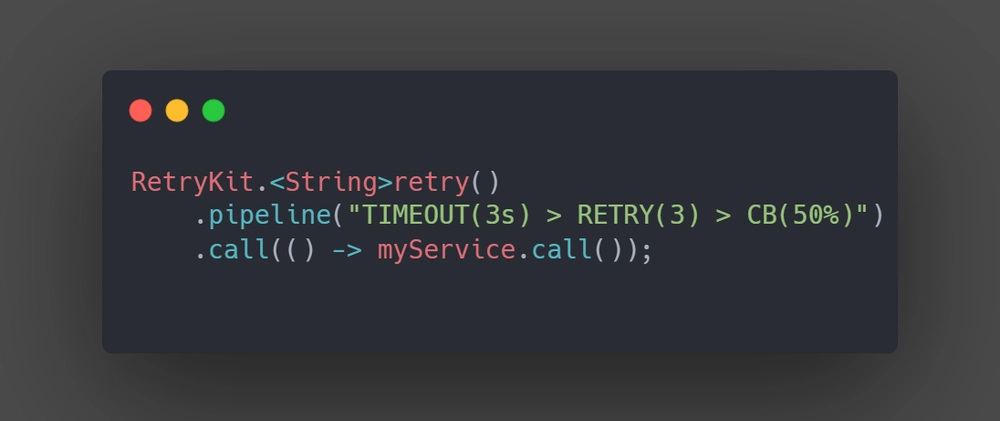
Most retry libraries make you choose: retry OR circuit breaker OR timeout. In real production systems you need all three, composed in the right order. RetryKit lets you express that as a single string:
RetryKit.<String>retry()
    .pipeline("TIMEOUT(3s) > RETRY(3) > CB(50%)")
    .call(() -> myService.call());
Read it left to right — outermost wrapper first. TIMEOUT(3s) — each attempt must complete within 3 seconds. RETRY(3) — retry up to 3 times on failure. CB(50%) — open the circuit if 50%+ of calls fail.
The full DSL syntax:
TIMEOUT(5s)
TIMEOUT(500ms)

RETRY(3)
RETRY(maxAttempts:5, waitDuration:500ms)
RETRY(maxAttempts:4, waitDuration:1s, backoff:2.0, maxWait:10s, jitter:0.2)

CB(50%)
CB(failureRate:50%, minCalls:5, wait:1m, halfOpen:2, timeout:2s)
A realistic production pipeline in one line:
.pipeline("TIMEOUT(2s) > RETRY(maxAttempts:4, waitDuration:500ms, backoff:2.0, jitter:0.2) > CB(failureRate:60%, minCalls:10, wait:30s)")
This used to take 40+ lines of config. Now it's one.
For teams that want to tune retry behavior without redeploying:
production:
  mode: RETRY_FIRST
  maxAttempts: 3
  waitDuration: PT1S
  circuitBreaker:
    failureRateThreshold: 50
    minimumNumberOfCalls: 5
    waitDurationInOpenState: PT1M

aggressive:
  mode: PIPELINE
  pipeline: "TIMEOUT(2s) > RETRY(3) > CB(50%)"
Load it in your app:
RetryKit.<String>fromYaml("/etc/myapp/retrykit.yaml")
    .profile("production")
    .<String>as()
    .withHotReload(Duration.ofSeconds(10))
    .fallback(ctx -> "fallback")
    .build();
Change maxAttempts or failureRateThreshold in the file — the running service picks it up in 10 seconds. No restart, no redeploy.
Two workflow modes depending on your use case. RETRY_FIRST — retry exhausts attempts, CB accumulates failures across retries. CB_FIRST — circuit breaker is checked before any retry attempt, if OPEN fail immediately — no retries wasted. Use CB_FIRST when the downstream service is known to be down.
Two distinct exceptions so you always know what happened:
try {
    kit.call(() -> myService.call());
} catch (RetryException e) {
    // service WAS called — all e.attempts() failed
} catch (CircuitBreakerOpenException e) {
    // service was NOT called — CB is open, we already know it's down
}
How does RetryKit compare?
| RetryKit | Resilience4j | |
|---|---|---|
| Dependencies | 0 | ~10 |
| JAR size | < 50 KB | ~500 KB |
| Pipeline DSL | yes | no |
| YAML hot reload | yes | no |
| Java version | 17+ | 8+ |
| Setup time | 5 min | 30 min+ |
Most enterprise retry libraries are built for every possible use case — you pay that cost even when you need none of it. RetryKit does one thing well.
GitHub: https://github.com/caninaam/retry-kit
Maven Central: https://central.sonatype.com/artifact/io.github.caninaam/retrykit
Next post — how the circuit breaker state machine works under the hood, and why compareAndSet matters in concurrent systems.