










Transaction speed on Solana isn't just about having a fast RPC anymore.
In 2026, with validators spread across dozens of data centers, leader schedules rotating every 4 slots, and QUIC migration well underway, the game has changed. Here's a breakdown of every method for landing transactions fast — from slowest to fastest — and what actually matters.
Method 1: Public RPC (Slowest)
Typical latency: 500ms–2s+
When you call sendTransaction on a public RPC like mainnet-beta.solana.com, your transaction goes through:
- Load balancer → RPC node
- RPC node validates and simulates
- Transaction enters the gossip network
- Gossip propagates to the leader (eventually)
The gossip network is the bottleneck. It was designed for reliability, not speed. Your transaction competes with thousands of others being propagated across the mesh. There's no priority, no direct path, and no guarantee of timely delivery.
Verdict: Only suitable for non-time-sensitive operations — transfers, staking, governance.
Method 2: Premium RPC Provider
Typical latency: 100–500ms
Premium RPC providers (Helius, Triton, QuickNode, etc.) maintain closer connections to validators and may forward transactions more efficiently. Some offer sendTransaction with priority forwarding.
The improvement comes from better network peering, fewer hops to reach validators, and sometimes direct connections to certain leaders. But you're still going through the provider's infrastructure, and you're locked into one provider's network topology. If the current leader is far from your provider, you still lose time.
Verdict: Good baseline for production applications. Not fast enough for MEV.
Method 3: Jito Bundles
Typical latency: 50–200ms
Jito's block engine receives your transaction (or bundle), simulates it, and forwards it to the Jito-enabled validator. The tip incentivizes inclusion.
Pros:
- Atomic bundle execution
- Tip-based priority
- Protection from sandwich attacks
Cons:
- Only works when a Jito validator is the leader (~65% of slots)
- The auction/simulation pipeline adds latency
- Single sender — if Jito's path to the leader is slow, you're slow
- Tip costs can be significant during competitive periods
Verdict: Excellent for bundle-based MEV. Not optimal for raw speed on every slot.
Method 4: Direct Leader Connection
Typical latency: 20–100ms
If you maintain your own infrastructure, you can resolve the current leader from the schedule, look up their TPU address, and send directly — bypassing gossip entirely.
Challenges:
- You need to track the leader schedule in real-time
- QUIC connections require TLS handshake and stake-weighted QoS
- You need servers near major validator data centers
- If the leader is in a region where you don't have infrastructure, you're back to high latency
Verdict: Fast when the leader is near your server. Unreliable otherwise.
Method 5: TPU Direct via UDP
Typical latency: 1–50ms (when conditions align)
Raw UDP packets sent directly to the leader's TPU port. Zero overhead — just serialized bytes over the wire.
The catch: UDP is fire-and-forget. No acknowledgment, no retry, no confirmation. And with Solana's QUIC migration, unstaked UDP connections are increasingly deprioritized. You need real-time leader schedule tracking, TPU address resolution, servers geographically close to the leader, and a separate confirmation pipeline.
Verdict: Absolute fastest when it works. Requires significant infrastructure to do reliably.
The Real Problem: Leader Geography
Here's what most guides miss: it doesn't matter how fast your submission method is if you're far from the leader.
Solana validators are distributed globally. The leader changes every ~1.6 seconds. If you're submitting from a server in Chicago and the current leader is in Tokyo, you're adding 150ms+ of network latency no matter what protocol you use.
The fastest transaction landing comes from being close to the leader when you submit.
Method 6: Sender-Agnostic Proximity Routing (Fastest Consistently)
This is where AllenHark Slipstream comes in. Instead of picking one method or one sender, Slipstream combines all of them with real-time leader proximity data.
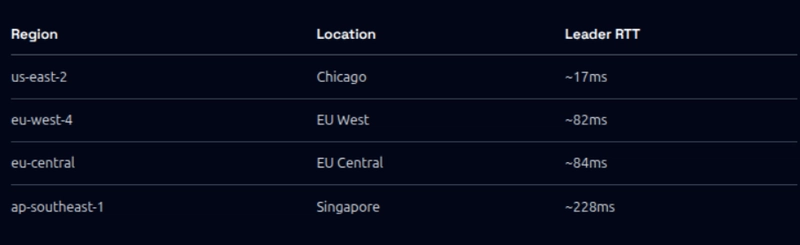
Slipstream maintains workers in 4 global regions:
When you submit a transaction, Slipstream:
- Identifies the current leader and its location
- Routes to the worker with lowest RTT to that leader
- Selects the optimal sender (Nozomi, Helius, 0slot, or custom)
- Delivers via the fastest protocol available
The result: consistent sub-20ms delivery when the leader is near a US data center (which covers the majority of slots), with graceful handling of EU and APAC leaders.
Why this wins:
- No single point of failure — 4 regions, 4 protocols, multiple senders
- Automatic optimization — you don't pick the sender, the network conditions do
- ~17ms US East RTT — competitive with direct TPU submission, but with retry logic
- Bundle support — atomic 2–5 tx bundles when you need them
- TPU direct mode — fire-and-forget when you want absolute minimum latency
Quick Setup
npm install @allenhark/slipstream
import { SlipstreamClient, configBuilder } from "@allenhark/slipstream";

const config = configBuilder().apiKey("sk_live_...").build();
const client = await SlipstreamClient.connect(config);

// Standard submission — routed to fastest path
const result = await client.submitTransaction(txBytes);

// TPU direct — fire-and-forget minimum latency
const tpuResult = await client.submitTransactionWithOptions(txBytes, {
    tpuSubmission: true,
});
Cost: 1 token (0.00005 SOL) per standard transaction. Free tier available (100 tokens/day).
Summary
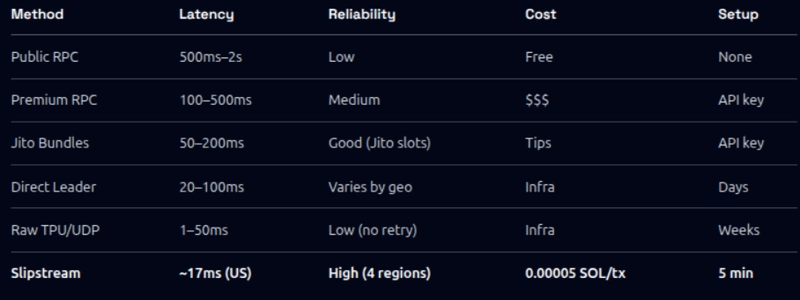
In 2026, the fastest way to consistently land Solana transactions is proximity-aware, sender-agnostic routing. You can build it yourself across multiple data centers — or use Slipstream and start in 5 minutes.
Get Started
Slipstream Quick Start - First transaction in 5 minutes
Slipstream Infrastructure - Live network stats
What is Slipstream? - Full product overview