





Getting a blockchain node running isn't the hard part. The hard part is everything that comes after — keeping it synchronized, updated, monitored, and available, day after day. Most teams underestimate this. Deployment goes smoothly. Then a node falls out of sync at 2am. A protocol hard fork requires coordinated updates across every node. A client crashes and nobody gets alerted. This is where DIY self-hosting gets expensive — not in servers, but in engineering time.
Why organizations run a self-hosted blockchain node
Organizations self-host for three reasons: compliance (some industries mandate on-premises or jurisdiction-specific infrastructure), control (direct access to blockchain data without rate limits or API dependency), and cost (at scale, self-hosting beats managed node pricing). The question isn't whether to self-host — it's how much of your team's time you want to spend on infrastructure versus your actual product.
Two paths: build it yourself or use a control plane
Teams that self-host typically choose one of two approaches. DIY means assembling open-source components, writing your own deployment configs, setting up monitoring, and maintaining everything in-house. Chainstack Self-Hosted means deploying a control plane on your own infrastructure that handles the complexity — while you retain full ownership of the underlying servers and data. Both give you full infrastructure control. The difference is how much engineering time goes into maintaining the plumbing.
The reality of running a self-hosted blockchain node yourself
Setup and installation
A production blockchain setup requires container orchestration, storage provisioning, networking configuration, and monitoring — each with its own dependencies. A misconfiguration at any layer can prevent nodes from starting or corrupt existing data. For a single Ethereum node, this is manageable. The challenge compounds with every additional node or protocol: each new protocol means rebuilding the deployment system from scratch. Expect 2+ weeks to get a production-ready setup running for the first time.
Node deployment
An Ethereum node requires two separate clients — an execution client and a consensus client — that must communicate continuously. Every deployment decision (resource allocation, storage sizing, sync strategy) requires deep familiarity with both Kubernetes and the specific blockchain clients you're running. Every decision becomes a configuration artifact that someone on your team needs to maintain indefinitely.
Ongoing operations
Client updates, security patches, sync issues, and failed nodes all need ongoing attention. Without a centralized management layer, this knowledge lives in runbooks and whoever originally built the system. Expect roughly 4 hours per week per engineer to keep a DIY setup healthy — more during protocol hard forks or corruption events.
💡 This is a preview. Read the full article — including the complete comparison table and decision framework — on Chainstack Blog
Chainstack Self-Hosted: the same control, less overhead
Chainstack Self-Hosted runs on your infrastructure — your servers, your cloud, your data. The control plane handles deployment, configuration, monitoring, and updates instead of custom scripts and runbooks.
Installation runs in 5–10 minutes, versus 2+ weeks for a DIY production setup. The platform bundles production-ready configurations for authentication, workflow orchestration, state management, and the control panel — tested together, not assembled from scratch.
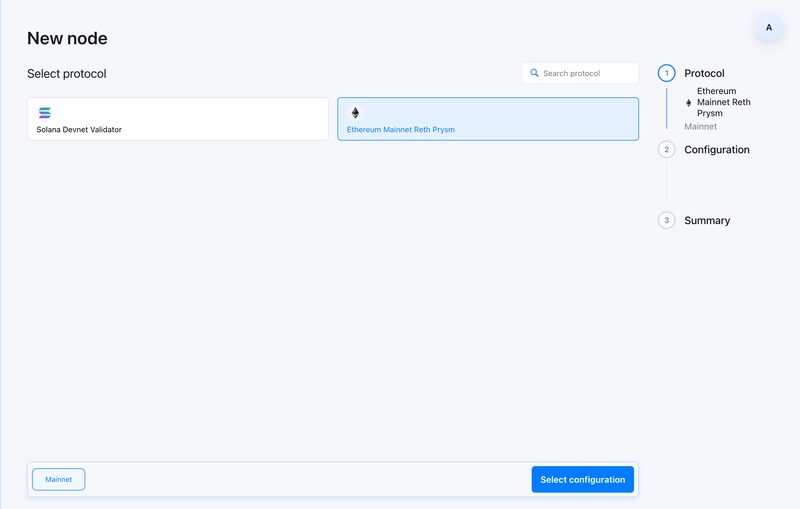
Node deployment happens through a web interface: select your protocol and click deploy. Chainstack Self-Hosted provisions Reth and Prysm with configurations tested in production — resource allocation, storage sizing, and sync modes are predetermined based on real-world requirements. Updates, monitoring, and recovery all happen through the same control panel. Failover routing lets you define where traffic goes when a node becomes unavailable — a secondary node, a Chainstack RPC endpoint, or one you specify.
The trade-off: you work within supported configurations rather than customizing every component. For most teams, tested defaults are faster and more reliable than custom setups. For genuinely specialized requirements, DIY may still be the right call.
The real cost: engineering time
Infrastructure hardware costs are easy to calculate. Engineering time is less visible but often larger. Building a production-ready DIY setup requires approximately two weeks from someone with Kubernetes and blockchain infrastructure experience. Ongoing maintenance runs ~4 hours per week. At typical senior engineer rates, that's roughly $6,000 upfront and $15,000+ annually — for a single protocol. Three protocols don't cost three times as much; coordination overhead compounds.
Chainstack Self-Hosted has a licensing cost. But the maintenance burden drops significantly, and the compounding value increases at scale. More importantly, engineering hours spent on infrastructure are hours not spent on the product that differentiates your business.
💡 Want the full comparison table and decision framework? Read the complete article on Chainstack Blog →