


惯性聚合 高效追踪和阅读你感兴趣的博客、新闻、科技资讯
阅读原文 在惯性聚合中打开

推荐订阅源

J
Java Code Geeks
钛媒体:引领未来商业与生活新知
钛媒体:引领未来商业与生活新知
H
Hackread – Cybersecurity News, Data Breaches, AI and More
腾讯CDC
F
Fortinet All Blogs
I
InfoQ
Jina AI
Jina AI
有赞技术团队
有赞技术团队
A
About on SuperTechFans
Stack Overflow Blog
Stack Overflow Blog
小众软件
小众软件
Recent Announcements
aimingoo的专栏
aimingoo的专栏
雷峰网
雷峰网
B
Blog RSS Feed
C
Check Point Blog
Y
Y Combinator Blog
博客园 - 聂微东
云风的 BLOG
云风的 BLOG
Cyber Security Advisories - MS-ISAC
Hugging Face - Blog
Hugging Face - Blog
Microsoft Security Blog
Engineering at Meta
Engineering at Meta
G
Google Developers Blog

DEV Community

Authentication Security Deep Dive: From Brute Force to Salted Hashing (With Java Examples) Why AI Systems Don’t Fail — They Drift Spilling beans for how i learn for exam😁"Reinforcement Learning Cheat Sheet" I Replaced Chrome with Safari for AI Browser Automation. Here's What Broke (and What Finally Worked) How Python Borrows Other People's Work The $40 Architecture: Processing 1 Billion API Requests with 99.99% Uptime Vibe Coding: A Workflow Guide (From Zero to SaaS) Most webhook security guides protect the wrong side. The scary part is delivery. Headless CMS for TanStack Start: Build a Blog with Cosmic EU Age Verification App "Hacked in 2 Minutes" — What Actually Happened Comfy Cloud’s delete function does not actually remove files Running AI Models on GPU Cloud Servers: A Beginner Guide Event-driven media intelligence with AWS Step Functions and Bedrock I scored 500 AI prompts across 8 quality dimensions — here's what broke How to Call Google Gemini API from Next.js (Free Tier, No Backend Needed) The Portal Protocol: Reclaiming Human Connection in the Age of AI How to Fix Your Team's Scattered Knowledge Problem With a Self-Hosted Forum Intro to tc Cloud Functors: A Graph-First Mental Model for the Modern Cloud Designing Multi-Tenant Backends With Both Ownership and Team Access I Built a Neumorphic CSS Library with 77+ Components — Here's What I Learned PostgreSQL Performance Optimization: Why Connection Pooling Is Critical at Scale Cómo construí un SaaS multi-rubro para gestionar expensas en Argentina con FastAPI + Vue 3 🚀 I Built an Ethical Hacking Scanner Tool – Open Source Project I Replaced /usage and /context in Claude Code With a Single Statusline A Pythonic Way to Handle Emails (IMAP/SMTP) with Auto-Discovery and AI-Ready Design I Collected 8.9 Million Polymarket Price Points — Here's What I Found About How Markets Really Move EcoTrack AI — Carbon Footprint Tracker & Dashboard Everyone's Using AI. No One Agrees How. 5 self-hosted ebook managers worth trying in 2026 Building Your First AI Agent with LangChain: From Chatbot to Autonomous Assistant
Technical Report: EU AI Act Code Footprint Analysis
Kuziva Muzon · 2026-04-27 · via DEV Community

Kuziva Muzondo

As of April 26, 2026, the AI industry is 98 days from the original August 2 enforcement deadline for high-risk systems. While the European Parliament’s March 26 vote (569-45) significantly increases the likelihood of a delay to December 2027 via the Digital Omnibus, the technical requirements of Articles 9–15 remain the fixed objective for engineering teams.

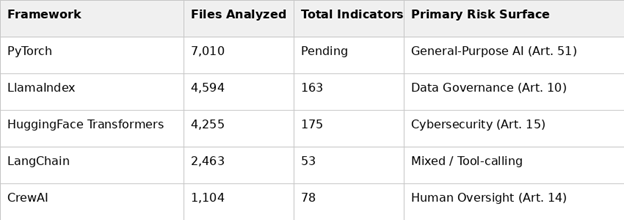
To quantify the readiness of the ecosystem, we conducted a source-code audit using Regula (v1.7.0). We analyzed 19,426 files across five cornerstone AI frameworks. The analysis identifies "compliance surface"—code patterns that trigger specific legal obligations under the Act.

The Framework Audit
Engineering Findings

Human Oversight (Article 14)
The highest density of agentic autonomy indicators was found in CrewAI. Under Article 14, high-risk systems must be designed for human intervention. Our scan identified 56 instances where autonomous loops lack native confirmation gates, shifting the compliance burden entirely to the end-implementer.

Cybersecurity and Weights (Article 15)
HuggingFace Transformers triggered 113 specific AI security patterns. These primarily involve model-loading and serialization risks. Article 15(4) mandates protection against model poisoning; using these frameworks requires a verified provenance chain for all external weights.

Data Governance (Article 10)
We identified 79 patterns in LlamaIndex indicating PII or sensitive data flowing into or out of LLMs without redaction. Article 10(5) requires training and testing data to be securely governed. Frameworks that facilitate RAG on sensitive datasets create a direct Article 10 surface and significant information disclosure risks.

Project Details
Regula is a zero-dependency Python CLI for AI governance. It uses 409 unique detection patterns to map code to the EU AI Act, OWASP LLM Top 10, and NIST AI RMF. It runs locally and generates signed evidence packs for regulatory submission.

*Source: https://github.com/kuzivaai/getregula
*