




What if, instead of Universal Basic Income, the powers that be hand us AI tokens? Those who manage to spin those tokens into something commercially viable will survive. The rest will still get their tokens, but they won't be able to trade them for food or shelter—and they will be easy to blame. In our increasingly technocratic society, this feels much closer to reality. Why give people money when you can give them tokens? It introduces an extra layer of control, a new gateway for exclusion.
I am actually writing this by hand (well, it doesn't mean I won't do a quick AI proofreading pass later) because I am staring down the barrel of my quota. Time to step back and share some thoughts. Why not?
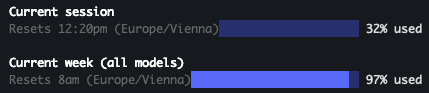
I have a Claude Code Max 20x subscription—basically the ceiling before you're forced into pay-as-you-go—but I only have 3% of my limit left. This isn't just the rolling 5-hour window limit; this is the hard weekly stop. It's manageable this time (although I still have work to do, and honestly, I dread doing it manually), but if you hit this wall after just two or three days of the week... good luck.
I try to conserve my tokens, but this is inevitable. Am I wasteful? Yes. Could I optimize? Sure, and I've tried. But the reality is that you can never have enough tokens. Having an AI implement a feature is not intrinsically demanding. It's the context. It’s loading the massive playbooks containing your best practices, business logic, and operational guidelines. It’s retrieving data from third-party APIs, parsing PDFs, scanning multiple repositories, digesting thousands of lines of error logs, and debugging end-to-end tests via screenshot analysis.
The more you automate, the more context you need, and the faster your quota burns. My attention is already fragmented across five or six concurrent sessions. If I want to stay focused, I can't be bothered to constantly switch models or manually compact prompts to save pennies. Yes, there are tools to help manage this (like writing a custom statusline hook), but there is no silver bullet. To borrow a metaphor: asking a developer to ration tokens is like asking a painter to use as little paint as possible while trying to express her art.
For software engineers, agentic AI has become more than a drug; it's basic infrastructure. We need it every single day, just like we need the internet. We are still doing software engineering, but AI has naturally promoted us all to software architects and engineering managers. The tools do us a lot of good, but the system around them is taking its toll.
Just look at the quota anxiety it creates.
Scenario one: It’s 12:30 PM, and you’ve used 37% of your 5-hour window, which resets at 1:00 PM. Time for a break? No. You don't want to let that remaining quota go to waste, because whatever you skip now might be impossible to compute in four hours when you're bursting at the seams trying to fix a massive suite of e2e tests.
Scenario two: The 5-hour windows aren't your main problem. Just working normally through the day is enough to hit that hard weekly limit. But what happens when you don't hit it? If you happen to have surplus tokens near the end of the billing cycle (unlike me today), you stay up late working just to make sure you use them all by the end of the week. Any unused token is a resource thrown in the garbage that you might terribly miss in just a few days.
Pick your poison.
Either you work in a big company where you are encouraged to consume thousands of dollars a month—because it means you fully embrace the trend and are super-performing, though that comes with its own kind of stress and sleeplessness since infinite tokens mean infinite expectations. Or you pay for the extra usage without blinking because it yields a high ROI. Otherwise, you are like most people, trying to get through the month with your flat-rate plan, knowing that you will eventually hit the cap and have to fall back on the API and/or supplement it with extra usage—you just don't know under what circumstances that shoe will drop.
It is fair to pay for a high-quality service, despite the occasional outages. But let's be honest about the promise of AI: it was supposed to boost our productivity and take the weight off our shoulders. Instead, we are working longer hours and dealing with more stress than ever. If you thought AI was a tool you could just set and forget while you relax, you misunderstood the assignment—and you might not keep your job for long.
This relentless pace and constant token-juggling is ultimately what brings us back to the broader picture. Universal Basic Income might happen just to keep the economic machine running, but don't be surprised if that "income" comes in the form of tokens to capitalize on.