










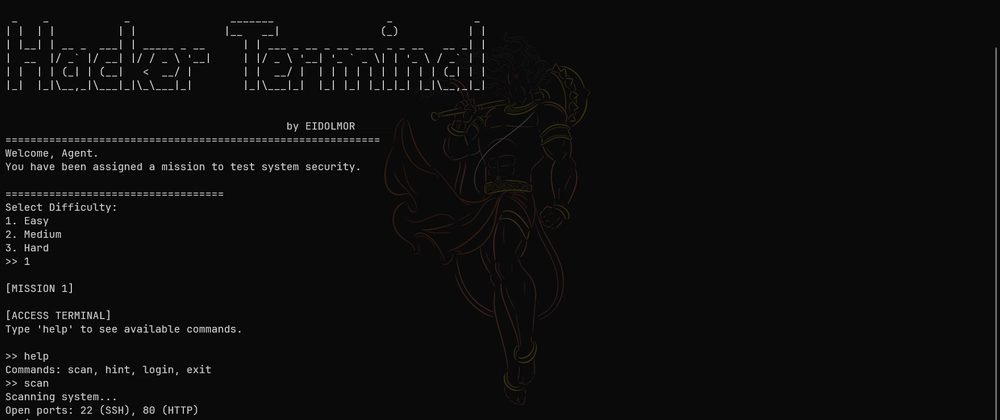

🚀 Introduction (The "Why")
As I started learning cybersecurity, I realized that just reading concepts or watching tutorials wasn't enough. Topics like password security, encryption, and system monitoring only truly make sense when you apply them.
So instead of building a typical beginner project, I decided to create something that would both-
-Reinforce what I've learned
-Help other beginners understand these concepts in a simple, interactive way
👉 The result is a terminal-based Hacker Simulation Game built in Python.
It's designed to be-
-Beginner-friendly
-Interactive
-Based on real cybersecurity ideas
🎮 What the Program Does
The game puts the player in the role of an ethical hacker completing missions-
-🔐 Password Cracking
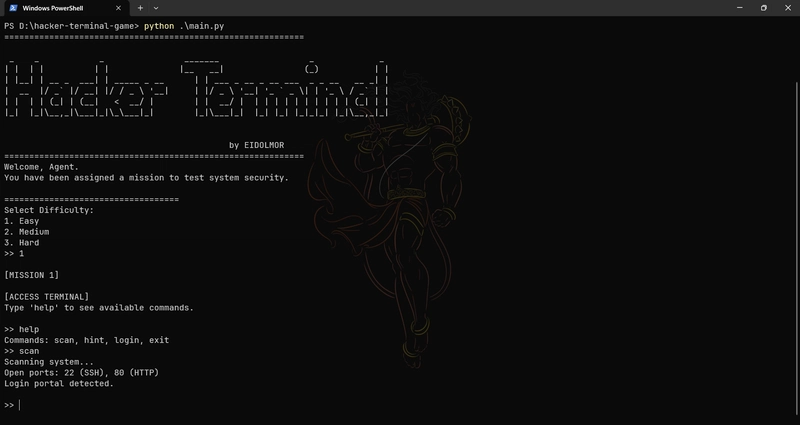
Simulates login systems with limited attempts and hint-based discovery.
-🔑 Cipher Decryption
Introduces encryption concepts using a Caesar cipher challenge.
-📜 Log Analysis
Teaches how to identify suspicious activity in system logs.
Each mission includes-
-Difficulty levels
-Randomized challenges
-Controlled hint systems
-Score tracking
🖥️** Terminal Gameplay**
🧠 How the Code Works
The project is structured into three main components:
-main.py
Controls the game flow using a Game class, managing score and progression.
-challenges.py
Contains all mission logic (password cracking, cipher decoding, log analysis).
-utils.py
Handles helper functions like terminal UI, difficulty selection, and formatted output.
Concepts used-
-Functions and loops
-Conditional logic
-Randomization for replayability
-Object-Oriented Programming (Game class)
The goal was to keep the code simple, modular, and easy to understand, especially for beginners.
🔗 GitHub Repository
Check out the full code here:
👉 Hacker Terminal Game
🔮 Future Improvements & Vision
This project is just the beginning. As I continue learning cybersecurity and development, I plan to expand this game with more advanced and realistic missions.
-Add a logging system to track player actions
-Introduce more cybersecurity challenges (e.g., brute force, network scanning, vulnerabilities)
-Expand the game progressively to multiple levels
👉 My roadmap-
-Build up to 10 levels in the terminal version
-Then transition to a web-based version of the game
-Long-term goal: reach Level 86 by the end of the year, turning this into a complete cybersecurity learning simulation
🏁 Conclusion
This project is a small step in my cybersecurity learning journey, but it helped me bridge the gap between theory and practical implementation.
By building this game, I was able to:
-Apply core cybersecurity concepts
-Improve my Python programming skills
-Create something useful for other beginners
If you're learning cybersecurity, try building something similar - it's one of the best ways to truly understand the concepts.