惯性聚合 高效追踪和阅读你感兴趣的博客、新闻、科技资讯
阅读原文 在惯性聚合中打开

推荐订阅源

Hugging Face - Blog
Hugging Face - Blog
Recent Announcements
V
Visual Studio Blog
博客园 - 叶小钗
H
Help Net Security
aimingoo的专栏
aimingoo的专栏
宝玉的分享
宝玉的分享
U
Unit 42
钛媒体:引领未来商业与生活新知
钛媒体:引领未来商业与生活新知
F
Fortinet All Blogs
V
V2EX
Stack Overflow Blog
Stack Overflow Blog
WordPress大学
WordPress大学
D
DataBreaches.Net
J
Java Code Geeks
H
Hackread – Cybersecurity News, Data Breaches, AI and More
A
About on SuperTechFans
酷 壳 – CoolShell
酷 壳 – CoolShell
量子位
C
Check Point Blog
奇客Solidot–传递最新科技情报
奇客Solidot–传递最新科技情报
小众软件
小众软件
Microsoft Azure Blog
M
MIT News - Artificial intelligence

DEV Community

Authentication Security Deep Dive: From Brute Force to Salted Hashing (With Java Examples) Why AI Systems Don’t Fail — They Drift Spilling beans for how i learn for exam😁"Reinforcement Learning Cheat Sheet" I Replaced Chrome with Safari for AI Browser Automation. Here's What Broke (and What Finally Worked) How Python Borrows Other People's Work The $40 Architecture: Processing 1 Billion API Requests with 99.99% Uptime Vibe Coding: A Workflow Guide (From Zero to SaaS) Most webhook security guides protect the wrong side. The scary part is delivery. Headless CMS for TanStack Start: Build a Blog with Cosmic EU Age Verification App "Hacked in 2 Minutes" — What Actually Happened Comfy Cloud’s delete function does not actually remove files Running AI Models on GPU Cloud Servers: A Beginner Guide Event-driven media intelligence with AWS Step Functions and Bedrock I scored 500 AI prompts across 8 quality dimensions — here's what broke How to Call Google Gemini API from Next.js (Free Tier, No Backend Needed) The Portal Protocol: Reclaiming Human Connection in the Age of AI How to Fix Your Team's Scattered Knowledge Problem With a Self-Hosted Forum Intro to tc Cloud Functors: A Graph-First Mental Model for the Modern Cloud Designing Multi-Tenant Backends With Both Ownership and Team Access I Built a Neumorphic CSS Library with 77+ Components — Here's What I Learned PostgreSQL Performance Optimization: Why Connection Pooling Is Critical at Scale Cómo construí un SaaS multi-rubro para gestionar expensas en Argentina con FastAPI + Vue 3 🚀 I Built an Ethical Hacking Scanner Tool – Open Source Project I Replaced /usage and /context in Claude Code With a Single Statusline A Pythonic Way to Handle Emails (IMAP/SMTP) with Auto-Discovery and AI-Ready Design I Collected 8.9 Million Polymarket Price Points — Here's What I Found About How Markets Really Move EcoTrack AI — Carbon Footprint Tracker & Dashboard Everyone's Using AI. No One Agrees How. 5 self-hosted ebook managers worth trying in 2026 Building Your First AI Agent with LangChain: From Chatbot to Autonomous Assistant
Understanding Transformers Part 13: Introducing Encoder–D...
Rijul Rajesh · 2026-04-26 · via DEV Community
Cover image for Understanding Transformers Part 13: Introducing Encoder–Decoder Attention

Rijul Rajesh

In the previous article, we built up the decoder layers and stopped at the relationship between input and output sentence.

So this brings us to the concept of Encoder-Decoder Attention

Why Encoder–Decoder Attention Matters

Consider the input sentence:

“Don’t eat the delicious looking and smelling pizza.”

When translating this sentence, it is very important to keep track of the word “Don’t”.

If the translation ignores this word, we might end up with:

“Eat the delicious looking and smelling pizza.”

These two sentences have completely opposite meanings.

Key Idea

Because of this, the decoder must pay close attention to the important words in the input.

This is where encoder–decoder attention comes in.

It allows the decoder to focus on the most relevant parts of the input sentence while generating the output.

In simple terms, encoder–decoder attention helps the decoder keep track of significant words in the input.

Updated Transformer Structure

With this idea, our current encoder–decoder structure looks like this:
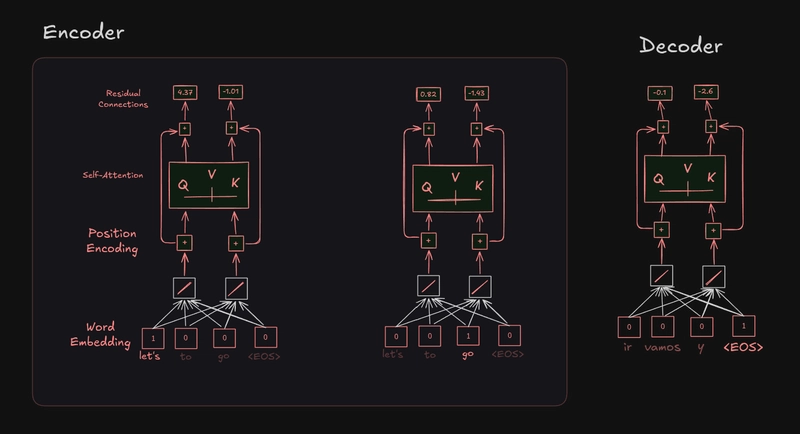
We will build on this and explore the details in the next article.


Looking for an easier way to install tools, libraries, or entire repositories?
Try Installerpedia: a community-driven, structured installation platform that lets you install almost anything with minimal hassle and clear, reliable guidance.

Just run:

ipm install repo-name

Enter fullscreen mode Exit fullscreen mode

… and you’re done! 🚀

Installerpedia Screenshot

🔗 Explore Installerpedia here