




Summary
A Cybersecurity AI Forward Deployed Engineer secures AI agents inside a client’s live systems, with real credentials attached. Accenture pays up to $235,100 for this role. You need deep security experience, hands-on agentic AI skills, and proof you can own results inside someone else’s environment. This guide covers the pay data, the skills employers test for, and the 6-step path to get there along with latest certification details
A Cybersecurity AI Forward Deployed Engineer works inside a client’s company and secures AI agents running in production, with real credentials and real access attached. Accenture now hires for this exact title, with US pay listed as high.
The job needs deep security skill, hands-on experience deploying agentic AI, and ownership of outcomes inside someone else’s environment. Here’s the real path: the job data, the pay numbers, and the skills employers screen for.
Palantir made the Forward Deployed Engineer title well known. These engineers work at a client’s site, building and deploying software inside real, messy environments. A product team ships features from head office. A forward deployed engineer ships them from inside the client’s world. Add “cybersecurity AI” to the title, and the job narrows fast.
Accenture’s own posting puts the role deep inside production delivery. The engineer sits with a client’s security and engineering teams and owns results: a smaller attack surface, safer AI in production, and a measurable jump in security posture.
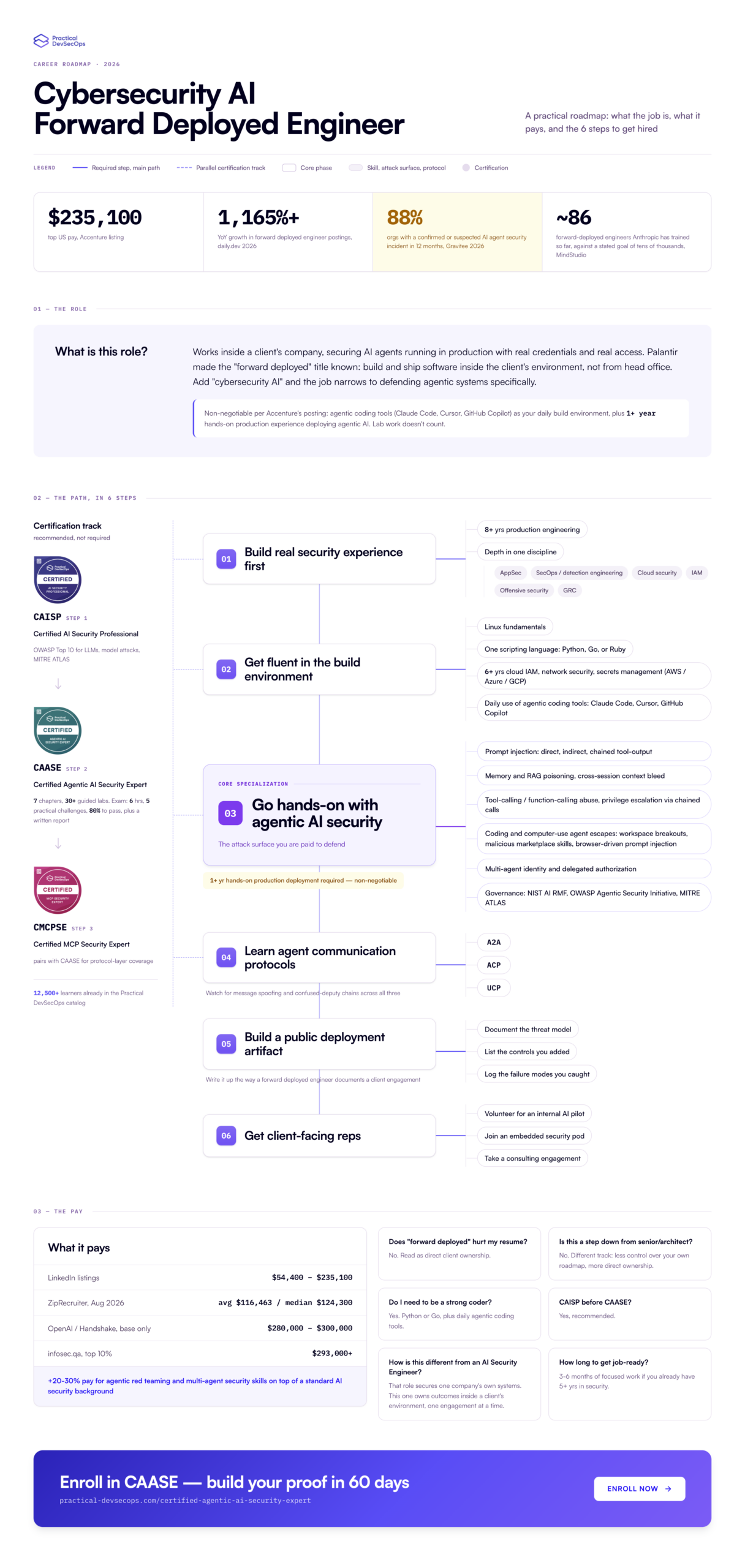
Because AI agents already broke things. 88% of organizations confirmed or suspected an AI agent security incident in the past 12 months. Healthcare hit 92.7%. Financial services hit 54.7%, per Gravitee’s State of AI Agent Security 2026 report. Agents now run with real credentials and real database access. Most companies deployed them faster than they built the controls to watch them.
Forward deployed engineer job postings are climbing fast too. They grew more than 1,165% year over year, according to daily.dev’s 2026 roundup.
Anthropic said it planned to train tens of thousands of forward-deployed engineers to help banks, airlines, and insurers deploy AI. It reportedly trained around 86, per MindStudio. That gap between demand and supply is why these jobs pay so well right now.
Pay varies by employer, seniority, and how much of the agentic AI security stack you know cold.
| Source | Role | Pay range (USD) |
| LinkedIn listings | Cybersecurity AI Forward Deployed Engineer | $54,400 – $235,100 |
| ZipRecruiter, Aug 2026, via KDnuggets | Forward Deployed Engineer, general (avg / median) | $116,463 / $124,300 |
| OpenAI, Handshake, via MindStudio | Forward Deployed Engineer, base only | $280,000 – $300,000 |
| infosec.qa, 2026 | AI Security Engineer, top 10% | $293,000+ |
Add agentic red teaming and multi-agent security skills to a standard AI security background, and pay jumps 20 to 30% higher, per infosec.qa’s guide. Agentic AI security knowledge is now the biggest pay multiplier on a cybersecurity resume. It’s a big reason AI security engineers already clear $200K in the US.
Accenture’s hiring bar for this role is specific and steep. You need:
That covers the engineering side. The part most career guides skip is the agentic AI attack surface itself.
Most cybersecurity training stops at prompt injection against a single model. This role goes several layers deeper: memory stores, tool orchestration, agent-to-agent trust. Structured, hands-on training closes that gap faster than piecing it together from scattered blog posts and vendor docs.
Follow these 6 steps in order.
Most AI security training on the market teaches prompt injection against a chatbot and calls it done. Certified Agentic AI Security Expert (CAASE) goes several layers deeper: attacking and defending an agent’s reasoning loop, memory, tool-calling interfaces, multi-agent identity, and communication protocols, across 7 chapters and 30+ guided labs.
Three things set it apart from normal AI security courses:
If you want a forward deployed engineer certification with a real cybersecurity focus, CAASE fills that gap. Sign up and start building that proof today, alongside 12,500+ learners already in the Practical DevSecOps catalog.
The Cybersecurity AI Forward Deployed Engineer role didn’t exist 2 years ago. Now Accenture pays up to $235,100 for it, and demand already outpaces supply. You close that gap with real security depth, hands-on agentic AI skills, and proof you can own outcomes inside a client’s environment. Enroll in the Certified Agentic AI Security Expert (CAASE) course and build that proof in 60 days.
Does the “forward deployed” title hurt my resume for future security roles?
No. Hiring managers read “forward deployed” as direct client ownership. On teamblind’s engineering community, engineers describe it as a sideways move at worst, with real customer exposure most engineers never get.
Is this a step down from a senior security engineer or architect role?
No. It’s a different track. You trade some control over your own roadmap for direct ownership of a client’s outcomes, and the pay reflects that trade.
Do I need to be a strong coder for this job?
Yes. You need enough Python or Go to read and modify agent runtimes and MCP tooling, plus daily fluency in agentic coding tools. Accenture treats those tools as your main way to build software.
Should I take CAISP before CAASE?
Practical DevSecOps recommends it. Certified AI Security Professional (CAISP) covers AI and LLM security fundamentals: the OWASP Top 10 for LLMs, model attacks, and MITRE ATLAS. Certified Agentic AI Security Expert (CAASE) builds on that foundation and moves into the agentic layer: runtimes, memory, tool orchestration, and multi-agent systems. If you’re still deciding where to start, see how CAISP compares against Certified MCP Security Expert (CMCPSE), the other certification in the same track.
What’s the difference between an AI Security Engineer and a Cybersecurity AI Forward Deployed Engineer?
An AI Security Engineer usually secures one company’s own AI systems from the inside. A Cybersecurity AI Forward Deployed Engineer works inside client environments, one engagement at a time, owning security outcomes for systems they don’t fully control. This role demands more client-facing skill and wider range across tech stacks.
How long does it take to become job-ready for this role?
If you already have 5+ years in a security discipline, plan on 3 to 6 months of focused, hands-on agentic AI security work to close the gap. Follow a structured plan, like this guide on how to prepare for an AI security certification. If you’re earlier in your career, build that security depth first. There’s no shortcut past that requirement.
Varun is a Security Research Writer specializing in DevSecOps, AI Security, and cloud-native security. He takes complex security topics and makes them straightforward. His articles provide security professionals with practical, research-backed insights they can actually use.
此内容由惯性聚合(RSS阅读器)自动聚合整理,仅供阅读参考。 原文来自 — 版权归原作者所有。
