








One of my long running side projects is a Gtk backend called “Broadway”. Instead of rendering to the screen this backend creates a HTTP server that you can connect to, and then exposes the UI remotely in the browser.
The original version of broadway was essentially streaming image frames, although there were various ways to optimize what got sent. This matches pretty well with how Gtk 3 rendering works, particularly on Wayland. Every frame it calls out to all widgets, letting them draw on top of a buffer and then sends the final frame to the compositor. Broadway just inserts some image delta computation and JavaScript magic in the middle of this.
Enter Gtk 4, breaking everything!
However, time moves on, and the current development branch of Gtk (which will be Gtk 4) has completely changed how rendering works, with the goal of doing efficient rendering on modern GPUs.
In the new model widgets don’t directly render to a buffer. Instead they build up a model of how the final result should look in terms of something called render nodes. These describe rendering as a tree of highlevel operations. The backend (we have software, OpenGL and Vulkan backends) then knows how to take this description and submit it to the GPU in an efficient way. This is somewhat similar to the firefox WebRender project.
Its would be possible to implement the broadway backend by hooking up the software renderer, letting it generate a buffer and then send that to the browser. However, that is pretty lame!
CSS comes to the rescue!
Instead I’ve been looking at making the browser actually draw the render nodes. Gtk defines a lot of its UI in terms of CSS these days, and that means that the render nodes actually are very close to the CSS rendering model. For example, the basic drawing operation are things like rounded boxes with borders, shadows, etc.
So, I was thinking, could we not take these render node and turn them into actual DOM nodes with CSS styles and send them to the browser. Then every frame we can just diff the DOM trees, sending the minimal changes necessary.
Sounds crazy right? But, it turns out to work pretty well.
Check out this example page which I created with the magic of “save as”. In particular, try zooming into that page in the browser, and play with the developer tools inspector to see the nodes. Here is a part of it zoomed in:
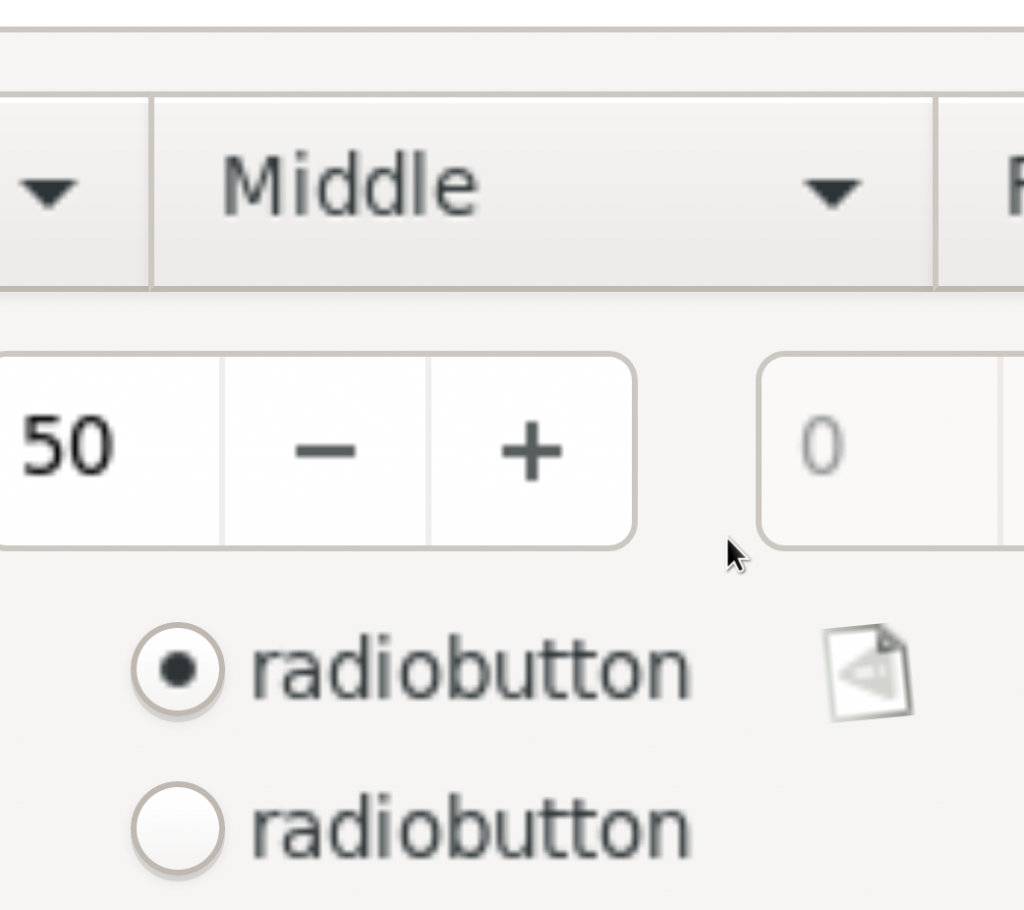
The icons and the text are not CSS, so they don’t scale, but look at those gorgeous borders, shadows and gradients!
Entering the 3rd dimension!
Particularly interesting is the support in Gtk for general 3D transforms. This maps well to the CSS transform on the browser style.
Check out this example of a spinning-cube transition. If you open up the browser inspector you can see that each individual element in the cube is still a regular CSS box.
Some technical notes
If you look at the examples above they all use data: uris for images. This is a custom mode that lets “screenshots” like the above work. Normally broadway uses blobs for the images.
Also, looking at the examples they seem very heavy in terms of images, as all the text are images. However, in a typical frame most of the render tree is identical to the previous frame, meaning any label that was used in the last frame need not be sent again. In fact, even if it changes position in the tree due to a parent node changing (scrolling, cube-switching, etc) it can still be reused as-is.
However, text is clearly the weak point in here. Unfortunately HTML/CSS has no low-level text rendering APIs we could use. I’m considering generating a texture atlas with pre-rendered glyphs that can be reused (like CSS sprites) when rendering text, that would mean we will have to download less data at least. If anyone has other ideas I would love to hear about it.