惯性聚合 高效追踪和阅读你感兴趣的博客、新闻、科技资讯
阅读原文 在惯性聚合中打开

推荐订阅源

K
Kaspersky official blog
T
Threat Research - Cisco Blogs
N
News and Events Feed by Topic
Hacker News: Ask HN
Hacker News: Ask HN
Project Zero
Project Zero
Application and Cybersecurity Blog
博客园 - 叶小钗
Security Latest
Security Latest
Spread Privacy
Spread Privacy
aimingoo的专栏
aimingoo的专栏
N
News and Events Feed by Topic
Webroot Blog
Webroot Blog
U
Unit 42
Cyberwarzone
Cyberwarzone
小众软件
小众软件
Scott Helme
Scott Helme
Engineering at Meta
Engineering at Meta
Microsoft Security Blog
T
The Blog of Author Tim Ferriss
A
About on SuperTechFans
爱范儿
爱范儿
S
Schneier on Security
让小产品的独立变现更简单 - ezindie.com
Schneier on Security
Latest news
Latest news
GbyAI
GbyAI
cs.CV updates on arXiv.org
Simon Willison's Weblog
The Register - Security
WordPress大学
WordPress大学
博客园_首页
Blog — PlanetScale
Blog — PlanetScale
PCI Perspectives
PCI Perspectives
Jina AI
Jina AI
AI
AI
NISL@THU
NISL@THU
I
Intezer
G
GRAHAM CLULEY
B
Blog
S
Secure Thoughts
IT之家
IT之家
宝玉的分享
宝玉的分享
Recent Announcements
Y
Y Combinator Blog
奇客Solidot–传递最新科技情报
奇客Solidot–传递最新科技情报
酷 壳 – CoolShell
酷 壳 – CoolShell
有赞技术团队
有赞技术团队
V2EX - 技术
V2EX - 技术
Recorded Future
Recorded Future
Hacker News - Newest:
Hacker News - Newest: "LLM"

Aikido Security's Blog

GlassWorm goes native: New Zig dropper infects every IDE on your machine Aikido Attack finds multiple 0-days in Hoppscotch The cybersecurity doomerism around Mythos doesn't match what we see on the ground axios compromised on npm: maintainer account hijacked, RAT deployed Popular telnyx package compromised on PyPI by TeamPCP Aikido × Lovable: Vibe, Fix, Ship CanisterWorm Gets Teeth: TeamPCP's Kubernetes Wiper Targets Iran TeamPCP deploys CanisterWorm on NPM following Trivy compromise Security testing is validating software that no longer exists Aikido Recognized by Frost & Sullivan with the 2026 Customer Value Leadership Award in ASPM GlassWorm Hides a RAT Inside a Malicious Chrome Extension fast-draft Open VSX Extension Compromised by BlokTrooper Glassworm Strikes Popular React Native Phone Number Packages Glassworm Is Back: A New Wave of Invisible Unicode Attacks Hits Hundreds of Repositories How Security Teams Fight Back Against AI-Powered Hackers Introducing Betterleaks, an open source secrets scanner by the author of Gitleaks Trump’s 2026 cybersecurity strategy: From compliance to consequence How does AI pentesting work with compliance? What continuous pentesting actually requires Rare Not Random: Using Token Efficiency for Secrets Scanning Persistent XSS/RCE using WebSockets in Storybook’s dev server Why Determinism Is Still a Necessity in Security WAF vs. RASP vs. ADR Introducing Aikido Infinite: A new model of self-securing software How Aikido secures AI pentesting agents by design Astro Full-Read SSRF via Host Header Injection How to Get Your Board to Care About Security (Before a Breach Forces the Issue) What is Slopsquatting? The AI Package Hallucination Attack Already Happening SvelteSpill: A Cache Deception Bug in SvelteKit + Vercel Top 6 Wiz Code Alternatives Aikido recognized as Platform Leader in Latio Tech's 2026 Application Security Report From detection to prevention: How Zen stops IDOR vulnerabilities at runtime npm backdoor lets hackers hijack gambling outcomes Introducing Upgrade Impact Analysis: When breaking changes actually matter to your code Why Trying to Secure OpenClaw is Ridiculous Claude Opus 4.6 found 500 vulnerabilities. What does this change for software security? Introducing Aikido Expansion Packs: Safer defaults inside the IDE International AI Safety Report 2026: What It Means for Autonomous AI Systems Self-Securing Software: What It Is, Why It Matters, and How It Works npx Confusion: Packages That Forgot to Claim Their Own Name What Is Continuous Pentesting? Introducing Aikido Package Health: a Better Way to Trust Your Dependencies AI Pentesting: Minimum Safety Requirements for Security Testing Secure SDLC for Engineering Teams (+ Checklist) Fake Clawdbot VS Code Extension Installs ScreenConnect RAT G_Wagon: npm Package Deploys Python Stealer Targeting 100+ Crypto Wallets Gone Phishin': npm Packages Serving Custom Credential Harvesting Pages Malicious PyPI Packages spellcheckpy and spellcheckerpy Deliver Python RAT Top 10 AI Security Tools For 2026 Agent Skills Are Spreading Hallucinated npx Commands Understanding Open-Source License Risk in Modern Software The CISO Vibe Coding Checklist for Security Top 6 Graphite alternatives for AI code review in 2026 From “No Bullsh*t Security” to $1B: We Just Raised Our $60m Series B Critical n8n Vulnerability Allows Unauthenticated Remote Code Execution (CVE-2026-21858) Top 14 VS Code Extensions for 2026 AI-Driven Pentesting of Coolify: Seven CVEs Identified Top Continuous Pentesting Tools in 2026 SAST vs SCA: Securing the Code You Write and the Code You Depend On JavaScript, MSBuild, and the Blockchain: Anatomy of the NeoShadow npm Supply-Chain Attack How Engineering and Security Teams Can Meet DORA’s Technical Requirements IDOR Vulnerabilities Explained: Why They Persist in Modern Applications Shai Hulud strikes again - The golden path MongoBleed: MongoDB Zlib Vulnerability (CVE-2025-14847) and How to Fix It First Sophisticated Malware Discovered on Maven Central via Typosquatting Attack on Jackson The Fork Awakens: Why GitHub’s Invisible Networks Break Package Security Top 10 Cyber Security Tools For 2026 SAST in the IDE is now free: Moving SAST to where development actually happens AI Pentesting in Action: A TL;DV Recap of Our Live Demo The Top 7 Threat Intelligence Tools in 2026 React & Next.js DoS Vulnerability (CVE-2025-55184): What You Need to Fix After React2Shell OWASP Top 10 for Agentic Applications (2026): What Developers and Security Teams Need to Know DAST vs Pentesting v AI Pentesting: Why DAST Cannot Replace Modern Pentesting PromptPwnd: Prompt Injection Vulnerabilities in GitHub Actions Using AI Agents Top 7 Cloud Security Vulnerabilities Critical React & Next.js RCE Vulnerability (CVE-2025-55182): What You Need to Fix Now How to Comply With the UK Cybersecurity & Resilience Bill: A Practical Guide for Modern Engineering Teams Shai Hulud 2.0: What the Unknown Wonderer Tells Us About the Attackers’ Endgame SCA Everywhere: Scan and Fix Open-Source Dependencies in Your IDE Safe Chain now enforces a minimum package age before install Shai Hulud Attacks Persist Through GitHub Actions Vulnerabilities Shai Hulud Launches Second Supply-Chain Attack: Zapier, ENS, AsyncAPI, PostHog, Postman Compromised CORS Security: Beyond Basic Configuration Revolut Selects Aikido Security to Power Developer-First Software Security The Future of Pentesting Is Autonomous How Aikido and Deloitte are bringing developer-first security to enterprise Secrets Detection: A Practical Guide to Finding and Preventing Leaked Credentials Invisible Unicode Malware Strikes OpenVSX, Again AI as a Power Tool: How Windsurf and Devin Are Changing Secure Coding Building Fast, Staying Secure: Supabase’s Approach to Secure-by-Default Development OWASP Top 10 2025: Official List, Changes, and What Developers Need to Know Top 10 JavaScript Security Vulnerabilities in Modern Web Apps The Return of the Invisible Threat: Hidden PUA Unicode Hits GitHub repositorties Top 7 Black Duck Alternatives in 2026 What Is IaC Security Scanning? Terraform, Kubernetes & Cloud Misconfigurations Explained AutoTriage and the Swiss Cheese Model of Security Noise Reduction Top Software Supply Chain Security Vulnerabilities Explained The Top 7 Kubernetes Security Tools Top 10 Web Application Security Vulnerabilities Every Team Should Know What Is CSPM (and CNAPP)? Cloud Security Posture Management Explained
Best Orca Security Alternatives for Cloud & CNAPP Security 2026
2026-05-15 · via Aikido Security's Blog

Orca Security is a cloud-native security platform (often classified as a CNAPP) that made its name with agentless scanning across AWS, Azure, and GCP. By reading cloud configuration and workload data directly from the hypervisor, Orca gave security teams a full-stack view of risks from exposed storage buckets to vulnerable OS packages all without installing agents. This one-shot visibility largely contributed to Orca’s popularity amongst enterprises needing quick cloud coverage.

However, over time, many developers and security leads have grown frustrated and are exploring alternatives. Common pain points include high alert noise (some call it “cloud security spam” due to endless low-priority findings), false positives or unactionable alerts, gaps in coverage like no code scanning, and pricing that feels out of reach for smaller teams.

As one reviewer put it:

"Orca provides a lot of information and can result in alert fatigue. There are some areas with vulnerability management that they can do better on." – G2 reviewer

Another gripe is that Orca’s enterprise focus comes with a hefty price tag:

"…might be a little expensive for small businesses." – G2 review

Orca review

In short, teams appreciate Orca’s comprehensive approach but want leaner, more dev-friendly solutions that cut the noise and cost. The good news is that in 2026, several strong Orca alternatives address these gaps. In this post, we have selected the very best to enhance your CNAPP journey in 2026. 

TL;DR

Aikido Security stands out as a compelling Orca Security alternative by unifying application and cloud security in one developer-friendly platform. While Orca offers solid CSPM and VM scanning coverage, Aikido matches that cloud security foundation and goes further with capabilities built for engineering teams: comprehensive code scanning (SCA, SAST, IaC), 

Additionally, developers can leverage its AI-powered autofix that generates remediation code directly in your workflow, and runtime protection via Aikido Zen. The result is significantly less alert noise, faster time-to-fix, and frictionless flat-rate pricing.

Skip ahead to the Top 5 Alternatives:

Looking for more CNAPP and CSPM tools? Check out our Top Cloud Security Posture Management (CSPM) Tools in 2026 for a complete comparison.
What is Orca?

Orca + Opus

Orca Security is an agentless cloud security platform focused on cloud security posture management (CSPM) and cloud infrastructure risk visibility. It scans cloud environments to identify misconfigurations, vulnerabilities, and exposed assets without deploying agents.

The primary appeal of Orca is that security teams can go from zero to one hundred without having to manage installations across potentially hundreds of resources, saving multiple engineering hours, but that alone was not enough.

Why Look for Alternatives?

  • Stalled innovation:
    Orca was a category leader several years ago and helped define the CSPM and early CNAPP space. However, the platform has seen limited innovation compared to newer entrants, allowing competitors to move faster in areas like risk prioritization, usability, and developer experience.
  • Displacement by newer platforms:
    As the market matured, more modern CNAPPs have emerged with broader coverage and better user experience. Tools like Wiz, Prisma Cloud, and Aikido now offer stronger correlation, shift-left capabilities, or developer-first workflows, reducing Orca’s differentiation.
  • Reliance on partnerships for code security:
    Orca does not provide native code scanning. Instead, it relies on partnerships, such as integrations with Snyk, to extend into application security. This increases tool sprawl and makes Orca less attractive to teams looking for a unified platform.
  • High alert volume and noise:
    Orca often generates large numbers of findings with limited built-in suppression, leading to alert fatigue and making it harder to focus on truly critical risks.

Key Criteria for Choosing an Alternative

When evaluating Orca Security alternatives, prioritize solutions that offer:

  • Comprehensive Coverage: Aim for platforms that cover cloud misconfigurations (CSPM), container image scanning, and ideally code scanning too. The goal is to avoid juggling five different tools for each layer of your stack.
  • Low Noise, High Signal: The best alternatives minimize false positives by adding context. For example, they might flag a vulnerability only if it’s exploitable in your environment. Fewer but more actionable alerts mean less burnout for your team.
  • Developer-Friendly Workflow: Choose tools that meet devs where they work – look for CI/CD pipeline integration, IDE plugins for real-time code feedback, and even AI-powered auto-fix features. A solution that fits into your DevOps process will see much higher adoption.
  • Fast Deployment & Performance: Modern teams move fast, and your security tool should too. Prefer agentless or lightweight solutions that you can deploy in minutes and that won’t slow down your CI/CD pipeline or runtime environment.
  • Transparent Pricing & Scalability: Security budgets aren’t infinite. Favor alternatives that offer clear, predictable pricing (flat or per-user plans) and a scalable architecture. You want something you can start small with and grow into – not a tool that requires six figures and a six-month POC to even get started.
  • Compliance & Reporting: If compliance is a big driver (SOC 2, ISO, etc.), ensure the alternative provides built-in compliance checks and easy reporting. Orca does this well, so an alternative should match or exceed those capabilities.

With these criteria in mind, let’s explore the top Orca Security alternatives and how they compare.

Below are five of the best alternatives to Orca Security. Each takes a different approach to cloud and application security, 
1. Aikido Security

Aikido Security

Aikido Security is a security platform, natively integrating security functions that engineering teams actually need, such as code scanning , container image scanning, and  Infrastructure-as-Code (IaC) analysis all without relying on third-party partnerships or bolted-on integrations. 

This matters because platforms like Orca have increasingly turned to partnerships (e.g., with Snyk for code security) to fill gaps in their offering. That means you're left deciding whether Orca alone is enough, or whether you need to juggle multiple vendors, contracts, and dashboards. 

In addition, Aikido has better usability and developer experience, and comes equipped with AI Autofix for SAST & IaC, and AutoTriage

Key Features

  • Unified code and cloud security:
    Provides CSPM for AWS, GCP, and Azure alongside native SAST, secrets detection, SCA, IaC scanning, and container image scanning, all within one platform.
  • AI Autofix for SAST and IaC:
    Automatically suggests one-click fixes for code and configuration issues, helping developers remediate vulnerabilities faster without deep security expertise.
  • Developer-first workflows:
    Integrates directly into CI/CD pipelines and IDEs, delivering immediate, actionable feedback where developers already work.
  • Alert suppression and prioritization:
    Uses contextual analysis to reduce noise, surface real risks, and prioritize issues based on exploitability and impact.
  • Advanced application protection:
    Includes API security, next-generation DAST, and optional runtime application self-protection through Aikido Zen.

Pros

  • Native code scanning without third-party integrations
  • AI-powered remediation for faster fixes
  • Strong alert noise reduction and issue prioritization
  • Clear, human-readable findings with solution guidance
  • Built by developers for developers, with strong usability
  • Short evaluation cycle with fast onboarding
  • Transparent, developer-based pricing with a lower total cost

Ideal Use Case

Developer-led teams and DevSecOps organizations that want to secure code, infrastructure, and applications early and continuously without managing multiple vendors. Aikido is particularly well suited for teams moving away from Orca due to alert fatigue, lack of code security, or enterprise pricing complexity.

Pricing

Flat, per-developer pricing with a free tier and a fully functional free trial. No per-asset or per-cloud charges.

G2 rating: 4.6/5 
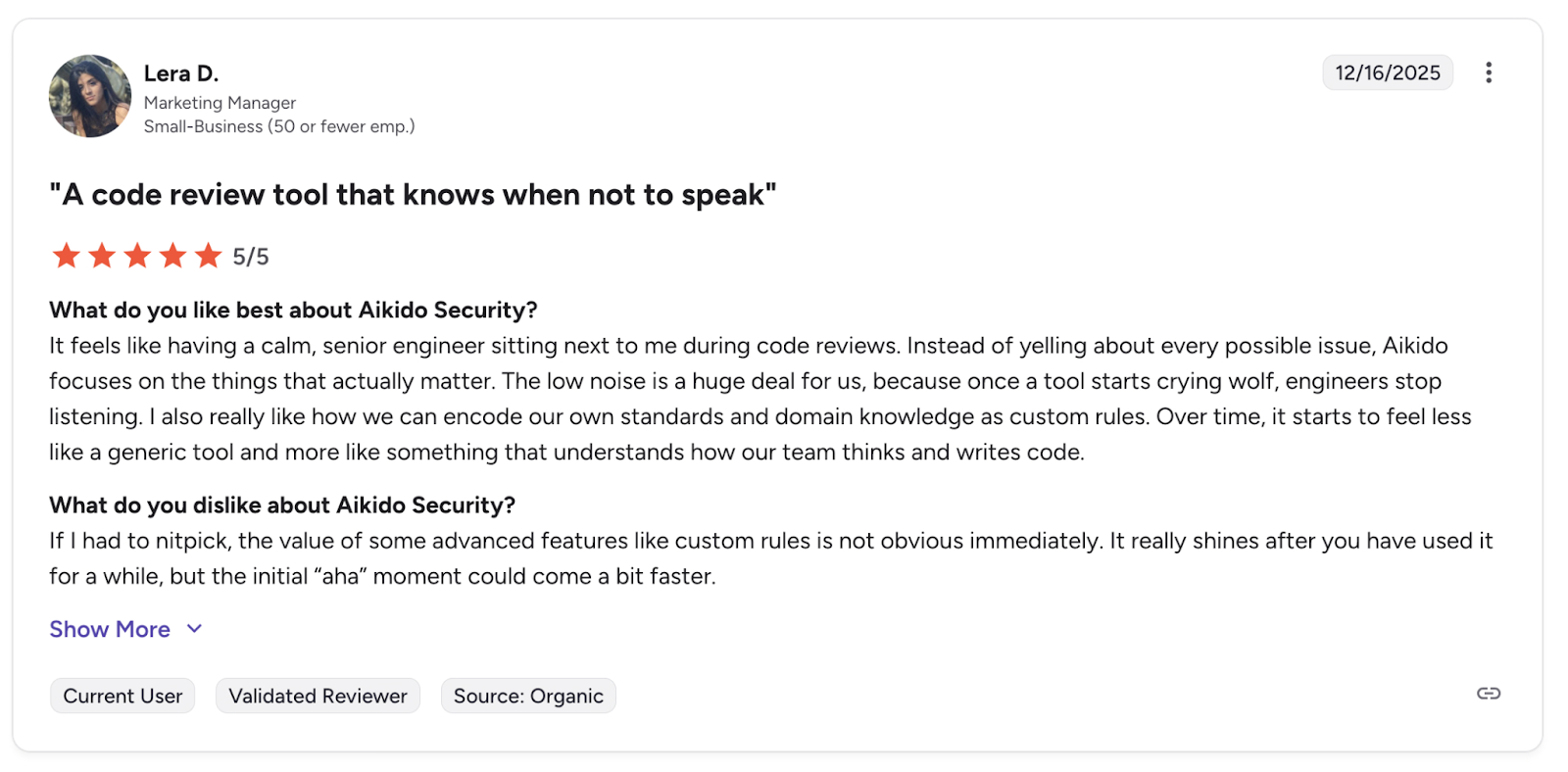
Aikido  Security review 

Aikido  Security review 

2. Aqua Security

Aqua security 

Aqua security 

Aqua Security

Aqua Security is a cloud native application protection platform that originated with container and Kubernetes security and later expanded into a broader CNAPP offering. The platform focuses heavily on container image scanning, runtime workload protection, and cloud posture management, making it a common choice for organizations running Kubernetes and serverless workloads in production.

Key Features

  • Container and Kubernetes security:
    Scans container images for vulnerabilities and misconfigurations and enforces security at runtime by detecting anomalous behavior in running workloads.
  • Runtime workload protection:
    Uses agents to monitor containers and hosts, enabling real-time threat detection and policy-based enforcement in production environments.
  • Cloud security posture management:
    Monitors AWS, Azure, and GCP for misconfigurations, compliance gaps, and risky configurations, with prioritization informed by runtime context.
  • Software supply chain security:
    Integrates Trivy for vulnerability and IaC scanning, covering Terraform, Kubernetes manifests, and Dockerfiles. Focus remains on infrastructure and container artifacts rather than application code.

Pros

  • Strong container and Kubernetes runtime protection
  • Deep visibility into running workloads
  • Well suited for Kubernetes-heavy environments

Cons

  • Heavier operational overhead due to agent-based runtime monitoring
  • Limited depth in application code scanning compared to developer-first platforms
  • Less emphasis on SAST, SCA, and developer remediation workflows
  • Can be complex to manage at scale without dedicated platform or DevOps teams

Ideal Use Case

Organizations running large-scale Kubernetes or containerized workloads that require runtime enforcement and production workload protection. Aqua is best suited for platform and DevOps teams focused on securing cloud workloads rather than application code.

Pricing

Custom pricing based on environment size, workloads, and enabled modules. Pricing details are not publicly listed and typically require a sales engagement.
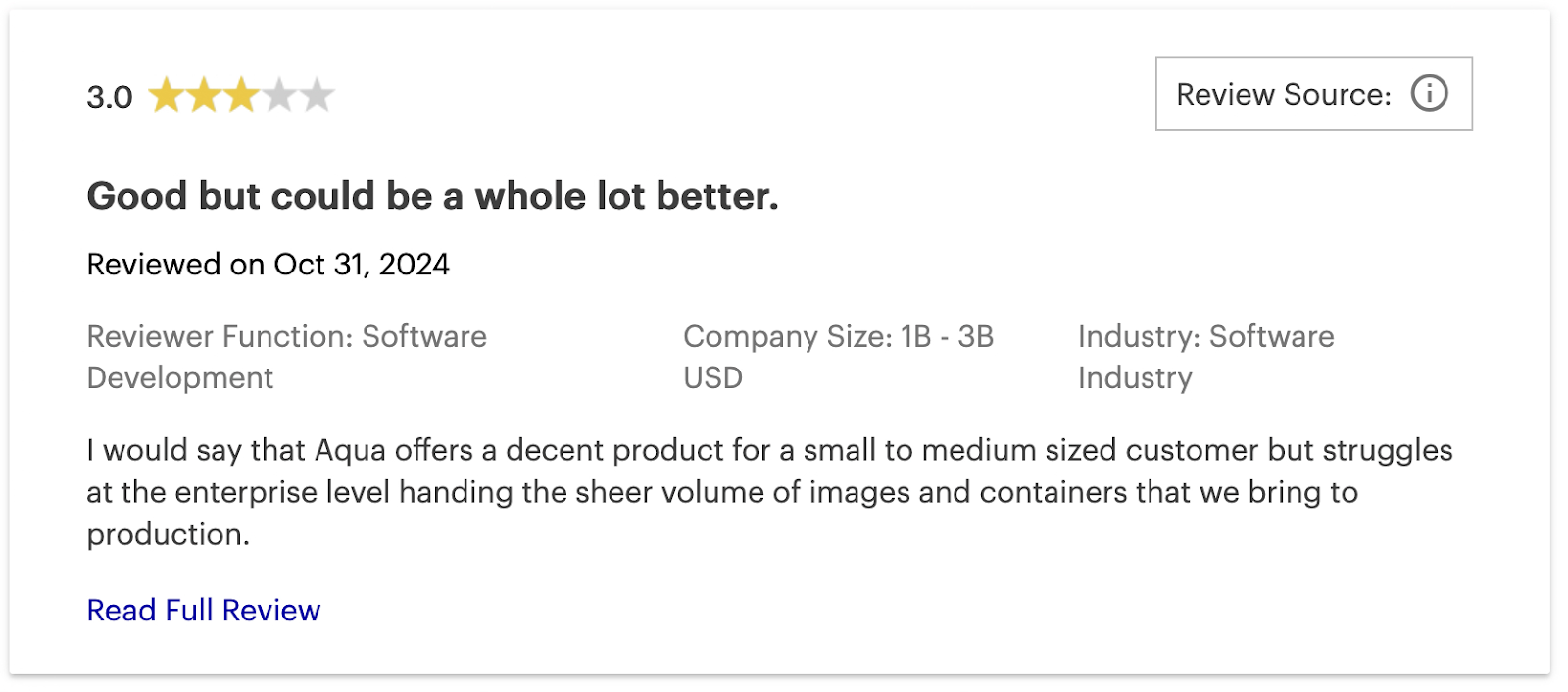

Aqua security review

Aqua security review

3. Check Point CloudGuard

Check Point CloudGuard website

Check Point CloudGuard website

Check Point CloudGuard is a cloud security platform focused on cloud security posture management and cloud network protection. It is commonly adopted by large enterprises with strict compliance requirements, particularly those already using Check Point firewalls in on-prem or hybrid environments. Compared to Orca, CloudGuard offers more active prevention and policy enforcement, but with greater operational complexity.

Key Features

  • Cloud security posture management and compliance:
    Continuously scans AWS, Azure, and GCP for misconfigurations and compliance violations, with built-in policies for standards such as PCI-DSS and HIPAA. Supports automated remediation and provides network topology visualization to identify exposed assets.
  • Cloud network protection:
    Inspects cloud traffic using virtual gateways with IDS and IPS capabilities, applying real-time protections against intrusions and malware using Check Point threat intelligence.
  • Unified security management:
    Centralized management through the Check Point Infinity portal, enabling consistent policy enforcement and automated response across cloud and on-prem environments.

Pros

  • Strong CSPM and compliance enforcement
  • Deep network security capabilities
  • Centralized management for hybrid and multi-cloud environments

Cons

  • Higher operational complexity than agentless CNAPP platforms
  • Less developer-focused than modern application security tools
  • Limited depth in application code scanning
  • Heavier setup and maintenance requirements

Ideal Use Case

Large enterprises with compliance-driven security programs that require strong CSPM, network-level threat prevention, and centralized governance across cloud and on-prem environments. CloudGuard is particularly suitable for organizations already invested in the Check Point ecosystem.

Pricing

CloudGuard pricing is module-based and typically requires a sales engagement. Costs vary based on cloud footprint, enabled features, and deployment model.
Gartner Rating: 4.7 / 5

4. Palo Alto Networks Prisma Cloud

Prisma cloud

Prisma Cloud is a comprehensive cloud-native security platform from Palo Alto Networks, combining cloud security posture management, workload protection, identity security, and code/IaC scanning. It is often adopted by large enterprises seeking end-to-end visibility and full-stack protection. Compared to Orca, Prisma Cloud offers broader coverage including code repository and runtime security. 

Key Features

  • Cloud posture and IAM security:
    Monitors AWS, Azure, and GCP for misconfigurations, overly permissive access, and compliance violations. Supports enforcement of least-privilege IAM and flags unused access keys, going beyond standard CSPM.
  • Code and IaC security (shift-left):
    Scans Infrastructure-as-Code templates (Terraform, CloudFormation, Helm) and code repositories for vulnerabilities, policy violations, and hardcoded secrets. Provides integrated application security posture management (ASPM) checks.
  • Enterprise management:
    Offers granular RBAC, multi-tenant dashboards, and integration with SIEM and SOAR tools. Benefits from Palo Alto’s ecosystem for unified cloud and network visibility.

Pros

  • Full-stack protection across cloud, code, and runtime
  • Shift-left scanning for IaC and code repositories
  • Enterprise-grade governance and multi-tenant capabilities
  • Strong integration with Palo Alto security ecosystem

Cons

  • High operational complexity and resource requirements
  • Expensive compared to smaller CNAPPs or developer-focused platforms
  • Overkill for small or dev-centric teams
  • Can require significant effort to manage and tune policies

Ideal Use Case

Large enterprises seeking a single platform for comprehensive cloud and application security, including runtime, code, and identity. Prisma Cloud is suited for organizations with the resources to manage a full-stack CNAPP and the need for enterprise-grade visibility and compliance.

Pricing

Custom pricing based on cloud footprint, enabled modules, and enterprise features. Requires engagement with Palo Alto Networks sales.
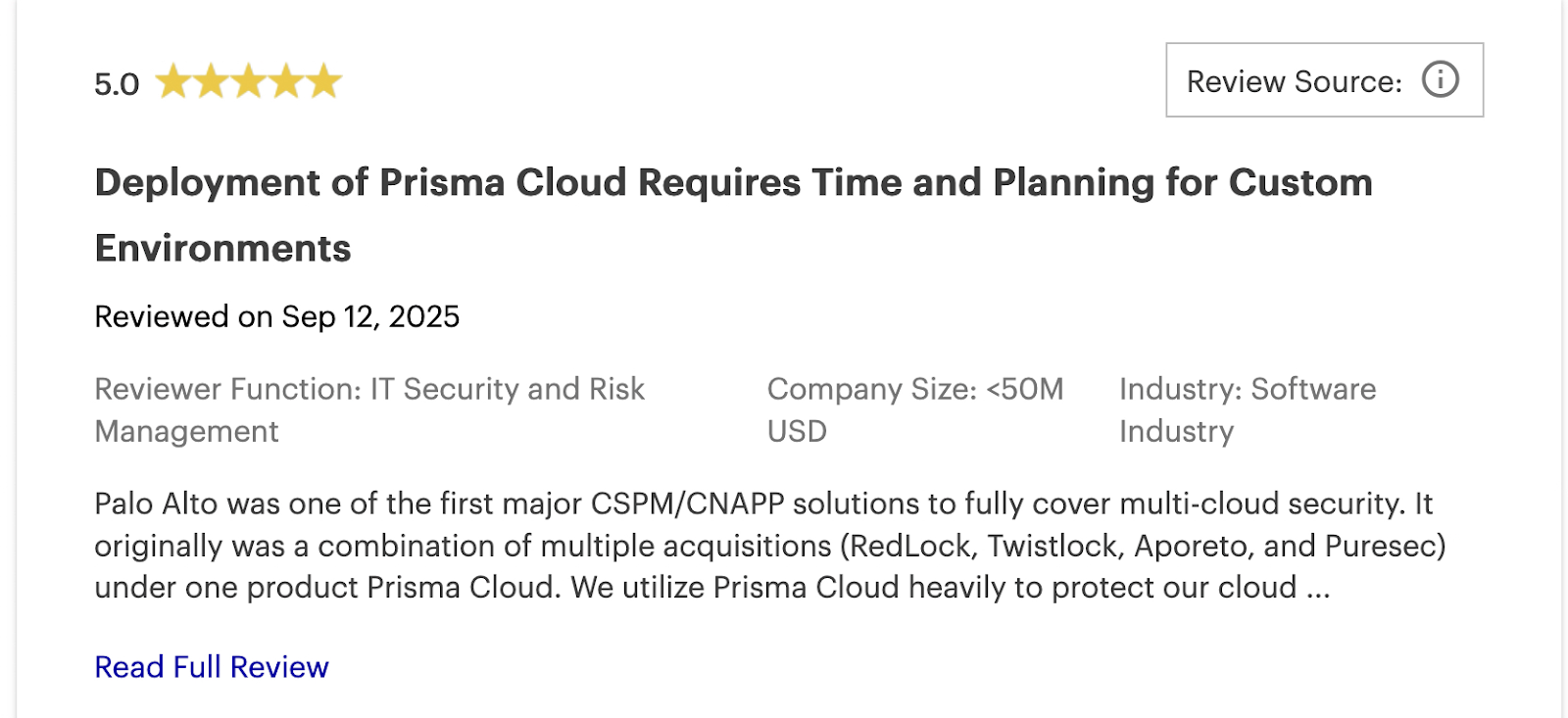
Gartner Rating 4.5 / 5

Prisma cloud review 

Prisma cloud review 

5. Sysdig

Sysdig

Sysdig is a container and cloud security platform focused on real-time runtime protection for containers and Kubernetes. It is best known for its use of the open-source Falco engine to detect suspicious behavior at runtime. Compared to Orca’s agentless, snapshot-based scanning, Sysdig emphasizes continuous visibility and live threat detection in production environments.

Key Features

  • Real-time threat detection:
    Uses agents or Kubernetes instrumentation to monitor container and host activity continuously. Falco rules detect suspicious behavior such as shell execution in containers or unauthorized file system changes.
  • Runtime risk prioritization:
    Correlates vulnerabilities with runtime usage to identify which issues are actively exploitable, reducing noise by focusing on vulnerabilities that are actually in use.
  • Incident response and forensics:
    Captures detailed runtime activity using kernel-level tracing, enabling investigation and replay of incidents for forensic analysis and compliance purposes.

Pros

  • Strong real-time runtime security for containers and Kubernetes
  • Effective prioritization using runtime context

Cons

  • Requires agents and runtime instrumentation
  • Limited focus on application code security
  • Less coverage of SAST, SCA, and developer workflows
  • Better as a complementary tool than a standalone platform for full coverage

Ideal Use Case

Teams running production Kubernetes environments that require real-time threat detection and runtime visibility. Sysdig is well suited for DevOps and platform teams focused on live workload protection and is often paired with developer-first tools for code, IaC, and cloud security.

Pricing

Sysdig pricing is usage-based and depends on monitored workloads, hosts, and enabled features. Pricing details typically require a sales engagement.
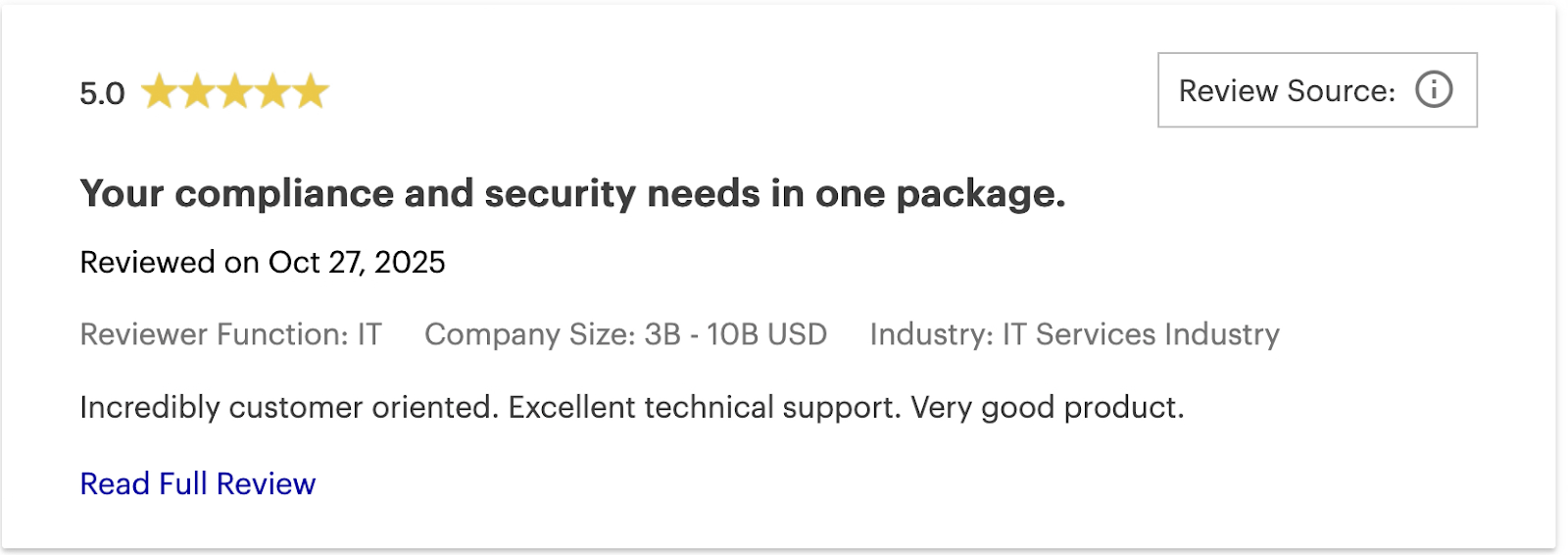
Gartner Rating 4.9 / 5

 Sysdig review

Sysdig review

6. Wiz

Wiz website 

Wiz website 

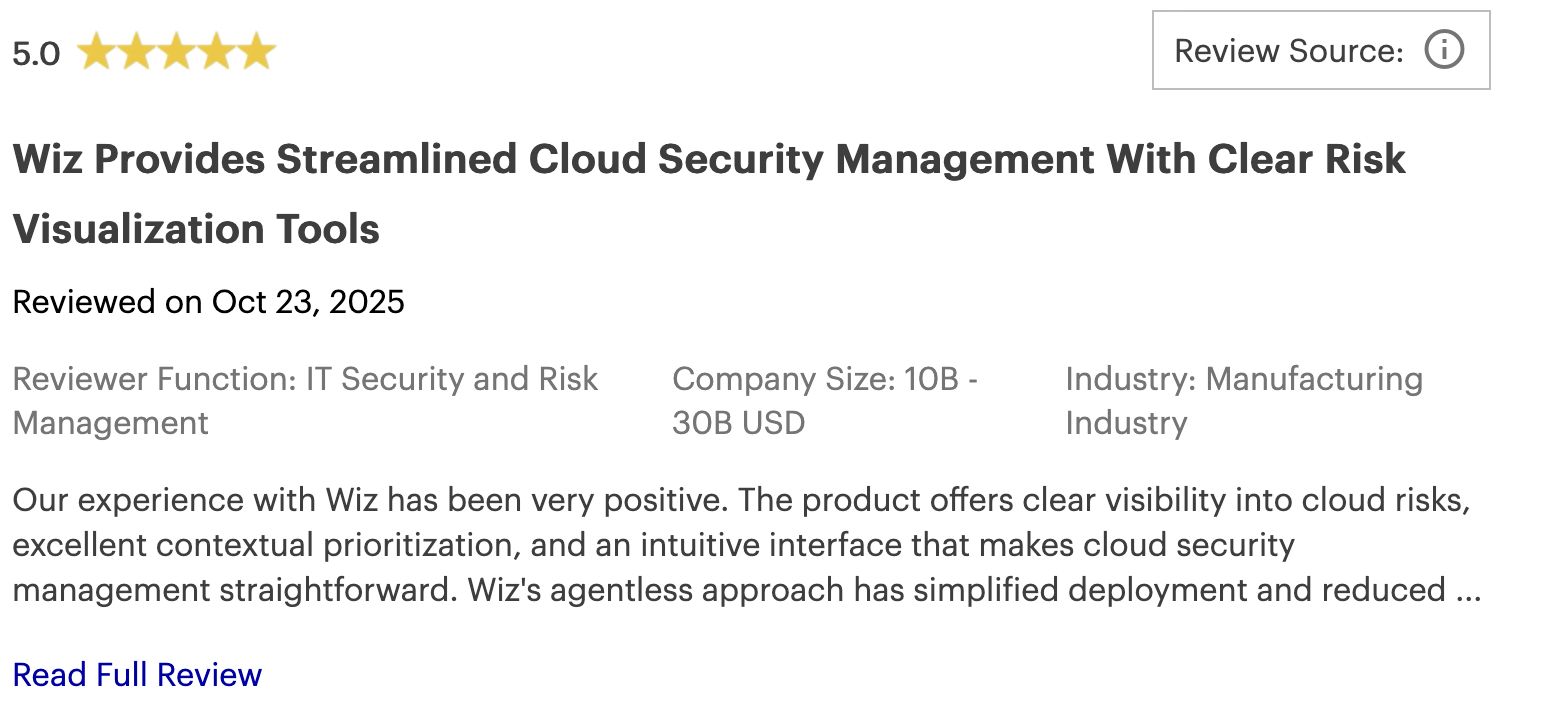
Wiz is a cloud security platform focused on agentless cloud security posture management and risk prioritization across cloud environments. It is widely adopted for its ease of deployment and fast time to value, particularly in large multi-cloud environments. Compared to Orca, Wiz offers a more modern user experience and stronger risk correlation, but remains primarily cloud-infrastructure focused rather than application- or developer-centric.

Key Features

  • Agentless cloud security posture management: Scans AWS, Azure, GCP, and Kubernetes environments without agents to identify misconfigurations, exposed assets, and compliance violations.
  • Risk graph and attack path analysis: Correlates misconfigurations, vulnerabilities, identities, and network exposure into attack paths, helping teams prioritize the most critical risks based on real-world exploitability.
  • Vulnerability and container image scanning: Identifies vulnerabilities in VMs, container images, and cloud workloads, with contextual prioritization based on exposure and permissions.
  • Cloud identity security: Analyzes IAM roles, permissions, and relationships to detect excessive privileges and risky access paths across cloud environments.

Pros

  • Fast deployment with no agents required
  • Strong risk prioritization and attack path visualization
  • Well suited for large, complex cloud environments

Cons

  • Limited depth in application code security
  • No native SAST or developer-focused remediation workflows
  • Shift-left capabilities are weaker than developer-first platforms
  • Relies heavily on infrastructure context rather than code-level insight

Ideal Use Case

Security teams managing large multi-cloud environments that need fast visibility, strong risk prioritization, and minimal operational overhead. 
Pricing: Custom pricing based on cloud footprint and enabled modules. 

Gartner Rating: 4.7 / 5

Wiz review

Wiz review


Comparison Table

Tool CSPM Code Scanning (SAST / Secrets) Container Security Runtime Protection Developer Friendly Pricing Transparency
Orca Security ✅ Full CSPM ❌ No scanning ⚠️ Basic image scan ❌ No agentless runtime ❌ Not dev-focused ❌ No pricing online
Aikido Security ✅ Full CSPM ✅ SAST & Secrets ✅ Deep container scan ❌ No runtime monitoring ✅ Built for developers ✅ Transparent pricing
Aqua Security ✅ Full CSPM ⚠️ Limited support ✅ Comprehensive ✅ Full runtime agent ⚠️ Dev UX mixed ⚠️ Contact for pricing
CloudGuard ✅ Full CSPM ❌ No scanning ⚠️ Basic container checks ✅ Network-based only ❌ Enterprise-focused ❌ No pricing available
Prisma Cloud ✅ Full CSPM ✅ Bridgecrew integration ✅ Full coverage ✅ Advanced runtime ⚠️ Steep learning curve ❌ Enterprise-only pricing
Sysdig ⚠️ Limited CSPM ❌ No code scanning ✅ Strong container focus ✅ Runtime & policy engine ⚠️ Not dev-centric ⚠️ Pricing unclear
Wiz ✅ Full CSPM ❌ No native SAST ✅ Image & workload scan ❌ No runtime agent ⚠️ Security-team focused ❌ No pricing online

Conclusion

Many teams in 2026 are rethinking their reliance on Orca Security. Whether it’s the volume of unfiltered alerts, the gaps in coverage (no code insight), or the high cost of scaling Orca, the reality is that modern security requires a more tailored approach.

Platforms like Aikido Security show that you can have comprehensive cloud and application security without the bloat. Other alternatives cater to specific needs (containers, compliance, etc.), so choose what fits your priorities. Teams are discovering that by switching to leaner, developer-friendly solutions, they can boost security visibility and velocity at the same time.

FAQ

Q1. What are the main limitations of Orca Security?

Orca focuses on agentless cloud posture management but has limited application security. It lacks native SAST and secrets scanning, offers minimal developer workflow support, relies on periodic scans rather than continuous monitoring, and does not publish pricing.

Q2. How does Aikido Security compare to Orca?

Aikido matches Orca on cloud and container security while adding built-in SAST, secrets scanning, and AI Autofix for SAST and IaC. It is developer-first, reduces alert noise, and offers transparent pricing.

Q3. Are there free or affordable alternatives to Orca Security?

Yes. Aikido offers transparent pricing and a short trial. Open-source tools like Trivy cover basic scanning, while platforms such as Wiz, Aqua, and Sysdig typically target enterprise budgets.

Q4. Does Orca support developer-first workflows like IDE or PR checks?

No. Orca is designed for cloud and security teams and does not natively integrate with IDEs or pull request workflows.

Q5. Can Orca be used alongside tools like Snyk or Aikido?

Yes. Orca is often paired with code security tools to fill gaps, but this increases tool sprawl and operational overhead.

Q6. What should I consider when choosing between Orca and its competitors?

Consider whether you need code security and developer workflows, how alerts are prioritized, scan frequency versus real-time protection, pricing transparency, and the cost of managing multiple tools.

You Might Also Like: