




Earlier this year, a lone hacker and a commercial AI subscription took down the Mexican government, stealing a massive trove of sensitive data in an attack that would previously have taken a skilled team months. And that was with a publicly available Claude model.
Anthropic's Mythos has since found thousands of zero-day vulnerabilities across every major operating system and browser, including flaws that survived decades of human review and millions of automated security tests. The window between vulnerability and working exploit is now hours, and the skill required to pull off a serious attack keeps dropping.
But defenders have the context attackers don't. You have your source code, your runtime behavior, your architecture, and your dependency graph. The organizations that will be ready are the one that are proactive rather than waiting for a scan to tell them something is wrong. This checklist is built around the defenders' advantages: know what you run, control your supply chain, find real issues before they surface elsewhere, and fix them faster than the exploit cycle.
For the teams that want to prepare for Mythos, this is for you.
The Mythos ready checklist has actionable tasks to harder your applications and infrastructure, sorted by the different layers, to prepare for threats from agentic AI.
Download the checklist now to get started!
We'll cover more about what the checklist contains about below.
In this new Mythos-Ready checklist, each item is written for the person who has to actually act on it, with enough context to understand why it matters now. While it's framed for CTOs, the items touch enough ground that security leads and engineering managers will find it directly relevant to the areas they own.
This is a living reference, so you can return to it when your stack changes or when a new model ships that changes what attackers can do. The threats are moving fast enough that what was low priority six months ago may be urgent today.
The checklist is also built on the premise that defenders can win. The items here are about making sure you're actually using your advantages before someone else finds the issues first.
We've pulled out a few items below to give you a sense of what's inside.
The most important aspect of being able to keep up with the latest developments in AI is to have the capability of testing your application for vulnerabilities. Every security leader is trying to build this in-house, but there are ready-made solutions that already have benchmarked the best models to use for various different use cases.
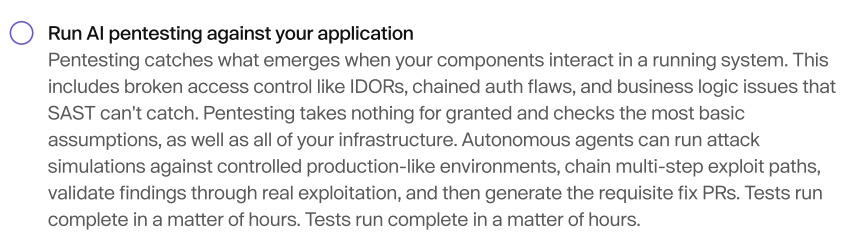
AI tools in malicious hands can reverse-engineer a vendor patch, figure out what it fixes, and produce a working exploit in hours. Your release process needs to ship security fixes the same day they're available. Measure how long it actually takes your team to go from "critical patch available" to "running in production" and drive that number down.

Coding agents and MCP servers need the same access controls you'd apply to any production user. Define what they can read, write, execute, and reach. An agent with extensive permissions and no logging is an unmonitored insider with a direct line to your codebase.

A compromised MCP server can bend agent behavior in ways that are difficult to spot and even harder to trace back. Vet every agentic component before connecting it to your systems, the same way you'd evaluate any third-party dependency.

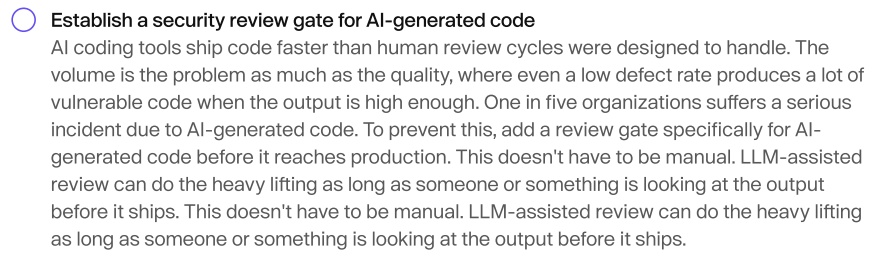
AI coding tools produce code faster than review processes were built to handle. Put a review gate in place before AI-generated code reaches production, and make sure it covers generated tests, infra config, and dependency changes, not just application code.
Those are just a few of the items covered. The full checklist walks through attack surface inventory, agentic supply chain controls, AI-generated code review, dependency and malware checks, incident response for AI-speed attacks, and more.

Download the Mythos-Ready Security Checklist now and start building the practices that hold up regardless of what model an attacker is running.
此内容由惯性聚合(RSS阅读器)自动聚合整理,仅供阅读参考。 原文来自 — 版权归原作者所有。