







I’ve been working on clustering faces using an autoencoder, and I finally have some fun screenshots to share so here they are.
Our input data looks like this: (from the google quickdraw dataset)
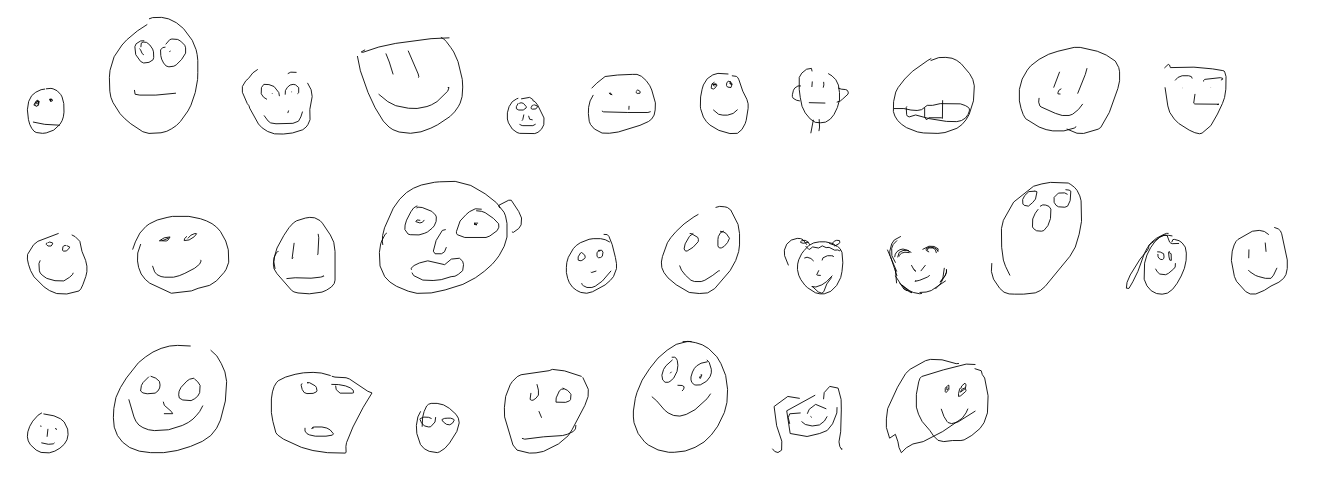
Each face is represented as a sequence of vectors, one vector for every line in the face (kind of like an SVG path). Here’s an example:
tensor([[-0.0956, -0.2869,  0.0000],
        [-0.3108, -0.1434,  0.0000],
        [-0.5738,  0.1673,  0.0000],
        [-0.3108,  0.2391,  0.0000],
        [-0.3586,  0.4303,  0.0000],
        ... lots more ...
The way RNN autoencoders work that there’s an Encoder RNN that turns this
sequence of vectors into 1 vector (mine is 50 dimension), and then a Decoder
RNN that turns the 1 vector back into a sequence of vectors.
The idea is to train the Encoder and Decoder networks so that
Decoder(Encoder(x)) is as close to x as possible for every x in the
training set. I used the mean squared error as a loss function to start.
The training didn’t go that well – I got the loss to go down a bit (from 0.3 to 0.25), but it definitely didn’t seem that well trained. I think it would have maybe done better if I trained it for longer but I got bored.
Here are 4 pairs of x and Decoder(Encoder(x)) from the training set
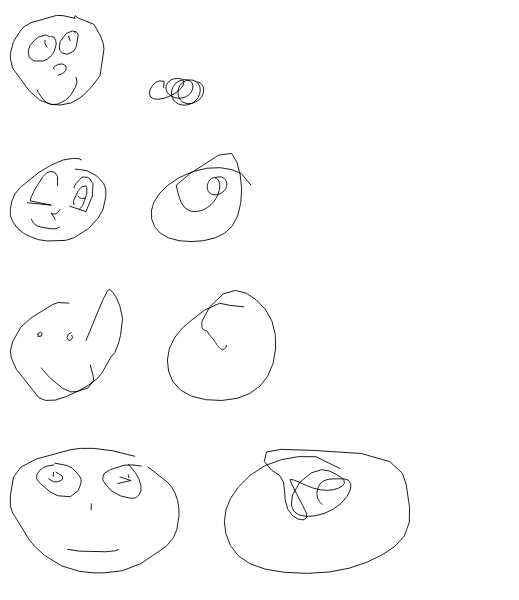
I’m actually pretty impressed by this – it seems to have figured how to draw a circle of about the right size for the face, and vaguely that it should draw something inside the circle. Way better than nothing!
My original goal was to cluster the faces by taking Encoder(x) for the inputs
in the training set and clustering those vectors.
I used DBSCAN from scikit-learn more or less arbitrarily, basically because it seemed like it might work better for higher dimensional vectors (I had 50 dimensions)
here’s what the clusters looked like:
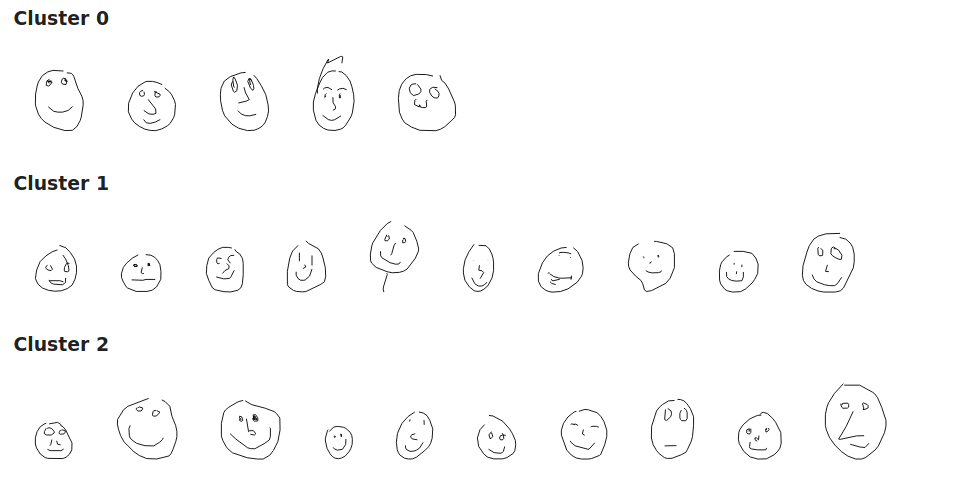
It seems to have clustered them mostly by the size of the face, and not by any of the interior features. This makes sense because the decoder seems to be able to reproduce the size of the face pretty effectively but totally fails at reproducing the interior features. Neat!
My next goal I think is to see if I can improve the autoencoder network so that it can also draw the components inside the face better. We’ll see how it goes!
此内容由惯性聚合(RSS阅读器)自动聚合整理,仅供阅读参考。 原文来自 — 版权归原作者所有。