









A 2-acre plot of land in the middle of Regent’s Park, once covered in concrete, glass and steel, has been turned into a new wildlife-friendly garden — by reusing the concrete.
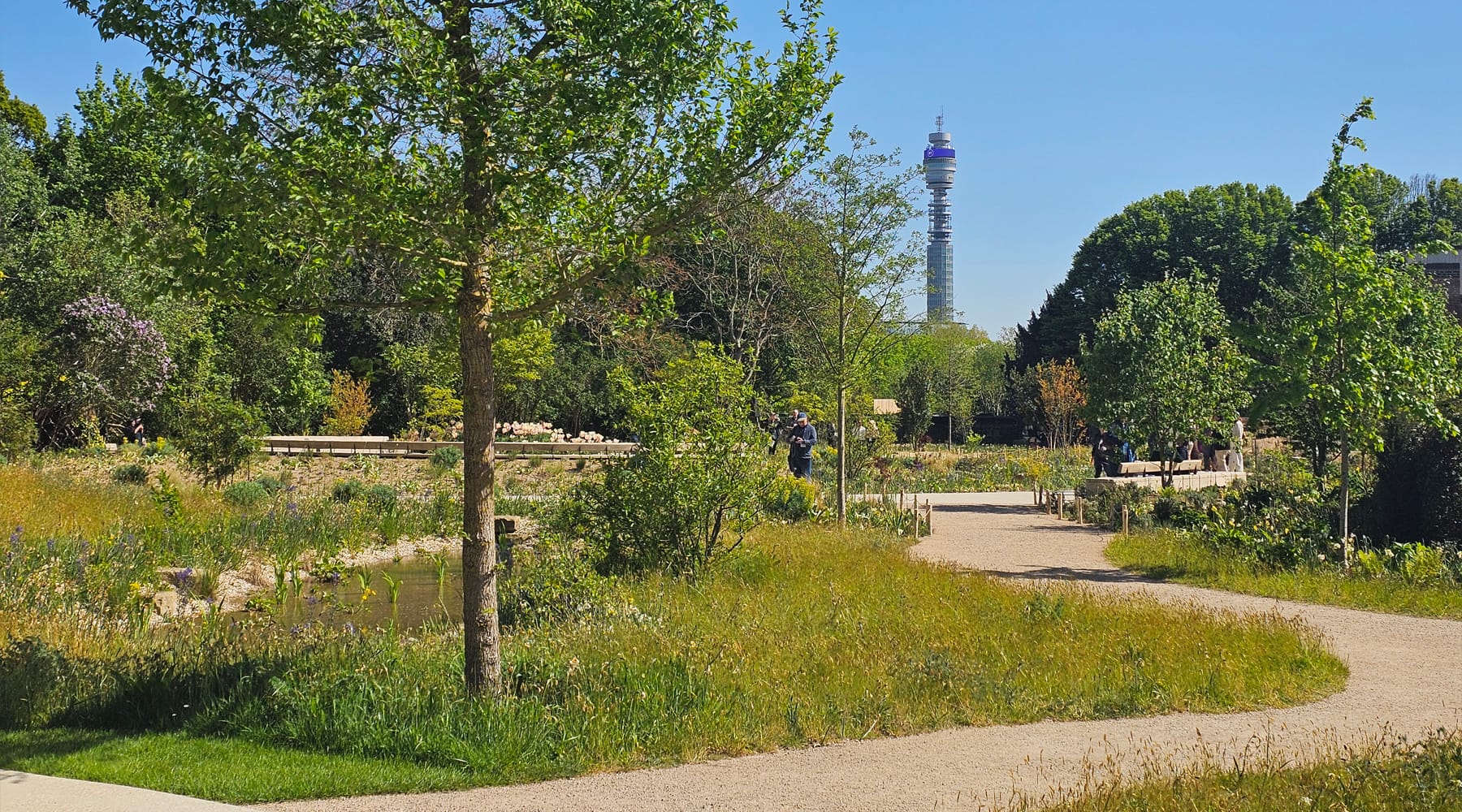
The plot of land was the park’s former nursery, but when they moved the work to the Hyde Park nursery, it left behind a semi-industrial landscape of concrete paving and old greenhouses. Normally, restoring a brownfield site requires a lot of rubble to be broken up and shipped off somewhere else, but the new QEII garden in Regent’s Park took a different approach – they kept most of it on site.
Some 1,000 cubic metres of concrete were broken up and crushed into gravel, then used to landscape the garden. That decision also drives the type of planting you’ll see in the garden, as all that concrete alters soil chemistry, creating a very high pH.
As Matthew Pottage, Head of Horticulture & Landscape Strategy, explained at a preview, they’re going for slower-growing plants that like to send down deep roots to the clay below the concrete gravel mix. Thanks to the deep roots and slower, stockier growth, the plants will be more resistant to climate change and less likely to suffer in our increasingly warm summers.
However, they need to be planted when young and will also be slower growing, so if you’re hoping to turn up when the garden opens to see a “Chelsea flower show” of a display, then you might be disappointed. The garden’s gestation has only just started, and it’s going to take time to reach full maturity. But that means regular visitors can see the garden growing up over the next few years rather walking in on day one and seeing a fixed end product.
Although I think the very tall tulips in the middle of the garden didn’t get the memo about growing slowly.

The rest of the garden is in zones, with flowering plants dominating the centre, woodlands to the south, and more grasslands to the north, and snaking around in places what almost looks like arid landscapes, waiting for the plants to cover the ground.

The plants were chosen to reflect those liked by the late Queen, and the pergola, made from the old greenhouse steel, contains 56 uprights – to represent the 56 countries of the Commonwealth. This year also happens to mark the Commonwealth’s centenary.
Some respite from a sunny day comes from a tree-lined corridor off to one side, where they’ve also created a wildlife habitat with old logs and fallen trees. And apparently, central London’s only known colony of breeding hedgehogs also lives here.

Two shallow lakes and a – at the time of visit, still dry– stream will add to the wildlife-friendly nature of the garden.
Water will be supplied by nearby runoff and stored in a large water tank beneath a viewing tower. That tower, a 1960s structure, has been refurbished with a small balcony for humans, but further up are nesting boxes for bats and birds.
Ironwork that wraps around the tower represents the flowers of the four nations that make up the UK. In a neat coincidence, when it first opened, the nursery had an ironmonger’s smithy pretty much where the ironwork-clad tower stands today.

Elsewhere, there’s lots – really a lot – of seating, ranging from fallen logs to single seats, park benches, and in the centre, the circular bench running around the central stone inscription.
“We all need to get the balance right between action and reflection. With so many distractions, it is easy to forget to pause and take stock.” – the Queen’s 2013 Christmas Speech.

The paths range from gravel to terrazzo, which itself was made from gravel recovered from the old glasshouses and rolled flat. Although there are steps up to the raised water tower area, there is also a slope, so the whole garden is accessible.
As a garden, it makes for a big change from the formal layout of the rest of The Regent’s Park, but maybe more than that, it demonstrates how brownfield sites can be turned into climate-resistant gardens without shipping all the hardcore rubble off to a landfill. Maybe it will inspire everything from a full-scale brownfield site regeneration to homeowners with an annoying pile of builders’ rubble in the corner of the back garden. If it leads to more gardens of this sort being created, that’s a regal legacy to be proud of.
The Queen Elizabeth II Garden will open to the public on Monday, 27th April 2026, and, as with the rest of the park, it is free to visit. The garden is at the southern end of the park, with the main entrance at the junction of Chester Road and The Broad Walk – next to the Espresso Bar.


此内容由惯性聚合(RSS阅读器)自动聚合整理,仅供阅读参考。 原文来自 — 版权归原作者所有。