



惯性聚合 高效追踪和阅读你感兴趣的博客、新闻、科技资讯
阅读原文 在惯性聚合中打开

推荐订阅源

J
Java Code Geeks
Hugging Face - Blog
Hugging Face - Blog
博客园_首页
爱范儿
爱范儿
罗磊的独立博客
美团技术团队
Jina AI
Jina AI
量子位
奇客Solidot–传递最新科技情报
奇客Solidot–传递最新科技情报
酷 壳 – CoolShell
酷 壳 – CoolShell
有赞技术团队
有赞技术团队
V
V2EX
阮一峰的网络日志
阮一峰的网络日志
小众软件
小众软件
IT之家
IT之家
雷峰网
雷峰网
freeCodeCamp Programming Tutorials: Python, JavaScript, Git & More
OSCHINA 社区最新新闻
OSCHINA 社区最新新闻
博客园 - 司徒正美
大猫的无限游戏
大猫的无限游戏
博客园 - 聂微东
月光博客
月光博客
人人都是产品经理
人人都是产品经理
博客园 - 三生石上(FineUI控件)

Home - CBSNews.com

"48 Hours" schedule: Live, DVR, and on demand Rory McIlroy wins second straight Masters Tournament Brian Hooker sent friends maps that he says show where his wife went missing in Bahamas Iran's parliament speaker says U.S. will be "nostalgic" for $4 gas as oil prices fuel inflation Democratic Rep. Eric Swalwell ends bid for California governor as he faces sexual assault allegations Trump says U.S. will blockade Strait of Hormuz after Iran peace talks collapse DHS looking into allegations Rep. Eric Swalwell hired nanny not authorized to work in U.S. Fallout from Eric Swalwell scandal grows as lawmakers eye House expulsion votes Rory McIlroy claims second straight Masters title Brian Hooker shared maps he says show where his wife went missing in the Bahamas Manhattan DA investigating sexual assault allegations against Rep. Eric Swalwell Extended interview: Sen. Dave McCormick on AI Trump says U.S. will blockade Strait of Hormuz and intercept ships that paid tolls to Iran Few see U.S. goals being met in Iran yet; Americans voice worry and stress in CBS News poll Hungarian Prime Minister Viktor Orbán concedes defeat in key election, ending 16 years in power Ukraine, Russia accuse each other of violating Putin's Orthodox Easter ceasefire Kimberly Langwell's Hidden Grave Decades after a Texas mom's disappearance, a tip leads to the location of her secret grave Kids, adults alike watch Artemis II crew's splashdown in San Diego JD Vance says U.S. and Iran did not come to a deal after marathon session Artemis II astronauts welcomed home to Houston after historic moonshot Artemis II crew returns to Houston after successful mission Artemis II astronauts speak publicly for first time since successful moon mission Federal appeals court sends White House ballroom construction lawsuit back to lower court Pope Leo criticizes "idolatry of self" in latest rebuke of Iran conflict: "Enough with war!" Iran reportedly proposes tolls for ships crossing Strait of Hormuz How Persian Gulf nations are reacting to the U.S. and Iran's temporary ceasefire U.S. naval destroyers have crossed the Strait of Hormuz, CENTCOM says Trump says U.S. is "clearing out" the Strait of Hormuz as U.S., Iranian officials meet in Pakistan Risk on the Road | Sunday on 60 Minutes
NASA maps show Earth's brightest and darkest regions at n...
Kerry Breen · 2026-05-15 · via Home - CBSNews.com

By

Kerry Breen is a news editor at CBSNews.com. A graduate of New York University's Arthur L. Carter School of Journalism, she previously worked at NBC News' TODAY Digital. She covers current events, breaking news and issues including substance use.

Read Full Bio

/ CBS News

Add CBS News on Google

New maps from NASA using nearly a decade's worth of data show how the use of artificial light has shifted over the years.  

To make the maps, NASA researchers analyzed data collected by its "Black Marble" program, which uses a specialized sensor to capture low-light imagery of Earth at night. The data was collected by three different satellites between 2014 and 2022. 

Researchers expected to find "a gradual increase in artificial light at night" over the years, NASA said in a news release. What they discovered was "much more nuanced patterns" of light radiance. 

"The analysis portrays a world flickering with industrial booms and busts, construction, and blackouts, as well as more gradual shifts, such as policy-driven retrofits," NASA said. 
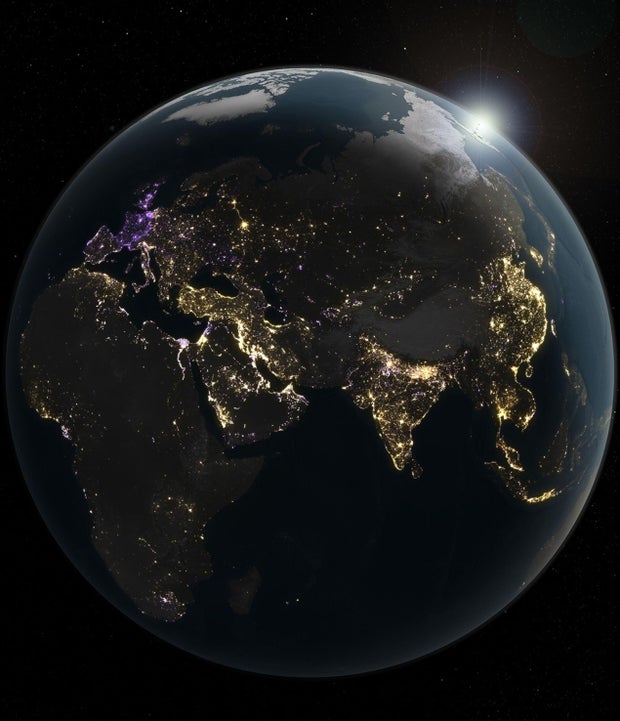
nightlights-20142022.jpg
A rendition of the Black Marble data collected by NASA. Purple shows spots of dimming, while gold shows spots of brightening.  NASA Earth Observatory/Michala Garrison

The researchers found that each location examined by the sensors underwent several distinct shifts over the nine years data was collected. During that time, radiance increased 34%, while dimming offset it by 18%, the researchers said. Both lighting and dimming "markedly intensified over the past decade," the researchers said in a study published in the academic journal Nature

"This evidence of increasing volatility in human night-time activity provides an important dynamic dimension for understanding urban evolution, energy transitions, policy impacts and ecological consequences of rapidly changing illuminated nights," the researchers wrote. 

In the United States, West Coast cities grew brighter as populations increased. On the East Coast, there was more dimming, which the researchers attributed to the use of energy-efficient lightbulbs and "broader economic restructuring." 
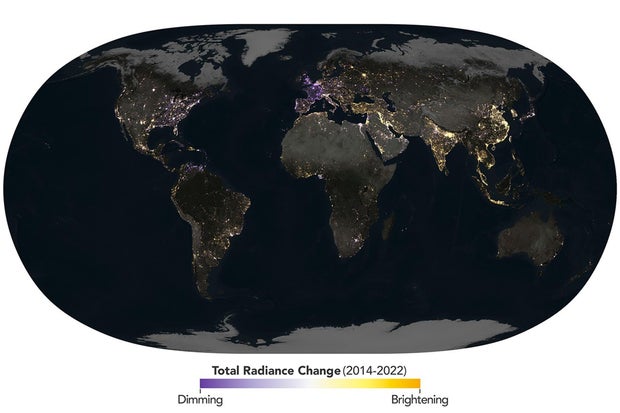
nightlights-global-20142022.jpg
An analysis of the Black Marble data collected by NASA. Purple shows spots of dimming, while gold shows spots of brightening.  NASA Earth Observatory/Michala Garrison

Worldwide, nights grew brighter in China and northern India, as urban development expanded. Throughout Europe, there was a pattern of dimming likely caused by energy conservation measures, and a sharp drop-off in 2022 after the war in Ukraine led to a regional energy crisis. 

"This global, high-resolution analysis ... refines and expands our understanding of how humanity is altering the night environment," the researchers wrote in their published paper. "Our findings show that the human light footprint is not a universally expanding entity but a dynamic system, characterized by the pervasive coexistence of brightening and dimming." 

In: