


惯性聚合 高效追踪和阅读你感兴趣的博客、新闻、科技资讯
阅读原文 在惯性聚合中打开

推荐订阅源

Last Week in AI
Last Week in AI
V
Visual Studio Blog
V
V2EX
有赞技术团队
有赞技术团队
The Cloudflare Blog
Jina AI
Jina AI
S
SegmentFault 最新的问题
Engineering at Meta
Engineering at Meta
酷 壳 – CoolShell
酷 壳 – CoolShell
让小产品的独立变现更简单 - ezindie.com
人人都是产品经理
人人都是产品经理
OSCHINA 社区最新新闻
OSCHINA 社区最新新闻
阮一峰的网络日志
阮一峰的网络日志
WordPress大学
WordPress大学
小众软件
小众软件
U
Unit 42
Y
Y Combinator Blog
Apple Machine Learning Research
爱范儿
爱范儿
Recent Announcements
M
MIT News - Artificial intelligence
P
Proofpoint News Feed
C
Check Point Blog
D
Docker

Home - CBSNews.com

"48 Hours" schedule: Live, DVR, and on demand Rory McIlroy wins second straight Masters Tournament Brian Hooker sent friends maps that he says show where his wife went missing in Bahamas Iran's parliament speaker says U.S. will be "nostalgic" for $4 gas as oil prices fuel inflation Democratic Rep. Eric Swalwell ends bid for California governor as he faces sexual assault allegations Trump says U.S. will blockade Strait of Hormuz after Iran peace talks collapse DHS looking into allegations Rep. Eric Swalwell hired nanny not authorized to work in U.S. Fallout from Eric Swalwell scandal grows as lawmakers eye House expulsion votes Rory McIlroy claims second straight Masters title Brian Hooker shared maps he says show where his wife went missing in the Bahamas Manhattan DA investigating sexual assault allegations against Rep. Eric Swalwell Extended interview: Sen. Dave McCormick on AI Trump says U.S. will blockade Strait of Hormuz and intercept ships that paid tolls to Iran Few see U.S. goals being met in Iran yet; Americans voice worry and stress in CBS News poll Hungarian Prime Minister Viktor Orbán concedes defeat in key election, ending 16 years in power Ukraine, Russia accuse each other of violating Putin's Orthodox Easter ceasefire Kimberly Langwell's Hidden Grave Decades after a Texas mom's disappearance, a tip leads to the location of her secret grave Kids, adults alike watch Artemis II crew's splashdown in San Diego JD Vance says U.S. and Iran did not come to a deal after marathon session Artemis II astronauts welcomed home to Houston after historic moonshot Artemis II crew returns to Houston after successful mission Artemis II astronauts speak publicly for first time since successful moon mission Federal appeals court sends White House ballroom construction lawsuit back to lower court Pope Leo criticizes "idolatry of self" in latest rebuke of Iran conflict: "Enough with war!" Iran reportedly proposes tolls for ships crossing Strait of Hormuz How Persian Gulf nations are reacting to the U.S. and Iran's temporary ceasefire U.S. naval destroyers have crossed the Strait of Hormuz, CENTCOM says Trump says U.S. is "clearing out" the Strait of Hormuz as U.S., Iranian officials meet in Pakistan Risk on the Road | Sunday on 60 Minutes
Mysterious "golden orb" found in ocean depths off Alaska ...
2026-04-23 · via Home - CBSNews.com

By

Kerry Breen

News Editor

Kerry Breen is a news editor at CBSNews.com. A graduate of New York University's Arthur L. Carter School of Journalism, she previously worked at NBC News' TODAY Digital. She covers current events, breaking news and issues including substance use.

Read Full Bio

/ CBS News

Add CBS News on Google

Scientists have solved the mystery of a "golden orb" found thousands of feet underwater by researchers from the National Oceanic and Atmospheric Association in 2023, the agency said on Wednesday

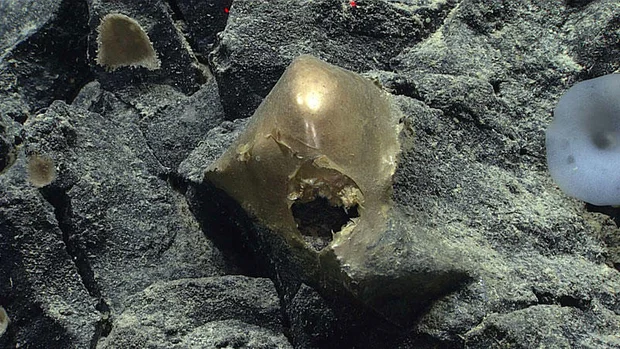
The orb was found in the Gulf of Alaska, by a remotely operated underwater vehicle. The device was over two miles underwater when it spotted a "strange, golden, mound-shaped object with a hole in it, stuck to a rock," NOAA said. It was collected and sent to the Smithsonian National Museum of Natural History for study. 

Allen Collins, the director of NOAA Fisheries' National Systematics Laboratory and a zoologist, said that he thought "routine processes" would allow scientists to identify the object. But the orb proved trickier. 
orb-800.jpg
Scientists with NOAA discovered an unidentified golden orb-like organism while operating a remote deep-sea diving vessel off the coast of Alaska on August 30. NOAA

"This turned into a special case that required focused efforts and expertise of several different individuals. This was a complex mystery that required morphological, genetic, deep-sea and bioinformatics expertise to solve," Collins said. 

First, scientists studied the physical structure of the orb. They found it wasn't an animal, but that it was a "fibrous material" covered with stinging cells, like an anemone or coral might be. Those cells were identified as spirocysts, a specialized cellular structure that can capture prey. Such cells only exist on one group of aquatic invertebrates, called cnidarians. 

The research team realized that the cells looked similar to the ones seen in a specimen collected in 2021. They compared the golden orb to that specimen, and found they were the same species. 

Initial DNA testing on the golden orb and the 2021 specimen was inconclusive, but whole-genome sequencing showed that both were "genetically almost identical" to a kind of cnidarian called Relicanthus daphneae. More analysis allowed the team to determine that the orb "had once been part of the base of a giant sea anemone," NOAA said in a video explaining the process

Mysterious Golden Orb Identified! by NOAA Ocean Exploration on YouTube

The golden object that caught everyone's eye is usually hidden underneath the anemone, NOAA said, but somehow, this one "seems to have been left behind." Scientists still don't know what happened to the top of the anemone. In the video, NOAA suggested it might have died or moved to a new home. 

The full anemone has a pink-colored, cylindrical body that can grow to up to three feet across, according to researchers. Its tentacles can be up to six feet long. It stinging spirocysts are the largest among all known cnidarians.

"So often in deep ocean exploration, we find these captivating mysteries, like the 'golden orb,'" said NOAA Ocean Exploration acting director William Mowitt. "With advanced techniques like DNA sequencing, we are able to solve more and more of them. This is why we keep exploring—to unlock the secrets of the deep and better understand how the ocean and its resources can drive economic growth, strengthen our national security, and sustain our planet." 

In: