








Kyle Holder's entire life savings were stolen from her by sophisticated scammers who used artificial intelligence to perfectly manipulate her. Her $300,000 in retirement and savings accounts, saved over decades, disappeared into the cryptocurrency universe in under three months.
Holder was one of thousands of Americans swindled out of a total estimated at $20 billion by way of cyber theft in 2025, according to the FBI. More than half of those funds were in cryptocurrency.
The first message came in around Christmas 2024 via WhatsApp, a popular messaging app that Holder used to communicate with family and friends in the United States, Canada and Israel. The message offered coaching on how to invest in the crypto market.
Holder, 73, had been an occupational therapist, but an injury made that untenable, so she was intrigued by the idea of investing from home.
"I just thought maybe this was a way that I could use my time, start something new and make money, to carry me into my older years," she told CBS News on a park bench near the assisted living facility she's had to move into, paid for by Medicaid.
Holder says she replied to the message asking for more information. Someone who called herself Niamh responded, and started asking about her life.
Holder recalled thinking she and Niamh had become friends. "She said she's a single parent and I thought I'm a single parent. She was always asking about me. And then she would say, 'Is the money being transferred?'"
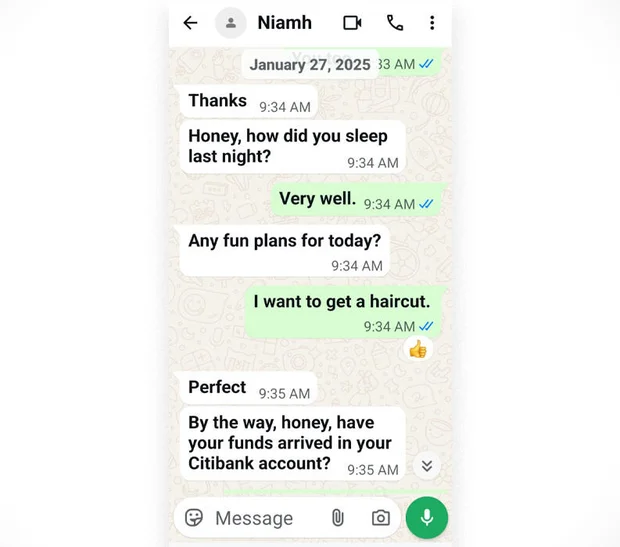
"Honey, how did you sleep last night?" Niamh sent her via WhatsApp early on in the scam. "Any plans for the day?... By the way, honey, have your funds arrived in your Citibank account?"
Niamh and another scammer, who was called a member of the "customer service team," coached Holder how to open two crypto wallets online. She then transferred a small sum to a crypto account tied to the scammer and thousands of dollars showed up in her crypto wallet.
Niamh assured Holder that the team she worked with would pay taxes on the funds they earned together. Holder thought she'd found a legitimate investment opportunity.
Next Niamh asked for help. "I hope you can understand the plight of being a single mom because the money I lent you includes child support for my daughter Alice and even some of the funds obtained through loans," Niamh wrote.
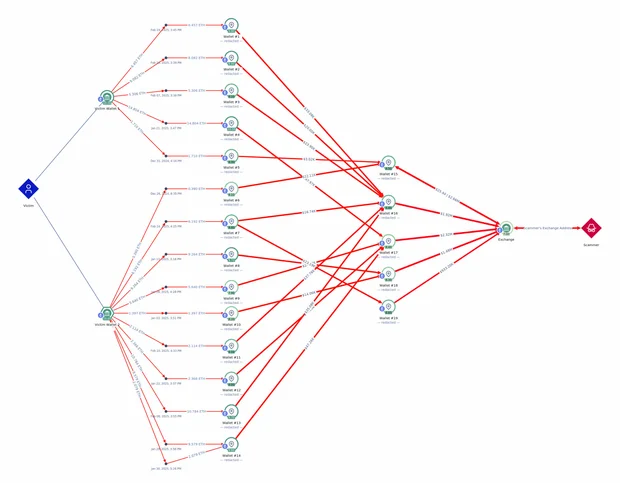
Holder transferred more from her crypto wallets, eventually sending almost $300,000 to 14 different wallets tied to the scammers.
Two months into communicating with Niamh, not seeing any money flowing back into her crypto wallets, Holder became worried.
"'Please assure me this is not a scam,' I actually said that to her. I'm getting worried," Holder told CBS News.
Niamh told her she'd sent money to the wrong crypto wallet.
"Oh my goodness, honey, how could you make such a little mistake? This is very bad. Contact [customer service] to consult on how to solve this problem," Niamh wrote to her.
That's when the WhatsApp messages became intimidating.
"You have made a fatal mistake," Niamh wrote in a message two months into their communication.
Holder said she no longer wanted to live when she realized what had happened — that all of her hard-earned savings were gone.
She had trouble getting out of bed for weeks. Social services were called in to check on her and eventually police took her to a local hospital. Social workers arranged for Medicaid to pay for her to move to an assisted living facility on Long Island, where she now shares a small room with another woman.
"I wanted to have something to leave to my children but there's nothing left," she said.
Her case was referred to the IRS Criminal Investigation New York Field Office, where special agents mapped out the scam.
Investigators found cyber criminals had transferred cryptocurrency from the 14 wallets to which Holder sent money into five new wallets to make it harder for anyone to trace.
"From these five wallets it makes its way to an exchange, which is the off-ramp," said Harry Chavis, the special agent in charge.
Chavis noted that the scammers likely used tools readily available on the dark web that enable targeting victims even more effectively.
"You could go here and they would sell potential lists of people who were prior victims.There's other data that has been scraped or pulled through hacks or leaks that can be sold for criminals to obtain. And then they're using these dark AI tools to write scripts to literally go specifically to the victim," Chavis told CBS News.
CBS News is not naming the dark web sites that provide AI tools for scammers.
Holder's money was consolidated with other victims' money and eventually the criminals off-ramped more than $5 million in cryptocurrency without being caught.
"While she may have contributed a couple hundred thousand dollars to this scam, they were able to ultimately see millions of dollars accumulating in this final wallet," Chavis said.
The IRS Criminal Division has recently set up an online tipline for cases like Holder's.
"Do not be ashamed. These are highly sophisticated scams and anyone can be a victim," Chavis said.
To avoid these types of scams, Chavis said, the most important thing to do in these moments is slow down and take a step back.
"Oftentimes, if you feel like you're getting a communication from an entity, verify with that entity that they're actually communicating with you before you just click or take the bait of what's coming in that communication," Chavis said. "…Oftentimes that urgency to just click something without double-checking, then you're one step too late. It's already been done."
Investigators say the sooner victims report, the better chance they have of identifying the perpetrators.
Chavis's team of special agents has been trying to identify other victims of the scam that hooked Holder. They have not been able to identify the perpetrators.
"They could be anywhere in the world," Chavis said.
Laura Geller contributed to this report.
In:
此内容由惯性聚合(RSS阅读器)自动聚合整理,仅供阅读参考。 原文来自 — 版权归原作者所有。