







Your customer just sent a message at 11:47 p.m. asking about their order status. Your inbox has 43 unread support requests. And you? You’re trying to get some sleep before an early morning. For founders of growing teams, delivering around-the-clock service often feels like a trade-off between growth and sanity.
That’s exactly why more small business owners are turning to artificial intelligence (AI) to handle the support load. But not all AI tools are built the same — and knowing which one actually fits your business can save you time, money, and a lot of confusion. In this article, we’re breaking down the differences between standard chatbots, AI chatbots, and AI service assistants for small and medium businesses, and what those differences mean for your customers and your team. Let’s get to the good stuff.
Not all bots are created equal — and the gap between a basic chatbot and a true AI service assistant for small business is bigger than most people realize.
A traditional chatbot follows a script. It responds to predefined questions using decision trees, which means it can handle simple, predictable queries like “What are your hours?” or “How do I reset my password?” But the moment a customer asks something outside that script, the conversation hits a wall.
An AI chatbot adds a layer of intelligence. It uses natural language processing to understand questions more flexibly, so it can handle a wider range of queries and sound more conversational. Still, it’s primarily reactive — it waits for a prompt and responds.
An AI service assistant is an intelligent, autonomous agent that doesn’t just respond — it reasons, acts, and follows through. It can:
Think of it this way: A chatbot is a vending machine. You press the right button, you get the prepackaged answer. An AI service assistant is more like a knowledgeable team member who knows your customers, reads context, and actually gets things done.
A traditional chatbot might feel like enough when you’re just getting started. But as a small and medium enterprise (SME) increases in customer base, the limitations show up fast.
Customers today expect fast, accurate, and personalized responses — no matter when they reach out or which channel they use. According to the latest Small and Medium Business Trends Report, 75% of SMBs are already investing in AI, and 85% of those businesses say they expect a return on that investment. Businesses choosing to stay with rule-based tools are leaving real opportunity on the table.
For a small business, every frustrated customer interaction carries more weight. You don’t have a massive support team to absorb bad reviews or missed conversations the way a large enterprise might. A customer who hits a dead end with a limited chatbot is a customer who might not come back — and one who might tell others.
An AI service assistant, or AI agent, closes that gap by handling complex, multi-turn conversations with context. It remembers what was said earlier in the conversation, pulls in relevant customer data from your customer relationship management (CRM) platform, and responds in a way that actually helps.
Here’s a real-world example of what an AI service assistant for small businesses can look like in action.
1-800Accountant, America’s largest virtual accounting firm serving small businesses and entrepreneurs, was facing a projected 40% growth in clients in 2025 — on top of the already intense pressure of tax season surges. To meet that demand, they estimated they’d need to hire and train more than 200 seasonal support staff — a solution that was neither sustainable nor realistic.
Instead, they deployed Agentforce as their AI service solution. The result: Agentforce resolved over 1,000 client engagements in the first 24 hours and went on to autonomously resolve 70% of chat engagements during tax week.
Their AI assistant reasoned across client data — including audit logs, support history, and live IRS information — to give fast, accurate, and personalized answers. When it encountered something beyond its scope, it escalated seamlessly to a human representative.
For a business that serves small business owners dealing with the stress of taxes and finances, that kind of reliable, always-on support isn’t a luxury — it’s a competitive advantage.
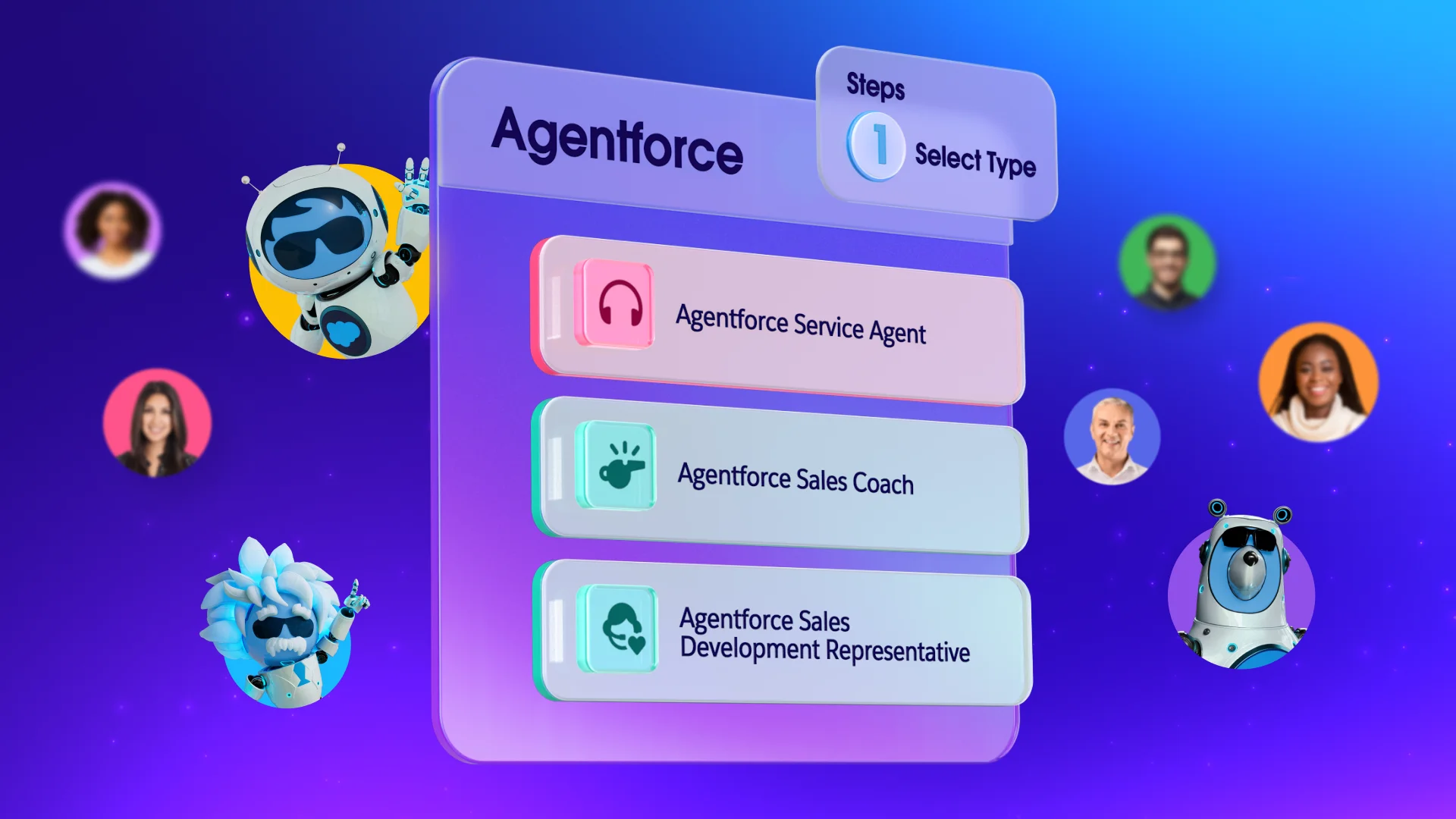
This is where the conversation shifts from “support tool” to “business platform.”
AI service assistants for SMEs aren’t limited to answering customer questions. When they’re built into a platform like Agentforce Service, they work across every team function — helping your sales team prep for calls, your marketing team draft personalized campaigns, your service team resolve cases faster, and your commerce experience respond to shoppers in real time.
You can start with embedded AI, and an employee agent for your service team. Agentforce is now built directly into Salesforce Suites — Free, Starter, and Pro — so you don’t need a dedicated IT team or a lengthy implementation project to get started.
Here’s how each tier works for SMBs:
The AI features require no extra setup, no additional cost within each tier, and no technical configuration — they’re ready to use right away.
One thing SMB owners often worry about with AI is data security. With Agentforce 360, your customer data is protected within the Salesforce environment and isn’t shared with third-party AI models. The platform includes built-in security, trust layers, and data governance — so you get the benefits of AI service assistants for small businesses without the privacy trade-offs.
No credit card required, no software to install.

Not every AI service tool is the right fit, and it’s worth asking a few questions before committing to one.
The best AI service assistants for small businesses work out of the box, connect to your existing CRM and data, and don’t require a team of engineers to maintain. They should also grow with you — whether you’re a solo founder today or a 50-person company in two years. Look for a solution that integrates across your sales, service, marketing, commerce, and productivity workflows so you’re not stitching together five different tools to get one coherent customer experience.
If you want a deeper look at what to evaluate, Salesforce’s guide on AI assistants for small business walks through the key considerations in plain language.
See what’s possible with service software built into your CRM, powered by AI and automation.


The conversation has moved past “should we use AI?” to “which AI is actually right for us?”
For SMBs, that answer increasingly points toward AI service assistants that are embedded directly into the tools you already use — not bolted on as an afterthought. With Agentforce 360, small businesses get an AI infrastructure that spans the full Salesforce portfolio: sales, marketing, service, commerce, and productivity — all working together on a single platform, with your customer data at the center.
The gap between businesses with AI service assistants for SMEs and those without is only going to widen. The good news? Getting started doesn’t require a big budget or a technical team. It just requires the right tools.
Start your AI journey with Salesforce Suites today or activate Foundations today to try Agentforce.
AI supported the writers and editors who created this article.
What’s an AI service assistant for small businesses?
An AI service assistant for small businesses is a tool powered by artificial intelligence that can understand customer questions, reason across your data, take action, and respond — all without human input. Unlike basic chatbots, these assistants handle multi-step conversations, connect to your CRM, and work across channels. Learn more aboutwhat makes AI assistants different and how they compare to traditional support tools.
How is an AI service assistant different from a chatbot?
A chatbot follows a predefined script and can only respond to questions it was programmed to handle. An AI service assistant uses natural language processing and real-time data to understand context, take action, and escalate intelligently when needed. The difference in customer experience — especially for SMBs with limited staff — is significant.
Do I need technical skills to set up an AI service assistant?
Not with Salesforce Suites. Agentforce features are built directly into Free, Starter, and Pro Suites, so there’s no extra setup, no coding required, and no additional cost within each tier. It’s designed to work right away, even if you don’t have an IT department.
Is my customer data safe when using an AI service assistant?
With Agentforce 360, your data stays inside the Salesforce environment and isn’t shared with third-party AI models. The platform includes built-in security, data governance, and trust layers — so your customer information stays private and protected.
How can AI service assistants help an SMB grow?
AI service assistants help SMBs scale without proportionally scaling headcount. They handle repetitive and complex support tasks around the clock, free up your team for higher-value work, and deliver consistent, personalized experiences to customers — whether you have five employees or fifty. Explore Salesforce’s Trailhead learning path to see how teams are putting AI to work across their businesses today.
此内容由惯性聚合(RSS阅读器)自动聚合整理,仅供阅读参考。 原文来自 — 版权归原作者所有。